Upgrade of A Robot Workstation for Positioning of Measuring Objects on CMM
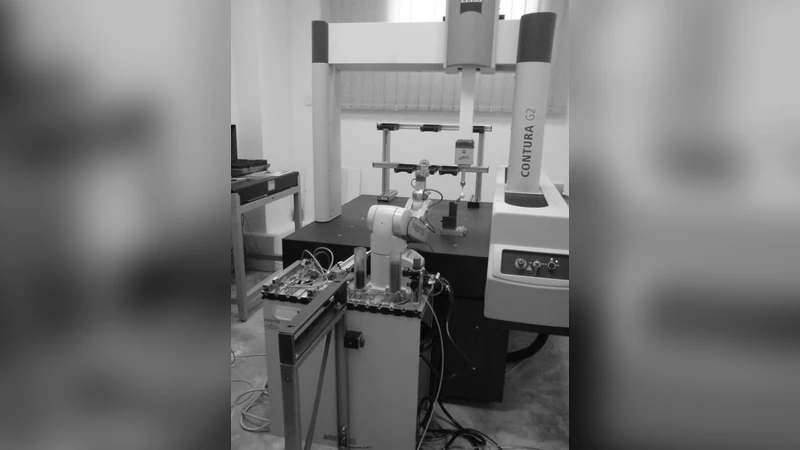
In order to decrease the measuring cycle time on the coordinate measuring machine (CMM) a robot workstation for the positioning of measuring objects was created. The application of a simple 5-axis industrial robot enables the positioning of the objects within the working space of CMM and measuring of different surfaces on the same object without human intervention. In this article an upgrade of an existing robot workstation through different design measures is shown. The main goal of this upgrade is to improve the measuring accuracy of the complex robot-CMM system.
💡 Research Summary
The paper presents an engineering upgrade of a combined coordinate measuring machine (CMM) and 5‑axis industrial robot workcell, aiming to reduce measurement cycle time while improving accuracy. The authors note that traditional CMM operation requires manual repositioning of the workpiece for each new surface to be inspected, which is time‑consuming and introduces human error. By integrating a Mitsubishi RV‑2AJ educational robot, the system can automatically grasp, transport, and re‑orient the part within the CMM’s measurement volume, allowing multiple surfaces to be measured without human intervention.
In the initial configuration, the robot base was bolted directly to the CMM frame. During CMM movements, structural vibrations propagated to the robot, degrading measurement repeatability. To address this, the authors designed a new anchoring system that decouples the robot from the CMM and secures the robot directly to the laboratory floor. This simple mechanical change isolates the robot from dynamic disturbances generated by the CMM’s moving bridge and carriage.
The experimental setup consisted of a Contura G2 CMM equipped with standard probing accessories and the aforementioned robot, all housed in a temperature‑controlled, low‑traffic laboratory. The test specimen was a composite cylindrical part featuring three diameters (d1 = 39 mm, d2 = 42.5 mm, d3 = 42.9 mm) and a height (H = 18.7 mm). Four characteristic planes—two frontal, two conical—were defined to represent typical measurement scenarios. For each geometric feature, ten repeated measurements were taken after a full calibration of both the CMM probe and the robot gripper. The robot’s positions were pre‑programmed during an offline teaching phase, ensuring consistent placement for each measurement cycle.
Statistical analysis compared the original workcell (robot attached to CMM) with the upgraded, floor‑anchored configuration. In the original setup, standard deviations ranged from 0.00019 mm (d3) to 0.006 mm (d1), and coefficients of variation (CV) were as high as 0.0154 for d1. After the upgrade, the standard deviations dropped dramatically to a range of 0.00011 mm–0.00049 mm, and CV values fell to 0.00126–0.00045, representing up to a ten‑fold reduction in measurement dispersion. The average measured values remained close to the nominal dimensions, confirming that the improvement primarily affected repeatability rather than systematic bias.
The authors conclude that the mechanical decoupling of the robot from the CMM is an effective, low‑cost strategy to mitigate vibration‑induced errors in hybrid measurement systems. The enhanced repeatability enables reliable automated inspection of complex parts, potentially reducing overall inspection time and labor costs. They acknowledge that residual error sources—such as robot positioning accuracy, thermal expansion of the probe, and coordinate‑system transformation uncertainties—were not fully quantified and suggest future work to model and compensate these effects.
Overall, the study demonstrates that a straightforward redesign of the workcell’s mechanical architecture can substantially improve the performance of CMM‑robot integration, offering a practical pathway for manufacturers seeking higher automation levels without sacrificing metrological quality.
Comments & Academic Discussion
Loading comments...
Leave a Comment