The University of Washington Mobile Planetarium Do-it-Yourself Guide
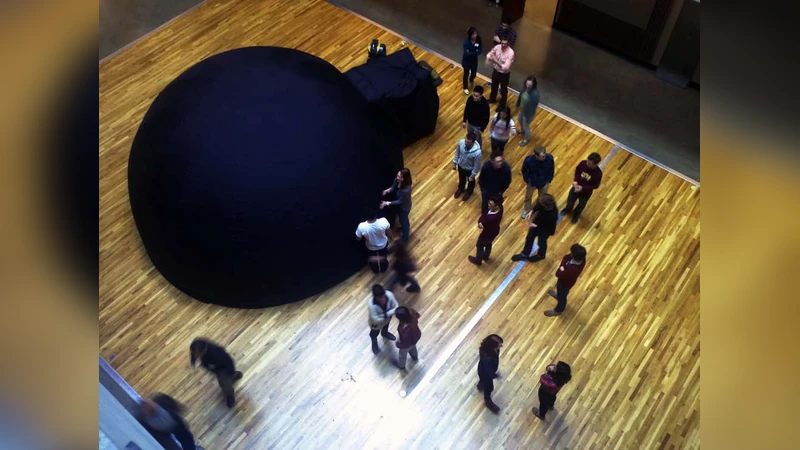
The UW Mobile Planetarium Project is a student driven effort to bring astronomy to high schools and the Seattle community. We designed and built an optics solution to project WorldWide Telescope in an inflatable planetarium from a laptop and off-the-shelf HD projector. In our first six months of operation, undergraduates at the UW gave planetarium shows to over 1500 people and 150 high school students created and presented their own astronomy projects in our dome, at their school. This document aims to share the technical aspects behind the project in order for others to replicate or adapt our model to their needs. This UW Mobile Planetarium was made possible thanks to a Hubble Space Telescope Education/Public Outreach Grant.
💡 Research Summary
The paper presents a comprehensive, step‑by‑step guide for building a low‑cost, mobile planetarium that can be deployed in high schools and community settings. Initiated by University of Washington undergraduates, the project was motivated by the observation that the university’s fixed‑site planetarium was not reaching local public high schools despite being within a ten‑mile radius. To overcome this gap, the team designed a portable system that could be transported by a few students in a standard car, set up quickly in a classroom, and used to deliver immersive astronomy shows powered by the free WorldWide Telescope (WWT) software.
Funding came from a Hubble Space Telescope Education/Public Outreach grant of $40,000, with a stipulation that no more than half be spent on the mobile unit. The total parts cost was about $14,000, of which roughly $12,000 was devoted to the inflatable dome and the first‑surface hemisphere mirror – the two most expensive components. The remaining budget covered a high‑lumens 1080p HD projector, a laptop, a fan, power distribution gear, protective cases, and a modest set of non‑essential accessories (audio, lighting, tickets, etc.). Personnel costs were limited to a graduate student (≈300 h) and an undergraduate assistant (≈240 h) during the build phase, followed by a volunteer crew of about ten undergraduates for ongoing transport and operation, overseen by a faculty advisor.
Key design decisions focused on cost, portability, and performance. Rather than purchasing an expensive fisheye lens, the team used two first‑surface mirrors – a convex hemisphere mirror to reflect the image onto the dome and a flat mirror to position the projector beneath the hemisphere, saving space and weight. The optics housing was fabricated in‑house, allowing precise alignment while protecting the delicate mirror surfaces. The inflatable dome (a 10‑ft Go‑Dome) was chosen for its ease of transport, light‑tightness, and fire‑rated material; the dome’s low height meant that most participants sit on the floor, but this trade‑off was acceptable for classroom deployment. ADA‑compliant entrance solutions were not found within budget, a limitation noted for future upgrades.
The projector selected was a commercially available 1920×1080, ≥1000 lumens unit under $1,000, providing sufficient brightness for a 10‑15 ft throw distance inside the dome. The laptop required a capable GPU, HDMI output, and enough storage for WWT’s cached imagery; a backlit keyboard or a small USB reading light was recommended for dark‑room operation. Power distribution was handled with a single 25‑ft extension cord and an eight‑outlet power strip to comply with fire codes that prohibit daisy‑chaining strips.
Operationally, the team adopted a “flipping” pedagogy: instead of delivering teacher‑centered lectures, students create and present their own tours using WWT, thereby increasing engagement and ownership. A one‑credit seminar introduced undergraduates to WWT, optics alignment, and show delivery; graduates then mentored a rotating volunteer crew. Over the first six months, the mobile planetarium reached more than 1,500 audience members and enabled 150 high‑school students to produce and showcase their own astronomy projects.
The paper also details auxiliary considerations: fan noise and speed control (used as a cue for show start/end), lighting (rope lights and a battery‑powered lantern for setup), audio (wireless microphones and a small PA system costing about $1,000), and ticketing systems for managing multiple short shows at science nights. Packaging solutions include a rolling goalie bag for the dome, a Pelican case for the projector, and simple backpacks for the laptop and accessories.
In summary, the UW Mobile Planetarium guide provides a replicable model that balances budget constraints, technical performance, and educational impact. By leveraging off‑the‑shelf hardware, free software, and student labor, the project demonstrates that high‑quality immersive astronomy experiences can be delivered outside traditional facilities, fostering active learning and community outreach. Institutions with modest resources can adopt this blueprint to expand STEM outreach and give students hands‑on experience in both astronomy content and technical project management.
Comments & Academic Discussion
Loading comments...
Leave a Comment