An Ontology Oriented Architecture for Context Aware Services Adaptation
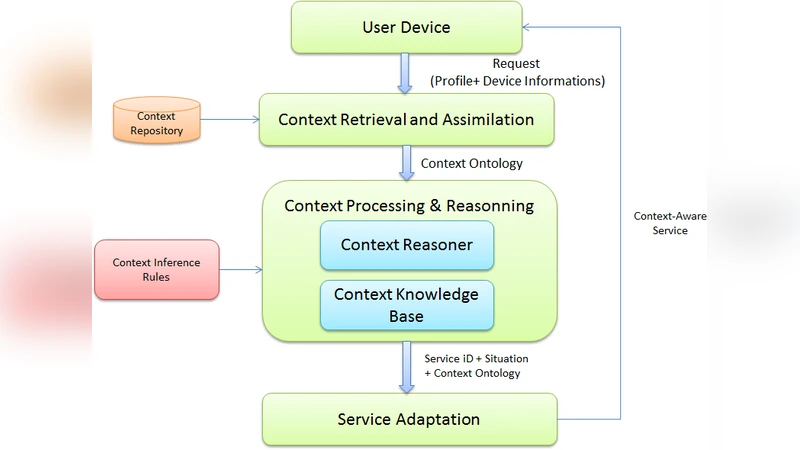
In the field of ubiquitous computing, a class of applications called context-aware services attracted great interest especially since the emergence of wireless technologies and mobile devices. Context-aware application can dynamically capture a range of information from its environment and this information represents a context, the application adapts its execution according to this context. An important challenge in ubiquitous computing is dealing with context. Ontologies presents the most promising instrument for context modeling and managing due to their high and formal expressiveness and the possibilities for applying ontology reasoning techniques. In this paper, we present an ontology based approach for the development of context aware services.
💡 Research Summary
The paper addresses the growing need for context‑aware services (CAS) in ubiquitous computing by proposing an ontology‑oriented architecture that integrates context modeling, reasoning, and service adaptation within a unified framework. After reviewing the ambiguous nature of “context” in the literature, the authors adopt Dey’s broad definition—any information that can be used to characterize the situation of an entity—as the basis for their work. They identify six fundamental challenges for CAS: context capture, representation, interpretation/reasoning, service adaptation, management, and reuse.
A comprehensive survey of existing context‑modeling techniques follows, covering key‑value pairs, markup‑based schemes, graphical (UML) models, object‑oriented approaches, logic‑based models, and ontology‑based models. The analysis highlights that while simpler models are easy to implement, they lack the expressive power and formal semantics required for sophisticated reasoning and interoperability. Ontology‑based models, by contrast, provide declarative semantics, support knowledge sharing, enable efficient reasoning, and facilitate service interoperability.
The authors then critique several prior ontology‑centric systems such as SOCAM and CONON. Although these platforms introduce context ontologies and reasoning engines, they fall short in areas like sensor selection flexibility, explicit service adaptation mechanisms, and dynamic context validity management.
To overcome these gaps, the paper proposes a four‑layer architecture: (1) Sensor/Device Layer for raw data acquisition, (2) Context Capture & Interpretation Layer that transforms sensor data into OWL‑DL instances using a two‑level ontology (a generic upper ontology plus domain‑specific extensions), (3) Reasoning Layer employing OWL DL reasoners together with SWRL rules to derive high‑level situations from low‑level facts, and (4) Service Adaptation Layer that extends the Web Service Modeling Ontology (WSMO) with an “Adaptation” meta‑object. This extension allows situation triggers to be directly mapped to service parameter reconfiguration or to the selection of alternative services.
A key contribution is the integration of model‑driven engineering (MDE). Designers can use UML‑based profiles such as ContextUML or CMP to create high‑level models; automatic transformation tools then generate the corresponding ontology definitions and WSMO adaptation specifications. Consequently, the entire CAS lifecycle—capture, representation, reasoning, adaptation, and reuse—is managed through a consistent set of metadata and rule artifacts, reducing the need for ad‑hoc coding.
The paper also introduces mechanisms for context reuse and validity management: inferred situations have a bounded lifetime, after which they are discarded, ensuring that only fresh, relevant context influences service behavior.
In the discussion, the authors enumerate the advantages of their approach: (i) advanced reasoning enables precise situation awareness, (ii) WSMO‑based adaptation automates service reconfiguration, (iii) the model‑driven pipeline improves developer productivity, and (iv) built‑in context lifecycle management enhances system robustness. They acknowledge limitations, notably the effort required to construct comprehensive ontologies, the performance overhead of real‑time reasoning at scale, and the challenge of extending the ontology to diverse domains. Future work includes developing lightweight reasoning engines, supporting dynamic ontology updates, and implementing a full prototype in an e‑Health scenario to validate the architecture in practice.
Comments & Academic Discussion
Loading comments...
Leave a Comment