Power-law distributions in binned empirical data
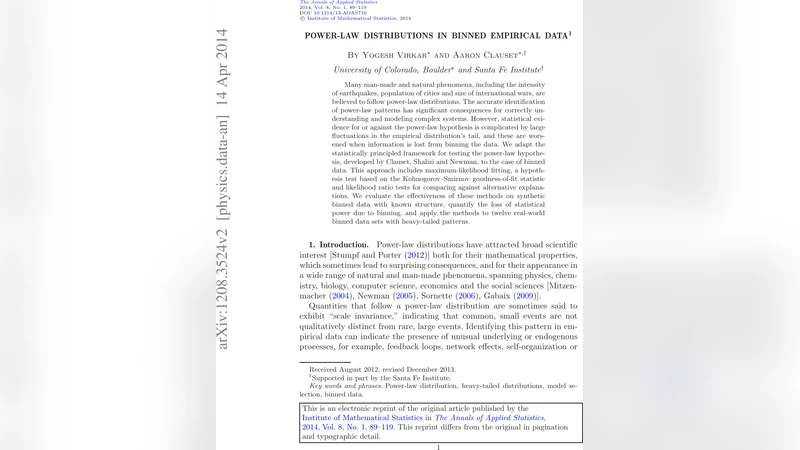
Many man-made and natural phenomena, including the intensity of earthquakes, population of cities and size of international wars, are believed to follow power-law distributions. The accurate identification of power-law patterns has significant consequences for correctly understanding and modeling complex systems. However, statistical evidence for or against the power-law hypothesis is complicated by large fluctuations in the empirical distribution’s tail, and these are worsened when information is lost from binning the data. We adapt the statistically principled framework for testing the power-law hypothesis, developed by Clauset, Shalizi and Newman, to the case of binned data. This approach includes maximum-likelihood fitting, a hypothesis test based on the Kolmogorov–Smirnov goodness-of-fit statistic and likelihood ratio tests for comparing against alternative explanations. We evaluate the effectiveness of these methods on synthetic binned data with known structure, quantify the loss of statistical power due to binning, and apply the methods to twelve real-world binned data sets with heavy-tailed patterns.
💡 Research Summary
The paper addresses a practical problem that arises in many empirical studies of heavy‑tailed phenomena: the data are often presented in binned (or “binned”) form, which obscures the fine‑grained structure of the tail and makes standard power‑law tests unreliable. Building on the widely used framework of Clauset, Shalizi, and Newman (2009), the authors develop a complete statistical pipeline that works directly with binned observations. First, they derive the likelihood of a discrete power‑law model when observations are aggregated into intervals (
Comments & Academic Discussion
Loading comments...
Leave a Comment