Self-organization towards optimally interdependent networks by means of coevolution
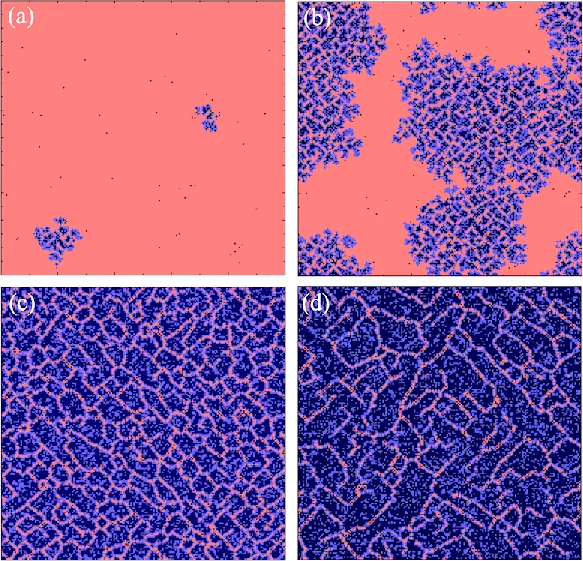
Coevolution between strategy and network structure is established as a means to arrive at optimal conditions for resolving social dilemmas. Yet recent research highlights that the interdependence between networks may be just as important as the structure of an individual network. We therefore introduce coevolution of strategy and network interdependence to study whether it can give rise to elevated levels of cooperation in the prisoner’s dilemma game. We show that the interdependence between networks self-organizes so as to yield optimal conditions for the evolution of cooperation. Even under extremely adverse conditions cooperators can prevail where on isolated networks they would perish. This is due to the spontaneous emergence of a two-class society, with only the upper class being allowed to control and take advantage of the interdependence. Spatial patterns reveal that cooperators, once arriving to the upper class, are much more competent than defectors in sustaining compact clusters of followers. Indeed, the asymmetric exploitation of interdependence confers to them a strong evolutionary advantage that may resolve even the toughest of social dilemmas.
💡 Research Summary
The paper investigates how the coevolution of strategies and inter‑network connections can spontaneously generate optimal interdependence and promote cooperation in the prisoner’s dilemma (PD). Two initially independent square lattices (networks A and B) are populated with agents that play the PD with their four nearest neighbours. Each agent is assigned a teaching activity w, initially set to a minimal value w_min = 0.01. When an agent successfully copies its strategy to a neighbour, w is increased by a fixed increment Δ; a failed attempt decreases w by the same amount. The teaching activity is bounded between w_min and 1.
A crucial rule links teaching activity to inter‑network coupling: if an agent’s w exceeds a threshold w_th, it is allowed to form an external link to the counterpart at the same lattice site in the other network. This external link adds a fraction α (0 ≤ α ≤ 1) of the counterpart’s payoff to the agent’s utility, i.e. U = π + απ′. If w falls below w_th the link is removed, eliminating the extra payoff. Strategy adoption follows a Fermi rule: the probability that agent x copies its strategy to neighbour y is W = w_x /
Comments & Academic Discussion
Loading comments...
Leave a Comment