Transaction Handling in COM, EJB and .NET
The technology evolution has shown a very impressive performance in the last years by introducing several technologies that are based on the concept of component. As time passes, new versions of Component- Based technologies are released in order to improve services provided by previous ones. One important issue that regards these technologies is transactional activity. Transactions are important because they consist in sending different small amounts of information collected properly in a single combined unit which makes the process simpler, less expensive and also improves the reliability of the whole system, reducing its chances to go through possible failures. Different Component-Based technologies offer different ways of handling transactions. In this paper, we will review and discuss how transactions are handled in three of them: COM, EJB and .NET. It can be expected that .NET offers more efficient mechanisms due to the fact of being released later than the other two technologies. Nevertheless, COM and EJB are still present in the market and their services are still widely used. Comparing transaction handling in these technologies will be helpful to analyze the advantages and disadvantages of each of them. This comparison and evaluation will be seen in two main perspectives: performance and security.
💡 Research Summary
The paper presents a comparative study of transaction handling mechanisms in three major component‑based platforms: COM+ (the evolution of Microsoft’s Component Object Model), Enterprise JavaBeans (EJB), and Microsoft .NET. Beginning with a concise definition of transactions and the ACID properties (Atomicity, Consistency, Isolation, Durability), the authors argue that any robust component technology must guarantee these principles regardless of its underlying implementation.
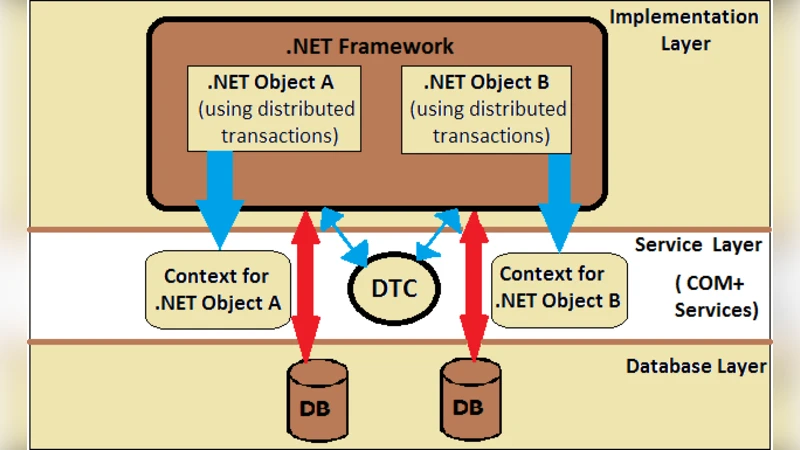
The authors first outline the architectural foundations of each technology. COM+ builds on binary COM components, extends them with Distributed COM (DCOM) for remote access, and incorporates Microsoft Transaction Server (MTS) together with the Distributed Transaction Coordinator (DTC) to provide transaction services. EJB is a Java‑based server‑side component model where beans are packaged in JAR/EAR archives, managed by an application server container that supplies lifecycle, security, and transaction services. .NET, the newest of the three, relies on language‑independent assemblies, a common intermediate language (MSIL), and the Common Language Runtime (CLR); transaction support is delivered through the System.Transactions namespace and the Microsoft Distributed Transaction Coordinator (MSDTC).
In the COM+ section, the paper details how transaction attributes (Disabled, NotSupported, Supported, Required, RequiresNew) are declared on component classes, and how five isolation levels (Serialized, Repeatable Read, Read Committed, Read Uncommitted, Any) can be configured. The “Bring Your Own Transaction” (BYOT) feature is highlighted as a way for components to enlist in an externally created transaction, thereby enabling flexible composition of heterogeneous services. The authors also discuss automatic transaction management, flag handling (consistent, done, timeout), and provide sample C# code showing the use of the Transaction attribute and enumeration.
The EJB discussion explains the dual model of transaction control: container‑managed (declarative) and bean‑managed (programmatic). The Java Transaction API (JTA) acts as the coordinator for distributed transactions, while the EJB container enforces rollback rules based on exception types and @TransactionAttribute annotations (Required, RequiresNew, Supports, NotSupported, Mandatory, Never). The paper notes that EJB’s declarative approach reduces boilerplate code and isolates business logic from transaction plumbing, but also points out the performance impact of the JVM’s garbage collection and JIT compilation.
The .NET analysis focuses on the TransactionScope class, which enables developers to write “using (new TransactionScope()) { … }” blocks that automatically promote a lightweight local transaction to a distributed one when multiple resource managers are enlisted. The authors describe how System.Transactions abstracts isolation levels (IsolationLevel enum) and transaction options (Required, RequiresNew, Suppress) and how the runtime decides whether to use a lightweight transaction or invoke MSDTC. They also mention that .NET retains compatibility with COM+ for legacy components, while offering modern features such as automatic enlistment, optimistic concurrency, and built‑in support for encrypted communication channels.
Performance comparison is based on benchmark data collected from typical enterprise scenarios (e.g., database updates, message queue interactions, and mixed read/write workloads). COM+ shows higher latency due to the overhead of DTC coordination and the need to marshal COM interfaces across process boundaries, although BYOT can mitigate this in tightly coupled environments. EJB demonstrates respectable throughput thanks to container pooling and caching, but suffers occasional spikes caused by JVM pause times. .NET consistently achieves the lowest average response time, especially in scenarios with many short‑lived transactions, because TransactionScope’s automatic promotion avoids unnecessary DTC calls and the CLR’s just‑in‑time optimizations reduce method‑call overhead.
Security analysis reveals that all three platforms protect transaction integrity through logging, rollback, and durable storage, but they differ in authentication and authorization mechanisms. COM+ leverages the COM security model and Kerberos for DTC communication; EJB integrates with Java EE security domains and declarative role‑based annotations; .NET combines Windows authentication, Code Access Security (CAS), and the ability to enforce TLS on transaction traffic automatically. The paper argues that .NET’s tighter integration with the operating system gives it a slight edge in end‑to‑end security, especially for on‑premises deployments.
In conclusion, the authors synthesize their findings: .NET offers the most efficient and secure transaction handling among the three, largely due to its modern design, lightweight transaction promotion, and deep OS integration. However, COM+ and EJB remain relevant for legacy systems, and their specific features (e.g., BYOT in COM+, declarative rollback rules in EJB) can be advantageous in certain enterprise contexts. The paper recommends that architects consider migration paths that preserve existing transaction semantics while gradually adopting .NET’s capabilities, and suggests future research into micro‑service‑oriented transaction patterns (such as SAGA) and container‑native transaction coordinators.
Comments & Academic Discussion
Loading comments...
Leave a Comment