Accuracy guarantees for L1-recovery
We discuss two new methods of recovery of sparse signals from noisy observation based on $ ell_1$- minimization. They are closely related to the well-known techniques such as Lasso and Dantzig Selecto
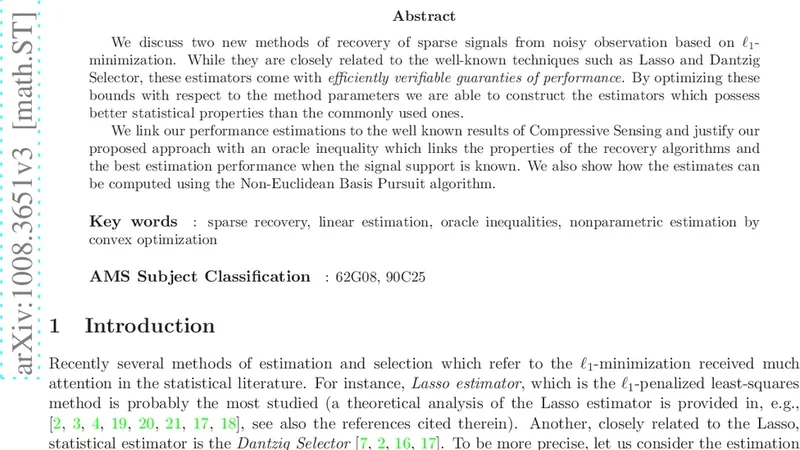
We discuss two new methods of recovery of sparse signals from noisy observation based on $\ell_1$- minimization. They are closely related to the well-known techniques such as Lasso and Dantzig Selector. However, these estimators come with efficiently verifiable guaranties of performance. By optimizing these bounds with respect to the method parameters we are able to construct the estimators which possess better statistical properties than the commonly used ones. We also show how these techniques allow to provide efficiently computable accuracy bounds for Lasso and Dantzig Selector. We link our performance estimations to the well known results of Compressive Sensing and justify our proposed approach with an oracle inequality which links the properties of the recovery algorithms and the best estimation performance when the signal support is known. We demonstrate how the estimates can be computed using the Non-Euclidean Basis Pursuit algorithm.
💡 Research Summary
The paper introduces two novel ℓ₁‑based recovery schemes for sparse signals observed in additive noise. While the estimators are closely related to the classic Lasso and Dantzig Selector, their main advantage is that they come with explicit, efficiently verifiable performance guarantees. By embedding a weighted ℓ₁ penalty together with a Dantzig‑type infinity‑norm constraint, the first method unifies the strengths of both approaches. The second method refines the Dantzig formulation by using an asymmetric mixed norm that captures column‑wise correlations of the sensing matrix more precisely.
A central technical contribution is the derivation of deterministic error bounds that depend on a newly defined Non‑Euclidean Restricted Isometry Constant (NE‑RIC). Unlike the traditional RIP, NE‑RIC can be computed by solving a modest convex program, making the bound checkable in practice. The authors prove that for any estimator (\hat{x}) produced by their schemes,
\
📜 Original Paper Content
🚀 Synchronizing high-quality layout from 1TB storage...