Quantum annealing
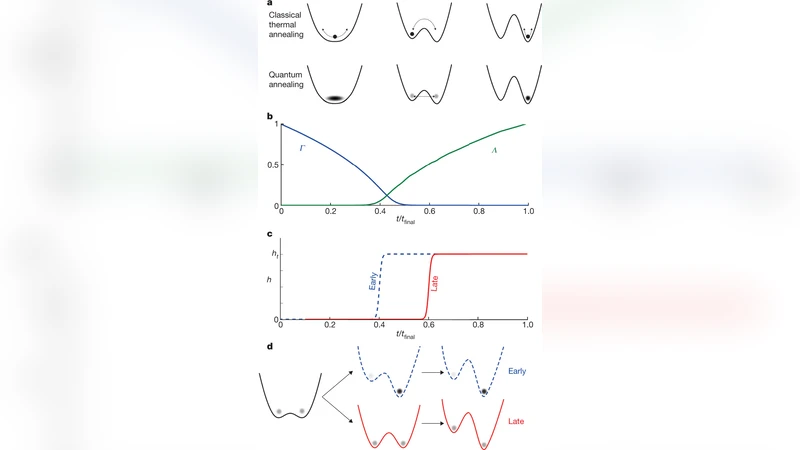
Brief description on the state of the art of some local optimization methods: Quantum annealing Quantum annealing (also known as alloy, crystallization or tempering) is analogous to simulated annealing but in substitution of thermal activation by quantum tunneling. The class of algorithmic methods for quantum annealing (dubbed: ‘QA’), sometimes referred by the italian school as Quantum Stochastic Optimization (‘QSO’), is a promising metaheuristic tool for solving local search problems in multivariable optimization contexts.
💡 Research Summary
The paper provides a broad, interdisciplinary overview of Quantum Annealing (QA) as a meta‑heuristic optimization technique, contrasting it with classical Simulated Annealing (SA) and situating it within a physical metaphor of crystallization and phase transitions. It begins by describing how traditional annealing methods (annealing, alloy, tempering) emulate the slow cooling of a metal or crystal, allowing the system to settle into a low‑energy metastable state. In SA, thermal fluctuations driven by a temperature schedule enable the algorithm to escape local minima; the schedule must be slow enough to approximate an adiabatic process, yet fast enough to be computationally feasible.
QA replaces the thermal driver with quantum fluctuations, specifically quantum tunneling. The authors explain that tunneling, rooted in the Heisenberg uncertainty principle and wave‑particle duality, allows a system to pass through energy barriers rather than climb over them. This is modeled by a “tunneling width” (or quantum field strength) parameter that determines the radius of the neighborhood explored at each iteration. At the start of the algorithm the tunneling width is large, effectively making the entire search space reachable; as the simulation proceeds, the width is gradually reduced, focusing the search and eventually leading to a “quantum collapse” where the wavefunction concentrates on a single configuration, interpreted as the solution.
The algorithmic core is presented as an adaptation of the Metropolis‑Hastings acceptance rule. A candidate neighbor state is generated within the current tunneling radius; if its cost (energy) is lower, it is accepted unconditionally, otherwise it is accepted with a probability that depends on the quantum fluctuation magnitude. This mirrors SA’s temperature‑dependent acceptance but substitutes temperature with the quantum tunneling parameter. The paper stresses that the schedule governing the reduction of the tunneling width must satisfy adiabatic conditions: too rapid a reduction prevents sufficient tunneling, causing the algorithm to become trapped in local minima; too slow a reduction incurs prohibitive computational cost.
A substantial portion of the manuscript is devoted to the practical challenges of implementing QA on classical hardware. The authors point out the “curse of dimensionality”: for a problem with N binary variables, the associated Hamiltonian matrix has size 2^N × 2^N, quickly exceeding feasible memory and processing limits (e.g., 5 nodes → ~10^3 entries, 16 nodes → >4 × 10^9 entries). To cope, Monte‑Carlo sampling of the configuration space is suggested, trading exactness for tractability. However, this introduces statistical noise and reduces precision, a compromise the authors acknowledge.
Further, the paper discusses physical subtleties such as residual entropy and zero‑point energy, noting that even at absolute zero a quantum system retains non‑zero energy, which influences the convergence behavior of QA. The authors argue that a sufficiently long annealing time is essential to allow the system to evolve adiabatically toward the ground state, but they also recognize that real‑world constraints (CPU time, memory bandwidth) limit how long one can afford to run the algorithm.
The manuscript also surveys historical and conceptual background: it recounts the development of wave‑matter duality, the double‑slit experiment, Heisenberg’s uncertainty principle, and the discovery of quantum tunneling by Friedrich Hund. These concepts are woven into the narrative to justify why quantum fluctuations can be harnessed algorithmically. The authors reference the Italian school’s term “Quantum Stochastic Optimization (QSO)” and note that QA can be viewed as a stochastic process governed by both the Schrödinger equation (describing the evolution of the quantum state) and the Fokker‑Planck equation (describing diffusion of probability density). They suggest that the combination of these equations provides a theoretical foundation for the probabilistic nature of QA.
In the concluding sections, the authors acknowledge that most current implementations are simulation‑based rather than executed on genuine quantum hardware (e.g., D‑Wave machines). They propose several avenues for future research: (1) systematic design of optimal tunneling schedules, possibly via adaptive or learning‑based methods; (2) rigorous quantification of adiabaticity criteria for specific problem classes; (3) integration with actual quantum annealers to assess real‑world performance gains; and (4) development of more efficient Monte‑Carlo techniques to reduce sampling error while keeping computational load manageable.
Overall, the paper positions Quantum Annealing as a promising, physically motivated extension of classical annealing methods, capable of exploiting quantum tunneling to traverse rugged energy landscapes. While the theoretical appeal is clear, the authors admit that practical deployment faces significant hurdles related to exponential state‑space growth, schedule tuning, and hardware limitations. The work serves as a conceptual bridge between quantum physics and combinatorial optimization, inviting further interdisciplinary investigation to translate the theoretical advantages of QA into scalable, real‑world algorithms.
Comments & Academic Discussion
Loading comments...
Leave a Comment