Equivariant correspondences and the Borel-Bott-Weil theorem
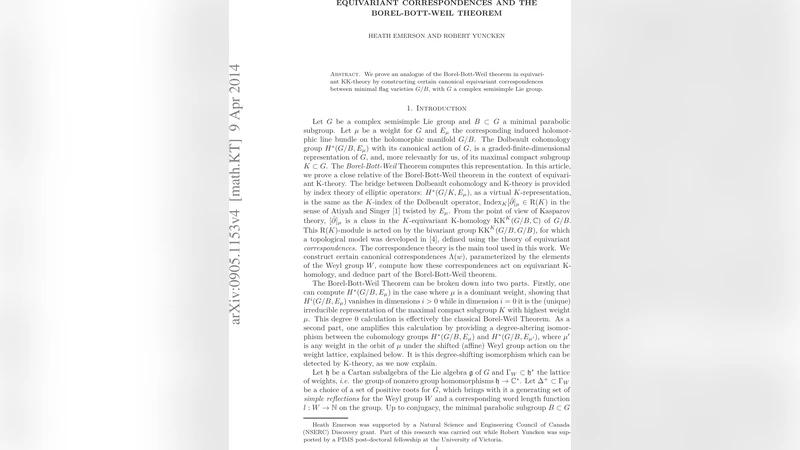
We prove an analogue of the Borel-Bott-Weil theorem in equivariant KK-theory by constructing certain canonical equivariant correspondences between minimal flag varieties G/B, with G a complex semisimple Lie group.
💡 Research Summary
The paper establishes an equivariant analogue of the classical Borel‑Bott‑Weil theorem within the framework of Kasparov’s equivariant KK‑theory. Working with a complex semisimple Lie group (G) and its minimal parabolic subgroup (B), the authors focus on the minimal flag variety (G/B) as the primary geometric object. The central goal is to construct canonical equivariant correspondences—triples ((X \leftarrow Z \rightarrow Y)) equipped with (G)-equivariant K‑orientations—that give rise to KK‑classes representing the line bundles appearing in the Borel‑Bott‑Weil picture.
The exposition proceeds in several stages. First, the necessary background on (G), (B), the cell decomposition of (G/B), and the basics of equivariant K‑theory and KK‑theory is reviewed. The authors emphasize the role of the Kasparov product and its compatibility with equivariant push‑forward and pull‑back maps, setting the stage for the later construction.
Next, the notion of an “equivariant correspondence’’ is introduced. A correspondence consists of a (G)-space (Z) together with equivariant maps (p\colon Z\to X) and (q\colon Z\to Y) that are K‑oriented. Such a datum defines a class in (KK_G(C_0(X),C_0(Y))). The paper proves that these correspondences compose via the Kasparov product, thereby providing a flexible categorical language for building KK‑elements.
With this machinery in hand, the authors turn to the representation‑theoretic side. For any weight (\lambda) in the dual Cartan algebra, they consider the (G)-equivariant line bundle (\mathcal L_\lambda) over (G/B). Classical Borel‑Bott‑Weil tells us that the sheaf cohomology groups (H^i(G/B,\mathcal L_\lambda)) are either zero or an irreducible (G)-module, determined by the action of the Weyl group (W). The paper lifts (\mathcal L_\lambda) to an equivariant KK‑class (
Comments & Academic Discussion
Loading comments...
Leave a Comment