Social well-being of a sample of Iranian nurses: a descriptive-analytic study
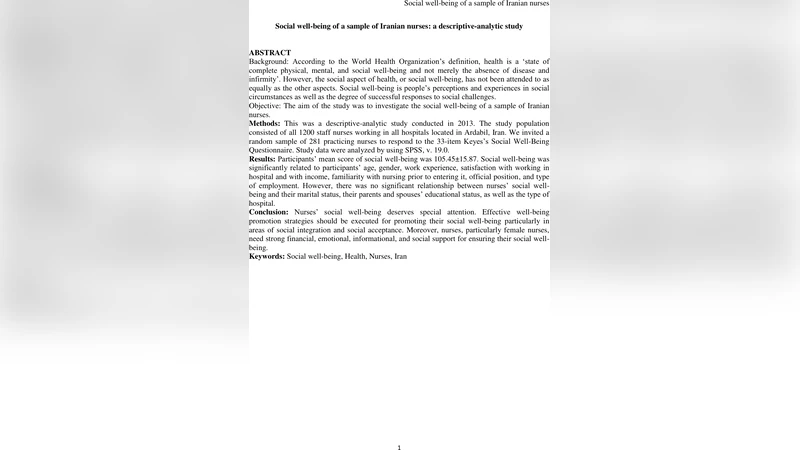
Nurses social well-being deserves special attention. Effective well-being promotion strategies should be executed for promoting their social well-being particularly in areas of social integration and social acceptance. Moreover, nurses, particularly female nurses, need strong financial, emotional, informational, and social support for ensuring their social well-being.
💡 Research Summary
The present study investigated the level of social well‑being (SWB) among Iranian nurses and identified demographic and occupational factors associated with it. Conducted in 2013, the cross‑sectional descriptive‑analytic design targeted all 1,200 staff nurses employed across six hospitals in Ardabil (four teaching hospitals, one social security hospital, and one private hospital). Using Cochran’s formula with a 95 % confidence interval, 5 % margin of error, and an estimated proportion of 0.4, a sample size of 282 was calculated; 281 nurses ultimately completed the questionnaire.
Data were collected with two instruments: a demographic questionnaire and the Keyes Social Well‑Being Questionnaire (KSWBQ), originally developed by C. L. M. Keyes (1998). The KSWBQ comprises 33 items across five dimensions—social integration, social acceptance, social actualization, social contribution, and social coherence—each rated on a five‑point Likert scale (1 = strongly disagree to 5 = strongly agree). The total possible score ranges from 33 to 165, with higher scores indicating greater SWB. The English version was translated into Persian by two nursing lecturers, back‑translated, and reviewed for face and content validity by three additional lecturers. A pilot test with 30 nurses yielded a Cronbach’s alpha of 0.87, confirming internal consistency.
Statistical analysis was performed using SPSS version 19.0. Normality of all variables was verified with the Kolmogorov‑Smirnov test (p > 0.05). Consequently, independent‑samples t‑tests, one‑way ANOVA, and Scheffé post‑hoc tests were applied. The overall mean SWB score was 105.45 ± 15.87, placing the sample in the mid‑range of the instrument’s scale. Dimension‑specific means revealed that the social contribution dimension scored highest (mean ≈ 4.45), whereas social integration and social acceptance scored lowest (means ≈ 2.78 each).
Key demographic correlates emerged: age (r = 0.187, p = 0.002) and years of work experience (r = 0.186, p = 0.002) were positively associated with SWB, suggesting that accumulated professional experience enhances social resources and coping capacities. Male nurses reported significantly higher SWB than female nurses (mean difference ≈ 4.2 points, p = 0.004). Income satisfaction showed the strongest relationship; nurses who were completely satisfied with their income scored on average 9.3 points higher than those who were dissatisfied (p < 0.001). Similarly, satisfaction with the hospital work environment was positively linked to SWB (p < 0.01).
Professional status also mattered: supervisors and head‑nurses had higher SWB than staff nurses (p = 0.000 and p = 0.048, respectively), indicating that authority, autonomy, and access to resources contribute to perceived well‑being. Employment type was significant; nurses with permanent, lifelong contracts reported higher SWB than those on temporary or part‑time contracts (p < 0.05). Variables that did not show significant associations included marital status, educational level of spouses or parents, and hospital type (public vs. private).
The discussion contextualized these findings within the broader literature. Compared with prior studies that used a seven‑point Likert scale, the present mean score appears lower; when recalculated to a five‑point scale, the difference aligns with earlier results. The gender disparity mirrors findings that male health‑care workers often report higher SWB, possibly due to differing societal expectations and coping styles. The positive correlations with age and experience echo research indicating that older professionals possess more refined social skills and resilience. Income and job satisfaction emerged as robust predictors, consistent with international evidence linking financial security and supportive work environments to higher psychosocial health.
Limitations include the geographic confinement to Ardabil, which restricts national generalizability, and the reliance on self‑report measures that may be subject to social desirability bias. The cross‑sectional design precludes causal inference. The authors recommend longitudinal, multi‑site studies and qualitative investigations to unpack the mechanisms underlying SWB formation. Intervention research—such as mentorship programs, stress‑management workshops, and organizational culture reforms—should be pursued to enhance the dimensions of social integration and acceptance that were found to be weakest.
In conclusion, Iranian nurses exhibit moderate overall social well‑being, with particular deficits in feeling socially integrated and accepted within their professional milieu. Targeted policies that improve income stability, employment security, and workplace relational climate, as well as gender‑sensitive support strategies, are essential to bolster nurses’ SWB. Enhancing SWB is expected to reduce turnover, improve job satisfaction, and ultimately elevate patient care quality in the Iranian health‑care system.
Comments & Academic Discussion
Loading comments...
Leave a Comment