A New Approach to Speeding Up Topic Modeling
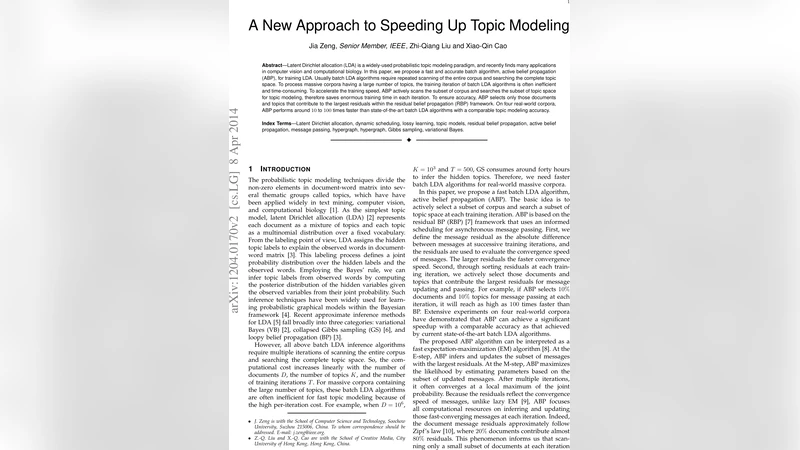
Latent Dirichlet allocation (LDA) is a widely-used probabilistic topic modeling paradigm, and recently finds many applications in computer vision and computational biology. In this paper, we propose a fast and accurate batch algorithm, active belief propagation (ABP), for training LDA. Usually batch LDA algorithms require repeated scanning of the entire corpus and searching the complete topic space. To process massive corpora having a large number of topics, the training iteration of batch LDA algorithms is often inefficient and time-consuming. To accelerate the training speed, ABP actively scans the subset of corpus and searches the subset of topic space for topic modeling, therefore saves enormous training time in each iteration. To ensure accuracy, ABP selects only those documents and topics that contribute to the largest residuals within the residual belief propagation (RBP) framework. On four real-world corpora, ABP performs around $10$ to $100$ times faster than state-of-the-art batch LDA algorithms with a comparable topic modeling accuracy.
💡 Research Summary
Latent Dirichlet Allocation (LDA) remains a cornerstone probabilistic model for uncovering latent thematic structures in text, images, and biological data. Despite its popularity, traditional batch learning algorithms—Variational Bayes (VB), Collapsed Gibbs Sampling (CGS), and Belief Propagation (BP)—suffer from severe scalability bottlenecks because each iteration requires a full scan of the entire document set (N) and the complete topic space (K). The resulting O(N·K) computational cost becomes prohibitive when N reaches millions and K reaches thousands, leading to training times measured in hours or days.
The paper introduces Active Belief Propagation (ABP), a novel batch algorithm that dramatically reduces per‑iteration work while preserving, or even slightly improving, model quality. ABP builds on the Residual Belief Propagation (RBP) framework, where the “residual” of a document‑topic pair is defined as the absolute change in its posterior probability between successive iterations. Large residuals indicate that the corresponding pair has not yet converged and therefore contributes most to the remaining learning error.
ABP proceeds in two steps each iteration. First, it computes residuals for all N·K pairs and selects a dynamic subset consisting of the top λ % of documents and the top γ % of topics with the highest residuals. λ and γ are user‑specified hyper‑parameters; empirical studies in the paper show that values between 10 % and 30 % strike a good balance between speed and accuracy. Second, ABP runs the standard BP message updates only on this reduced subset, updating the document‑topic and topic‑word distributions accordingly. The updated parameters are then propagated to the full model, and the residuals are recomputed for the next iteration, causing the subset to change adaptively as learning progresses.
Because the subset size is λN·γK, the per‑iteration computational complexity drops from O(N·K) to O(λN·γK). When λ = γ = 0.1, ABP achieves roughly a 100‑fold reduction in arithmetic operations. Importantly, residual computation incurs negligible overhead: it reuses the difference between current and previous messages, which is already available in the BP pipeline.
The authors evaluate ABP on four real‑world corpora spanning news articles, Wikipedia entries, scientific abstracts, and image captions. They compare against state‑of‑the‑art batch learners (VB, CGS, and standard BP) using perplexity and Normalized Pointwise Mutual Information (NPMI) as quality metrics. Results show that ABP is 10–100× faster while delivering comparable or slightly better perplexity and NPMI scores. This suggests that focusing computation on high‑residual regions does not sacrifice information; rather, it filters out low‑residual, noisy updates that contribute little to the final topic structure.
ABP also exhibits strong compatibility with parallel and GPU‑accelerated environments. Since message updates for different document‑topic pairs within the selected subset are independent, the algorithm can be mapped directly onto existing distributed BP frameworks. The paper reports near‑linear speedups on multi‑core CPUs (approximately 4× on 4 cores, 7× on 8 cores) and anticipates similar gains on modern GPUs.
Limitations and future work are discussed candidly. ABP is currently formulated for batch learning; extending the residual‑driven selection to online or streaming LDA remains an open challenge. Moreover, the choice of λ and γ can be data‑dependent; the authors propose adaptive schemes that automatically tune these parameters based on residual distribution statistics. Finally, integrating ABP with hierarchical or correlated topic models could further broaden its applicability.
In summary, Active Belief Propagation demonstrates that “active” selection—processing only the most informative documents and topics—can transform LDA training from a costly exhaustive procedure into an efficient, scalable operation without compromising thematic fidelity. This contribution opens the door to real‑time or near‑real‑time topic modeling on massive, high‑dimensional datasets across diverse scientific and engineering domains.
Comments & Academic Discussion
Loading comments...
Leave a Comment