Cybernetic Principles of Aging and Rejuvenation: the buffering-challenging strategy for life extension
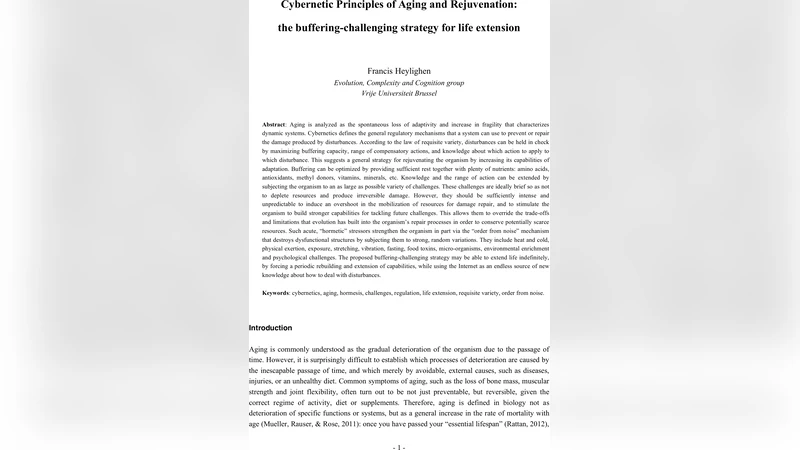
Aging is analyzed as the spontaneous loss of adaptivity and increase in fragility that characterizes dynamic systems. Cybernetics defines the general regulatory mechanisms that a system can use to prevent or repair the damage produced by disturbances. According to the law of requisite variety, disturbances can be held in check by maximizing buffering capacity, range of compensatory actions, and knowledge about which action to apply to which disturbance. This suggests a general strategy for rejuvenating the organism by increasing its capabilities of adaptation. Buffering can be optimized by providing sufficient rest together with plenty of nutrients: amino acids, antioxidants, methyl donors, vitamins, minerals, etc. Knowledge and the range of action can be extended by subjecting the organism to an as large as possible variety of challenges. These challenges are ideally brief so as not to deplete resources and produce irreversible damage. However, they should be sufficiently intense and unpredictable to induce an overshoot in the mobilization of resources for damage repair, and to stimulate the organism to build stronger capabilities for tackling future challenges. This allows them to override the trade-offs and limitations that evolution has built into the organism’s repair processes in order to conserve potentially scarce resources. Such acute, “hormetic” stressors strengthen the organism in part via the “order from noise” mechanism that destroys dysfunctional structures by subjecting them to strong, random variations. They include heat and cold, physical exertion, exposure, stretching, vibration, fasting, food toxins, micro-organisms, environmental enrichment and psychological challenges.
💡 Research Summary
The paper frames aging as a loss of adaptivity and a rise in fragility, concepts borrowed from dynamical‑system theory. It treats every organism as a goal‑directed cybernetic system whose primary goal is survival. Such a system must keep its essential variables (temperature, blood pressure, glucose, oxygen, etc.) within narrow limits despite a multitude of disturbances. The author draws on Ashby’s law of requisite variety, which states that to counteract a given variety of disturbances a system must possess an equal variety of possible actions, and must know which action to apply to each disturbance. This relationship is formalized with an entropy inequality: H(E) ≥ H(D) – H(A) + H(A|D) – B, where H denotes Shannon entropy, D the disturbance set, A the set of compensatory actions, H(A|D) the lack of knowledge, and B the buffering capacity.
Two complementary regulatory mechanisms are distinguished: passive buffering (e.g., nutritional stores, sleep, physical “shock absorbers”) and active regulation (feed‑forward and feedback). Buffering requires no energy or specific knowledge but cannot achieve non‑equilibrium goals; active regulation can, but it is limited by the speed of response and the accuracy of predictions. The author therefore proposes a “buffering‑challenging” strategy. First, maximize buffering by ensuring ample rest, balanced macronutrients, antioxidants, methyl donors, vitamins, and minerals. This creates a robust baseline that dampens routine perturbations. Second, deliberately expose the organism to brief, intense, and unpredictable stressors—heat, cold, vigorous exercise, fasting, dietary toxins, controlled infections, environmental enrichment, and psychological challenges. These acute “hormetic” events trigger an overshoot in repair pathways (autophagy, mitochondrial biogenesis, antioxidant up‑regulation, anti‑inflammatory signaling), eliminate dysfunctional structures, and expand the repertoire of regulatory models and knowledge the organism possesses. In cybernetic terms, such challenges increase H(A) and reduce H(A|D), thereby shrinking the right‑hand side of the inequality and allowing H(E) to be kept low.
The paper links this approach to the concept of attractors in state‑space dynamics. Aging is portrayed as a drift toward an approximate attractor—a reduced “homeodynamic space”—where the system’s possible states become increasingly constrained, making recovery from disturbances harder. By injecting strong, stochastic perturbations, the organism can be nudged out of this attractor basin, re‑exploring previously inaccessible regions of state space and restoring plasticity. The “order from noise” principle is invoked: random variations can dismantle maladaptive structures, enabling the emergence of more efficient configurations.
Practical implications include lifestyle recommendations: regular high‑quality sleep, nutrient‑dense diets, periodic heat‑or‑cold exposure (saunas, cold showers), interval training, intermittent fasting, occasional ingestion of mild toxins (e.g., phytochemicals), probiotic or controlled pathogen exposure, and cognitive or social novelty. The author stresses that the stressors must be brief enough to avoid irreversible damage yet intense enough to provoke a strong compensatory response.
Limitations are acknowledged. Empirical evidence for long‑term safety and efficacy of such a regimen is still sparse, especially in diverse human populations. The model assumes that individuals can accurately gauge the intensity and duration of challenges, and that the buffering resources are sufficient to prevent catastrophic failure during the stress episode. Moreover, the framework would benefit from personalized mapping of an individual’s disturbance profile and adaptive capacity, potentially leveraging big‑data and AI to refine the choice of challenges.
In summary, the paper offers a novel cybernetic perspective on aging, uniting the principles of requisite variety, buffering, and hormesis into a coherent “buffer‑plus‑challenge” protocol. By simultaneously strengthening passive defenses and expanding active regulatory diversity, it proposes a pathway to delay, mitigate, or even reverse age‑related fragility, thereby extending healthy lifespan.
Comments & Academic Discussion
Loading comments...
Leave a Comment