Exponential random graph models for networks with community structure
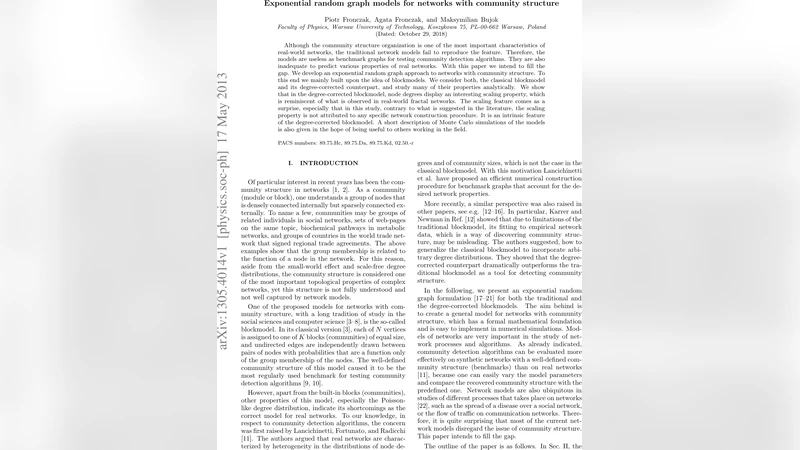
Although the community structure organization is one of the most important characteristics of real-world networks, the traditional network models fail to reproduce the feature. Therefore, the models are useless as benchmark graphs for testing community detection algorithms. They are also inadequate to predict various properties of real networks. With this paper we intend to fill the gap. We develop an exponential random graph approach to networks with community structure. To this end we mainly built upon the idea of blockmodels. We consider both, the classical blockmodel and its degree-corrected counterpart, and study many of their properties analytically. We show that in the degree-corrected blockmodel, node degrees display an interesting scaling property, which is reminiscent of what is observed in real-world fractal networks. The scaling feature comes as a surprise, especially that in this study, contrary to what is suggested in the literature, the scaling property is not attributed to any specific network construction procedure. It is an intrinsic feature of the degree-corrected blockmodel. A short description of Monte Carlo simulations of the models is also given in the hope of being useful to others working in the field.
💡 Research Summary
The paper addresses a critical gap in network modeling: the inability of traditional random graph models to reproduce the pronounced community structure observed in many real‑world systems. To remedy this, the authors develop an exponential random graph (ERG) formulation for networks with explicit community organization, presenting two variants: the classical stochastic blockmodel and a degree‑corrected version.
Starting from the ERG framework, the authors express the probability of a graph G as P(G)=exp
Comments & Academic Discussion
Loading comments...
Leave a Comment