T-functions revisited: New criteria for bijectivity/transitivity
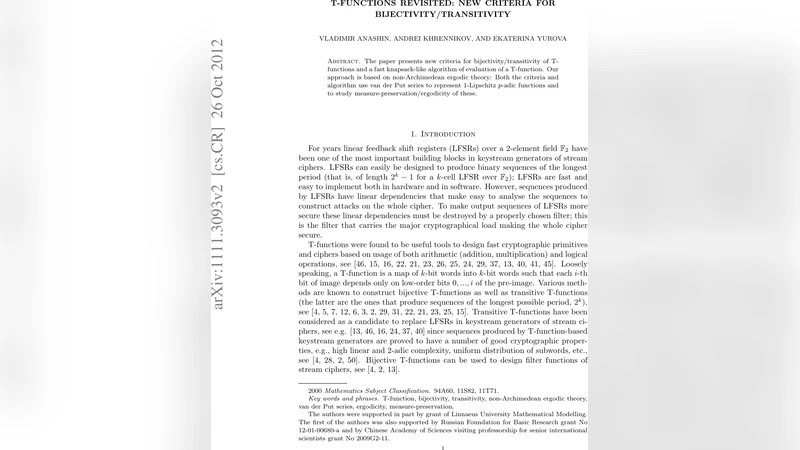
The paper presents new criteria for bijectivity/transitivity of T-functions and fast knapsack-like algorithm of evaluation of a T-function. Our approach is based on non-Archimedean ergodic theory: Both the criteria and algorithm use van der Put series to represent 1-Lipschitz $p$-adic functions and to study measure-preservation/ergodicity of these.
💡 Research Summary
The paper “T‑functions revisited: New criteria for bijectivity/transitivity” develops a novel framework for deciding whether a given T‑function is bijective (invertible) or transitive (single‑cycle) by exploiting non‑Archimedean (2‑adic) ergodic theory. A T‑function is defined as a mapping on binary words where the i‑th output bit depends only on the first i + 1 input bits; equivalently, it is a 1‑Lipschitz function on the space of 2‑adic integers ℤ₂. Traditional approaches used Mahler series to represent such functions, but extracting the necessary coefficients can be cumbersome, especially when the function is expressed as a composition of elementary computer instructions (addition, masking, shifts, etc.).
The authors introduce the van der Put series as a more convenient representation: \
Comments & Academic Discussion
Loading comments...
Leave a Comment