A Multiscale Kinetic-Fluid Solver with Dynamic Localization of Kinetic Effects
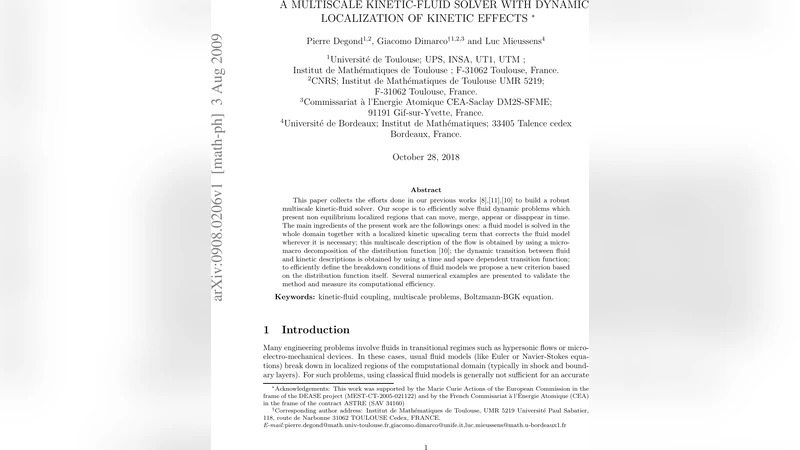
This paper collects the efforts done in our previous works [P. Degond, S. Jin, L. Mieussens, A Smooth Transition Between Kinetic and Hydrodynamic Equations, J. Comp. Phys., 209 (2005) 665–694.],[P.Degond, G. Dimarco, L. Mieussens, A Moving Interface Method for Dynamic Kinetic-fluid Coupling, J. Comp. Phys., Vol. 227, pp. 1176-1208, (2007).],[P. Degond, J.G. Liu, L. Mieussens, Macroscopic Fluid Model with Localized Kinetic Upscaling Effects, SIAM Multi. Model. Sim. 5(3), 940–979 (2006)] to build a robust multiscale kinetic-fluid solver. Our scope is to efficiently solve fluid dynamic problems which present non equilibrium localized regions that can move, merge, appear or disappear in time. The main ingredients of the present work are the followings ones: a fluid model is solved in the whole domain together with a localized kinetic upscaling term that corrects the fluid model wherever it is necessary; this multiscale description of the flow is obtained by using a micro-macro decomposition of the distribution function [P. Degond, J.G. Liu, L. Mieussens, Macroscopic Fluid Model with Localized Kinetic Upscaling Effects, SIAM Multi. Model. Sim. 5(3), 940–979 (2006)]; the dynamic transition between fluid and kinetic descriptions is obtained by using a time and space dependent transition function; to efficiently define the breakdown conditions of fluid models we propose a new criterion based on the distribution function itself. Several numerical examples are presented to validate the method and measure its computational efficiency.
💡 Research Summary
The paper presents a robust multiscale kinetic‑fluid solver designed to handle fluid dynamic problems in which non‑equilibrium regions are localized, move, merge, appear, or disappear over time. Building on earlier works by Degond, Jin, Mieussens, Dimarco, Liu and others, the authors adopt a micro‑macro decomposition of the particle distribution function f into an equilibrium Maxwellian M
Comments & Academic Discussion
Loading comments...
Leave a Comment