Electron cyclotron maser emission mode coupling to the z-mode on a longitudinal density gradient in the context of solar type III bursts
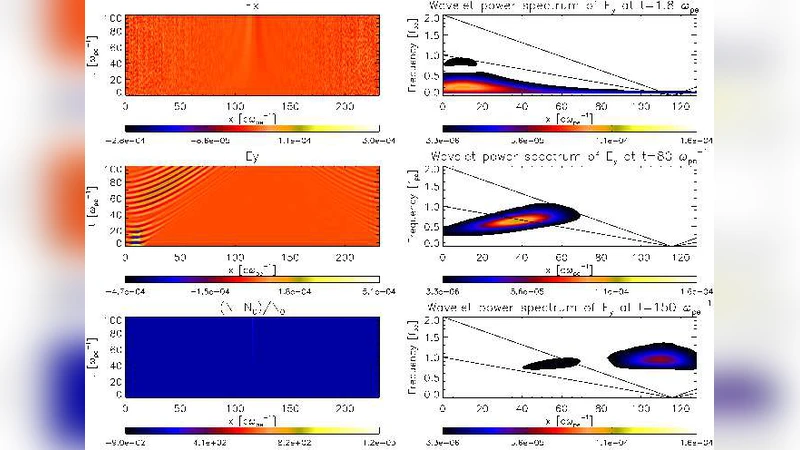
A beam of super-thermal, hot electrons was injected into maxwellian plasma with a density gradient along a magnetic field line. 1.5D particle-in-cell simulations were carried out which established that the EM emission is produced by the perpendicular component of the beam injection momentum. The beam has a positive slope in the distribution function in perpendicular momentum phase space, which is the characteristic feature of a cyclotron maser. The cyclotron maser in the overdense plasma generates emission at the electron cyclotron frequency. The frequencies of generated waves were too low to propagate away from the injection region, hence the wavelet transform shows a pulsating wave generation and decay process. The intensity pulsation frequency is twice the relativistic cyclotron frequency. Eventually, a stable wave packet formed and could mode couple on the density gradient to reach frequencies of the order of the plasma frequency, that allowed for propagation. The emitted wave is likely to be a z-mode wave. The total electromagnetic energy generated is of the order of 0.1% of the initial beam kinetic energy. The proposed mechanism is of relevance to solar type III radio bursts, as well as other situations, when the injected electron beam has a non-zero perpendicular momentum, e.g. magnetron.
💡 Research Summary
The paper investigates a novel mechanism for generating electromagnetic (EM) radiation in the context of solar type III radio bursts, focusing on the role of a perpendicular component of an injected electron beam and a longitudinal plasma density gradient. Using high‑resolution 1.5‑dimensional particle‑in‑cell (PIC) simulations, the authors model a Maxwellian background plasma threaded by a uniform magnetic field B₀ aligned with the density gradient. The plasma is overdense (electron plasma frequency ω_pe ≫ electron cyclotron frequency ω_ce), and a super‑thermal electron beam is injected with a substantial perpendicular momentum p⊥, creating a positive slope (∂f/∂p⊥ > 0) in the perpendicular momentum distribution – the hallmark of a cyclotron maser instability (CMI).
Key findings from the simulations are as follows:
-
Cyclotron Maser Generation – Immediately after injection, the beam drives a cyclotron maser that amplifies EM waves at frequencies near the relativistic cyclotron frequency ω_c = eB₀/(γm_e). Because the background plasma is overdense, these waves correspond to non‑propagating modes (essentially X‑mode or electro‑static components) that cannot escape the source region.
-
Pulsating Growth and Decay – The wave amplitude exhibits a regular pulsation with a period equal to twice the relativistic cyclotron frequency (2 γ ω_ce). This reflects a nonlinear energy exchange cycle: the beam feeds the maser, the wave grows, then the wave damps, returning energy to the particles, and the process repeats.
-
Mode Conversion on the Density Gradient – As the wave propagates along the decreasing density, its dispersion relation evolves. The gradient enables coupling from the initially trapped cyclotron‑maser mode into the low‑frequency Z‑mode, whose frequency approaches the plasma frequency ω_pe. Once the wave reaches ω ≈ ω_pe, it becomes a true propagating EM mode capable of leaving the source region.
-
Formation of a Stable Wave Packet – After several pulsation cycles, a coherent wave packet stabilizes and travels outward along the gradient. The packet carries the bulk of the generated EM energy.
-
Energy Efficiency – The total EM energy extracted from the beam is about 0.1 % of the beam’s initial kinetic energy. Although modest, this conversion efficiency is comparable to that inferred for type III bursts and demonstrates that a perpendicular beam component can be a viable energy source for observable radio emission.
-
Dependence on Beam Geometry – Simulations with purely parallel beams (p⊥ ≈ 0) produce negligible EM emission, confirming that the perpendicular momentum is essential for the cyclotron maser to operate.
The authors argue that this two‑step process—cyclotron‑maser generation followed by gradient‑induced Z‑mode coupling—offers an alternative to the conventional plasma‑emission scenario, which relies on Langmuir wave generation and subsequent nonlinear conversion. The cyclotron‑maser route naturally explains the observed rapid frequency drift and pulsating intensity often seen in type III bursts, especially when the electron beam possesses a significant pitch‑angle distribution. Moreover, the mechanism may be relevant to laboratory devices such as magnetrons, where electron beams with non‑zero perpendicular momentum are deliberately employed.
In conclusion, the study provides compelling numerical evidence that a super‑thermal electron beam with a perpendicular momentum component can excite cyclotron‑maser radiation in an overdense plasma, and that a longitudinal density gradient can convert this trapped radiation into a propagating Z‑mode. This process yields observable EM emission with realistic energy conversion efficiency and offers a fresh perspective on the generation of solar type III radio bursts. Future work should extend the analysis to fully three‑dimensional geometries, explore a broader parameter space (magnetic field strength, gradient scale length, beam density), and compare the simulated spectra with high‑resolution solar radio observations.
Comments & Academic Discussion
Loading comments...
Leave a Comment