SDO/AIA Detection of Solar Prominence Formation within a Coronal Cavity
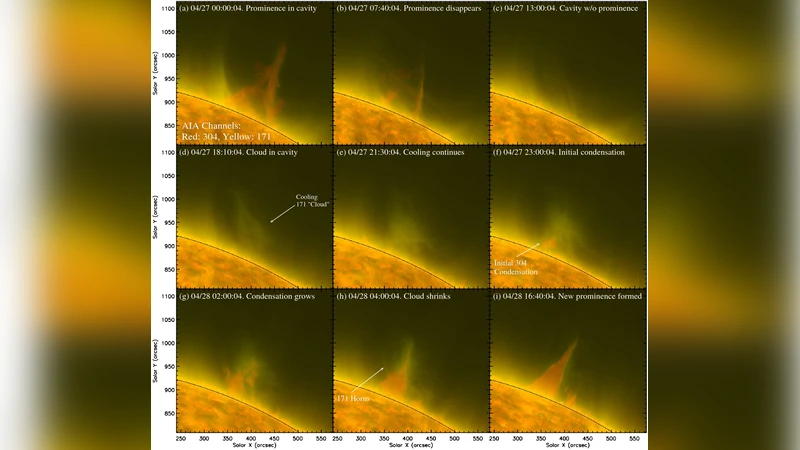
We report the first analyses of SDO/AIA observations of the formation of a quiescent polar crown prominence in a coronal cavity. The He II 304 \AA\ (log T_{max} ~ 4.8 K) data show both the gradual disappearance of the prominence due to vertical drainage and lateral transport of plasma followed by the formation of a new prominence some 12 hours later. The formation of the prominence is preceded by the appearance of a bright emission “cloud” in the central region of the coronal cavity. The peak brightness of the cloud progressively shifts in time from the Fe XIV 211 \AA\ channel, through the Fe XII 193 \AA\ channel, to the Fe IX 171 \AA\ channel (log T_{max} ~ 6.2, 6.1, 5.8 K, respectively) while simultaneously decreasing in altitude. Filter ratio analysis estimates the initial temperature of the cloud in the cavity to be approximately log T \sim 6.25 K with evidence of cooling over time. The subsequent growth of the prominence is accompanied by darkening of the cavity in the 211 \AA\ channel. The observations imply the possibility of prominence formation via in situ condensation of hot plasma from the coronal cavity, in support of the proposed process of magneto-thermal convection in coronal magnetic flux ropes.
💡 Research Summary
The authors present the first comprehensive analysis of Solar Dynamics Observatory/Atmospheric Imaging Assembly (SDO/AIA) observations that capture the complete life cycle of a quiescent polar‑crown prominence within a coronal cavity. Using the He II 304 Å channel (log T_max ≈ 4.8 K), they document the gradual disappearance of an existing prominence, which occurs through a combination of vertical drainage and lateral plasma transport along magnetic field lines. Approximately twelve hours after the disappearance, a new prominence becomes visible. Crucially, the formation of the new structure is preceded by the emergence of a bright “cloud” in the cavity’s core. This cloud first brightens in the Fe XIV 211 Å channel (log T_max ≈ 6.2 K), then sequentially in the Fe XII 193 Å (log T_max ≈ 6.1 K) and Fe IX 171 Å (log T_max ≈ 5.8 K) channels, while simultaneously descending in altitude.
Filter‑ratio diagnostics applied to the multi‑temperature AIA data estimate the cloud’s initial temperature at log T ≈ 6.25 K, with a measurable cooling trend of roughly 0.2 dex over the observation period. The descending motion and shrinking volume of the cloud indicate that gravitational settling and radiative/ conductive losses are driving a rapid thermal instability. As the cloud cools below the formation temperature of He II, a dark, dense structure appears in the 304 Å images, marking the birth of the new prominence. The growth of this prominence is accompanied by a progressive darkening of the surrounding cavity in the 211 Å channel, suggesting that hot coronal plasma is being depleted as it condenses into the cooler, denser filament material.
These observations provide strong empirical support for the magneto‑thermal convection scenario, in which plasma trapped in a magnetic flux rope becomes thermally unstable, cools in situ, and condenses to form prominence material. The observed 12‑hour timescale for cooling and condensation aligns well with predictions from recent numerical simulations of thermal non‑equilibrium in flux‑rope environments. Moreover, the study demonstrates that coronal cavities can act as long‑term reservoirs of mass and heat, capable of supplying material for prominence formation without requiring large‑scale mass inflow from the chromosphere.
The paper emphasizes the critical role of high‑resolution, multi‑wavelength imaging in disentangling the thermal evolution of coronal structures. It argues that future work combining such observations with advanced MHD simulations will enable quantitative constraints on key physical parameters—thermal conductivity, radiative loss functions, and magnetic topology—that govern in‑situ condensation. Ultimately, the work expands the paradigm of prominence formation, showing that, in addition to the classic model of chromospheric evaporation and subsequent condensation, prominences can also arise directly from cooling of hot plasma already residing within a coronal cavity.
Comments & Academic Discussion
Loading comments...
Leave a Comment