First SDO AIA Observations of a Global Coronal EUV "Wave": Multiple Components and "Ripples"
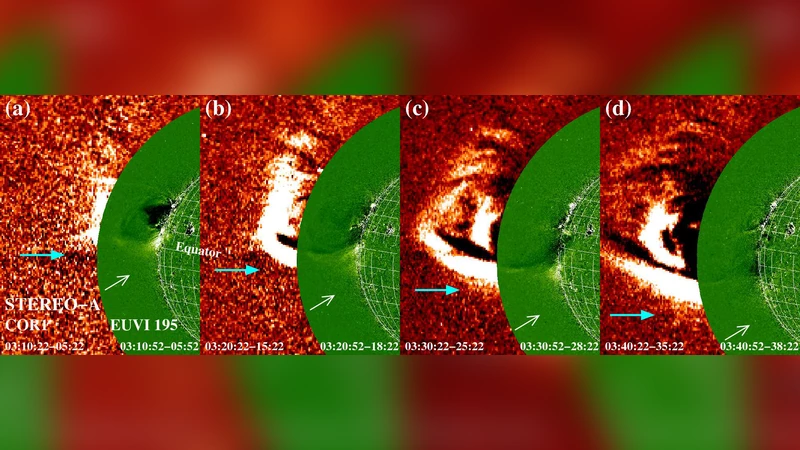
We present the first SDO AIA observations of a global coronal EUV disturbance (so-called “EIT wave”) revealed in unprecedented detail. The disturbance observed on 2010 April 8 exhibits two components: one diffuse pulse superimposed on which are multiple sharp fronts that have slow and fast components. The disturbance originates in front of erupting coronal loops and some sharp fronts undergo accelerations, both effects implying that the disturbance is driven by a CME. The diffuse pulse, propagating at a uniform velocity of 204-238 km/s with very little angular dependence within its extent in the south, maintains its coherence and stable profile for ~30 minutes. Its arrival at increasing distances coincides with the onsets of loop expansions and the slow sharp front. The fast sharp front overtakes the slow front, producing multiple “ripples” and steepening the local pulse, and both fronts propagate independently afterwards. This behavior resembles the nature of real waves. Unexpectedly, the amplitude and FWHM of the diffuse pulse decrease linearly with distance. A hybrid model, combining both wave and non-wave components, can explain many, but not all, of the observations. Discoveries of the two-component fronts and multiple ripples were made possible for the first time thanks to AIA’s high cadences (10-20 s) and high signal-to-noise ratio.
💡 Research Summary
This paper presents the first detailed observations of a global coronal extreme‑ultraviolet (EUV) disturbance—commonly referred to as an “EIT wave”—using the Atmospheric Imaging Assembly (AIA) aboard the Solar Dynamics Observatory (SDO). The event occurred on 8 April 2010 and was captured with unprecedented temporal (10–20 s cadence) and photometric fidelity across multiple EUV channels, allowing the authors to resolve fine spatial and temporal structures that were previously inaccessible with SOHO/EIT’s 10–20 min cadence.
The disturbance consists of two distinct components. The first is a broad, diffuse pulse that propagates southward with a remarkably uniform speed of 204–238 km s⁻¹. This pulse maintains a coherent shape for roughly 30 minutes, showing only a linear decrease in both amplitude and full‑width at half‑maximum (FWHM) with distance. Its arrival at progressively larger radii coincides with the onset of coronal loop expansions and the emergence of a slower, sharper front, suggesting that the pulse is driven by the associated coronal mass ejection (CME).
Superimposed on the diffuse pulse are multiple sharp fronts. These fronts separate into a slow component, which initially travels at ~150 km s⁻¹ and accelerates to match the diffuse pulse speed, and a fast component, which starts near 300 km s⁻¹ and overtakes the slow front. When the fast front catches up, a series of small‑scale “ripples” appear at the interface. The ripples manifest as localized steepening of the intensity profile and then propagate independently, a behavior reminiscent of nonlinear wave interactions.
The authors argue that neither a pure wave model nor a purely non‑wave (CME‑driven compression) model can account for all observed features. Instead, they propose a hybrid scenario: the diffuse pulse represents a genuine fast‑mode MHD wave continuously driven by the expanding CME, while the sharp fronts are manifestations of CME‑induced plasma compression and restructuring that behave like pseudo‑waves. This hybrid model successfully explains the coexistence of a coherent, constant‑speed pulse with accelerating, overtaking fronts and the generation of ripples. However, certain aspects remain puzzling. The linear decay of amplitude and width with distance is not predicted by standard linear wave theory, and the exact physical mechanism that produces the ripples—whether it is nonlinear wave‑wave interaction, wave‑front collision, or localized inhomogeneities—requires further numerical modeling.
In summary, the high‑cadence, high‑signal‑to‑noise AIA observations reveal that the classic “EIT wave” is not a monolithic phenomenon but a composite of a true MHD wave and CME‑driven non‑wave structures. The detection of overtaking fronts and the resulting ripples provides the first direct evidence of nonlinear wave‑like behavior in the solar corona, highlighting the importance of simultaneous wave and non‑wave processes in the dynamics of large‑scale coronal disturbances. This work sets a new benchmark for future studies of coronal EUV waves and their relationship to CMEs.
Comments & Academic Discussion
Loading comments...
Leave a Comment