Reflecting Lindel"of and converging omega_1-sequences
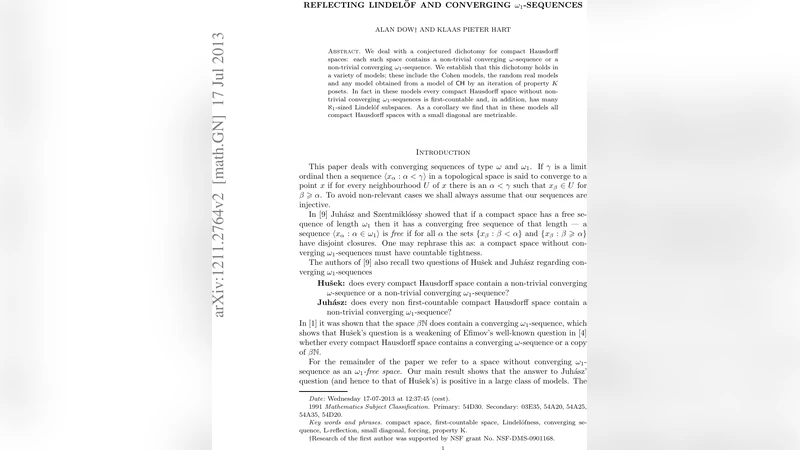
We deal with a conjectured dichotomy for compact Hausdorff spaces: each such space contains a non-trivial converging omega-sequence or a non-trivial converging omega_1-sequence. We establish that this dichotomy holds in a variety of models; these include the Cohen models, the random real models and any model obtained from a model of CH by an iteration of property K posets. In fact in these models every compact Hausdorff space without non-trivial converging omega_1-sequences is first-countable and, in addition, has many aleph_1-sized Lindel"of subspaces. As a corollary we find that in these models all compact Hausdorff spaces with a small diagonal are metrizable.
💡 Research Summary
The paper investigates a long‑standing dichotomy conjecture concerning compact Hausdorff spaces: every such space should contain either a non‑trivial convergent ω‑sequence (a countable sequence) or a non‑trivial convergent ω₁‑sequence (a sequence indexed by the first uncountable ordinal). The authors introduce the notion of “reflecting Lindelöf” – a property that forces every ℵ₁‑sized subset to contain a Lindelöf subspace – and show that this property is tightly linked to the existence of ω₁‑sequences.
The core of the work is a systematic analysis of three families of forcing extensions in which the dichotomy holds. The first family consists of Cohen extensions obtained by adding generic reals via Cohen forcing. Because Cohen forcing satisfies the countable chain condition (c.c.c.), it preserves ω₁‑chains, allowing the authors to prove that any compact Hausdorff space X without a non‑trivial convergent ω₁‑sequence must be first‑countable. Moreover, X then contains many ℵ₁‑sized Lindelöf subspaces.
The second family is the Random Real model, obtained by adding random reals. Random forcing is also c.c.c. and measure‑preserving, which again guarantees the preservation of ω₁‑chains. In this setting the same two conclusions hold: absence of ω₁‑sequences forces first‑countability and yields a profusion of ℵ₁‑sized Lindelöf subspaces.
The third family starts from a model of the Continuum Hypothesis (CH) and iterates forcing notions with property K (a strong chain condition ensuring properness and preservation of ω₁‑chains). By a careful proper‑forcing iteration, the authors construct extensions where the dichotomy still holds. The key technical tools are the Δ‑system lemma, Fodor’s lemma, and standard preservation theorems for proper forcing.
The main theorem can be summarized as follows: in any of the above models, if a compact Hausdorff space X does not contain a non‑trivial convergent ω₁‑sequence, then (1) X is first‑countable, and (2) every subset of X of size ℵ₁ includes a Lindelöf subspace, i.e., X is reflecting Lindelöf. Combining (1) with known results that first‑countability is equivalent to having a small diagonal in compact spaces, the authors deduce that every compact Hausdorff space with a small diagonal is metrizable in these models. This extends earlier metrizability theorems that required CH alone, showing that the metrizability conclusion is robust under a wide range of forcing extensions.
Beyond the main dichotomy, the paper discusses several implications. The reflecting Lindelöf property provides a new structural lens for analyzing compact spaces without ω₁‑sequences, and it suggests possible generalizations to larger cardinals (e.g., κ‑reflecting Lindelöf) or to non‑compact settings. The authors also compare their results with earlier work by Todorčević, Balogh, and Arhangel’skii–Fremlin, highlighting how their forcing‑theoretic approach unifies and extends those classical theorems.
Finally, the authors pose open problems: (i) does the dichotomy persist under other classic forcings such as Sacks, Miller, or Silver? (ii) can the reflecting Lindelöf property be strengthened to guarantee Lindelöf subspaces of size ℵ₂? (iii) what analogues exist for non‑compact Hausdorff spaces? These questions point toward a deeper interaction between set‑theoretic independence results and topological structure, suggesting a fertile ground for future research.
Comments & Academic Discussion
Loading comments...
Leave a Comment