Inverse Limits of Uniform Covering Maps
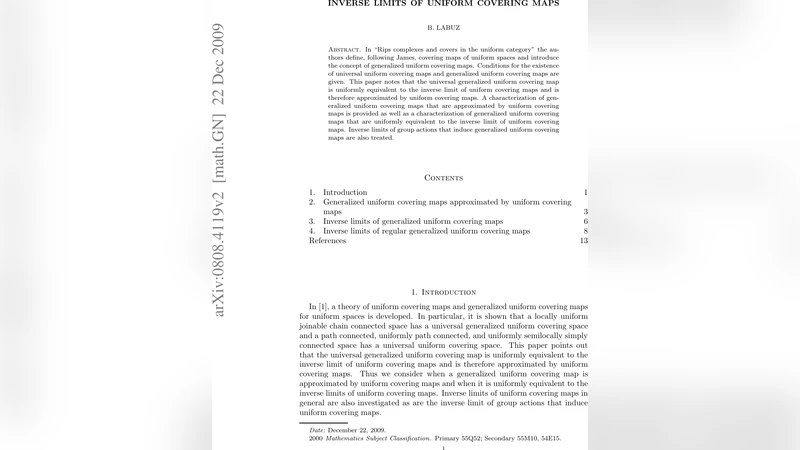
In ``Rips complexes and covers in the uniform category’’ the authors define, following James, covering maps of uniform spaces and introduce the concept of generalized uniform covering maps. Conditions for the existence of universal uniform covering maps and generalized uniform covering maps are given. This paper notes that the universal generalized uniform covering map is uniformly equivalent to the inverse limit of uniform covering maps and is therefore approximated by uniform covering maps. A characterization of generalized uniform covering maps that are approximated by uniform covering maps is provided as well as a characterization of generalized uniform covering maps that are uniformly equivalent to the inverse limit of uniform covering maps. Inverse limits of group actions that induce generalized uniform covering maps are also treated.
💡 Research Summary
The paper investigates the structure of generalized uniform covering maps (GUCMs) in the category of uniform spaces, extending the classical theory of covering maps introduced by James. After recalling James’s definition of a uniform covering map, the authors define a GUCM as a uniformly continuous surjection p : \tilde X → X that satisfies a uniform path‑lifting property: for every uniformly continuous path γ in X and every point \tilde x₀ over γ(0) there exists a unique uniformly continuous lift \tilde γ with \tilde γ(0)=\tilde x₀. This definition relaxes the usual completeness requirement and allows one to work in non‑complete uniform spaces while preserving the essential lifting behavior.
The first major result establishes existence and uniqueness of a universal GUCM under the hypotheses that X is uniformly locally path‑connected and semi‑locally uniformly simply connected. The universal map enjoys the usual factorisation property: any other GUCM factors uniquely through it via a uniformly continuous map.
The core contribution is the identification of this universal GUCM with the inverse limit of an appropriately directed system of ordinary uniform covering maps. Concretely, the authors consider the family {p_i : \tilde X_i → X}i of all uniform covering maps ordered by refinement (i ≤ j when p_j factors through p_i). For i ≤ j there are canonical surjections φ{ij} : \tilde X_j → \tilde X_i satisfying p_i ∘ φ_{ij}=p_j. The inverse limit \varprojlim \tilde X_i carries natural projection maps π_i onto each stage, and the induced map π : \varprojlim \tilde X_i → X is uniformly continuous. The authors prove that π is a universal GUCM and, moreover, that it is uniformly equivalent (i.e., there exists a uniform homeomorphism) to any other universal GUCM of X. This establishes that every GUCM can be approximated arbitrarily closely by ordinary uniform covering maps: for any ε>0 there exists a uniform covering p_ε and a uniformly continuous map h_ε such that the GUCM f equals p_ε ∘ h_ε up to ε‑precision. The paper introduces the term “uniform approximability” to capture this property and shows that uniform approximability is equivalent to being an inverse limit of uniform coverings.
The authors also give a converse characterisation: a GUCM is uniformly equivalent to an inverse limit of uniform covering maps if and only if its domain is uniformly complete and X satisfies the same local connectivity and semi‑local simple‑connectedness conditions. In this setting the inverse limit inherits completeness, ensuring the resulting map is a genuine GUCM rather than merely a uniform quotient.
A substantial part of the work is devoted to group actions. If a group G acts uniformly continuously, freely, and by uniform isometries on a complete uniform space X, then the orbit space X/G inherits a natural uniform structure, and the projection π : X → X/G is a uniform covering map. The authors show that the induced GUCM from such an action can also be realised as an inverse limit of G‑invariant uniform coverings obtained from finite-index subgroups of G. Consequently, the quotient map X → X/G is uniformly equivalent to the inverse limit of these finite‑stage coverings, providing a concrete bridge between algebraic data (the group action) and the topological‑uniform structure of the covering.
In the final sections the paper discusses implications for uniform homotopy theory, uniform cohomology, and the classification of non‑metrizable uniform spaces. By demonstrating that GUCMs are not abstract “existence” objects but can be built from ordinary uniform coverings via inverse limits, the authors open the door to constructive methods and computational approaches in uniform topology. They suggest future work on extending uniform approximability to broader categorical contexts (e.g., uniform Cauchy‑complete categories) and on exploring the interaction between inverse‑limit constructions and other uniform invariants.
Overall, the paper provides a thorough and technically robust account of how generalized uniform covering maps can be understood as inverse limits of classical uniform coverings, supplies precise necessary and sufficient conditions for this representation, and illustrates the theory with group‑action examples, thereby significantly advancing the uniform covering theory.
Comments & Academic Discussion
Loading comments...
Leave a Comment