Similarity and bisimilarity notions appropriate for characterizing indistinguishability in fragments of the calculus of relations
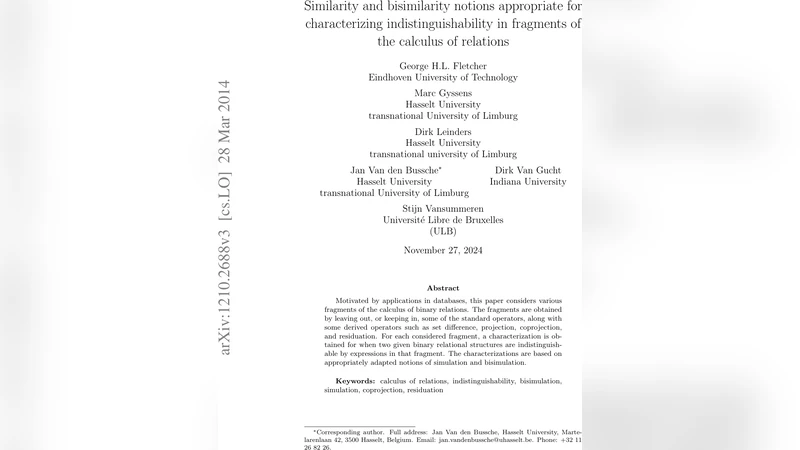
Motivated by applications in databases, this paper considers various fragments of the calculus of binary relations. The fragments are obtained by leaving out, or keeping in, some of the standard operators, along with some derived operators such as set difference, projection, coprojection, and residuation. For each considered fragment, a characterization is obtained for when two given binary relational structures are indistinguishable by expressions in that fragment. The characterizations are based on appropriately adapted notions of simulation and bisimulation.
💡 Research Summary
The paper investigates the expressive power of various fragments of the calculus of binary relations, a formalism that underlies many database query languages. By systematically selecting which standard operators (union, intersection, difference, composition, converse, etc.) and derived operators (projection, coprojection, residuation) are retained, the authors define a family of fragments that correspond to realistic subsets of query capabilities. For each fragment they ask a fundamental question: when are two finite relational structures indistinguishable by any expression built from the operators of that fragment?
To answer this, the authors generalize the classic notions of simulation and bisimulation. In the full calculus, bisimulation provides a precise characterization of indistinguishability, but once non‑symmetric operators such as set difference, projection, or residuation are introduced, the standard bisimulation becomes either too strong (rejecting structures that are actually indistinguishable) or too weak (failing to capture all distinguishing power). The paper therefore introduces two families of relational games: (1) conditional simulations, which are one‑directional relations that preserve the results of all operators present in the fragment, and (2) restricted bisimulations, which add extra preservation constraints for the non‑symmetric operators. For fragments that contain difference, a “difference‑preserving simulation” is required; for those with projection, a “projection‑preserving bisimulation” is defined.
The main technical contribution consists of two complementary theorems for every fragment. The soundness theorem shows that if a pair of structures is related by the appropriate simulation or bisimulation, then no expression of the fragment can separate them. The proof proceeds by induction on the syntax of expressions, handling each operator according to the preservation conditions of the chosen relational game. The completeness theorem proves the converse: if two structures cannot be distinguished by any fragment expression, then there exists a suitable simulation/bisimulation linking them. This direction is established via a game‑theoretic construction in which two players alternately select elements and apply allowed operators; the existence of a winning strategy for the duplicator corresponds exactly to the required relational correspondence.
The authors also discuss algorithmic aspects. The simulation and bisimulation relations can be computed in polynomial time for most fragments, extending classic partition‑refinement algorithms used for modal logics. They illustrate how these results can be applied to database schema mapping, query optimization, and automated verification of query equivalence: if two schemas are indistinguishable under a fragment that matches the target query language, then any query expressed in that language can be safely rewritten or transferred between the schemas without loss of semantics.
Overall, the paper provides a unified, operator‑by‑operator analysis of indistinguishability in relational calculi, bridging a gap between abstract logical characterizations and practical concerns in database theory. Its systematic treatment of simulations and bisimulations for each fragment offers both a deeper theoretical understanding and concrete tools for developers of query processors and schema‑integration systems.
Comments & Academic Discussion
Loading comments...
Leave a Comment