Cascading Failures in Networks with Proximate Dependent Nodes
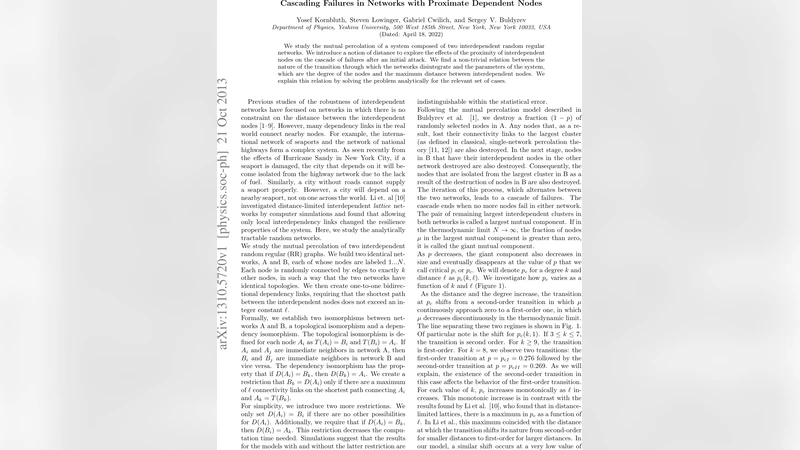
We study the mutual percolation of a system composed of two interdependent random regular networks. We introduce a notion of distance to explore the effects of the proximity of interdependent nodes on the cascade of failures after an initial attack. We find a non-trivial relation between the nature of the transition through which the networks disintegrate and the parameters of the system, which are the degree of the nodes and the maximum distance between interdependent nodes. We explain this relation by solving the problem analytically for the relevant set of cases.
💡 Research Summary
This paper investigates the mutual percolation and cascade of failures in a system composed of two interdependent random regular (RR) networks when the interdependency links are constrained by a maximum Euclidean (graph‑theoretic) distance ℓ. The authors first construct two identical RR graphs A and B, each of size N and degree k, and impose a one‑to‑one bidirectional dependency mapping D such that the shortest path between a node i in A and its dependent counterpart D(i) in B does not exceed ℓ edges. For the simplest non‑trivial case ℓ = 1, the dependency links can only connect neighboring nodes; consequently the network can be partitioned into “monomers” (nodes that depend on their exact counterpart) and “dimers” (pairs of neighboring nodes that depend on each other). Dimers are further distinguished as matched (both nodes survive the initial attack) or unmatched (only one survives).
The cascade proceeds as in the classic Buldyrev model: a fraction (1 − p) of nodes in A is removed at random, then all nodes that become disconnected from the largest component in A are also removed, followed by the removal of their dependent nodes in B, and the process repeats alternately between the two layers until no further nodes fail. The size of the surviving mutually connected giant component is denoted µ(p). The authors develop a probabilistic framework that treats monomers, matched dimers, and unmatched dimers separately. They introduce the monomer fraction m (derived from a discrete version of Rényi’s parking problem) and the probability q that a link leaving a dimer reaches a monomer. For each node type they define a failure probability a (a_m, a_d, a_u) and auxiliary probabilities z (z_m, z_d) that capture the joint failure of a pair of links across the two layers.
Equations (4)–(8) express a_d, a_m, a_u, z_d, and z_m in terms of p, k, m, q, and each other, accounting for the fact that the events “failure through network A” (x) and “failure through network B” (y) may be independent (for matched dimers) or correlated (for unmatched dimers). The overall fraction of nodes in the mutual giant component is then given by a closed‑form expression (9), which combines the contributions of monomers and dimers and incorporates the probabilities that a node’s counterpart in the other layer is attached to the giant component.
Solving the coupled equations iteratively yields µ(p) curves that match extensive Monte‑Carlo simulations (N = 10⁶, 100 realizations) with high precision. The main findings are:
-
Transition order depends on degree k: For k ≤ 7 the system undergoes a continuous (second‑order) percolation transition; µ(p) decreases smoothly to zero as p approaches a critical value p_c(k,ℓ). For k ≥ 9 the transition becomes discontinuous (first‑order); µ(p) drops abruptly to zero at p_c, indicating a catastrophic collapse.
-
Special case k = 8, ℓ = 1: Two distinct transitions are observed. The first at p_c^I ≈ 0.2762 is a first‑order jump to a non‑zero µ (α), while a second, continuous transition at p_c^{II} ≈ 0.2688 drives µ to zero. This double‑transition phenomenon arises from the interplay between monomer and dimer populations near the critical point.
-
Effect of distance ℓ: Increasing ℓ monotonically raises p_c for any fixed k, meaning that longer dependency links make the system more fragile. This contrasts with earlier lattice‑based studies where p_c exhibited a non‑monotonic dependence on ℓ.
-
Analytic solution for ℓ = 1: By mapping the mutual percolation problem onto a single RR network with modified failure probabilities, the authors obtain an exact analytical description of the cascade dynamics, extending the classic single‑layer percolation equation b = (1 − p) + p b^{k‑1} to incorporate the three node types and their correlations.
The paper concludes that distance‑limited interdependencies dramatically alter network robustness. Networks with short dependency distances and low degree degrade gradually via second‑order transitions, offering higher resilience, whereas networks with long dependency distances and high degree are prone to abrupt, system‑wide failures. The analytical framework presented provides a valuable tool for assessing and designing real‑world interdependent infrastructures—such as power grids coupled with transportation or logistics networks—where geographic proximity of dependent components is a natural constraint.
Comments & Academic Discussion
Loading comments...
Leave a Comment