Claude Bouchu, intendant de Bourgogne au 17`eme si`ecle, a-t-il invente le mot "statistique"
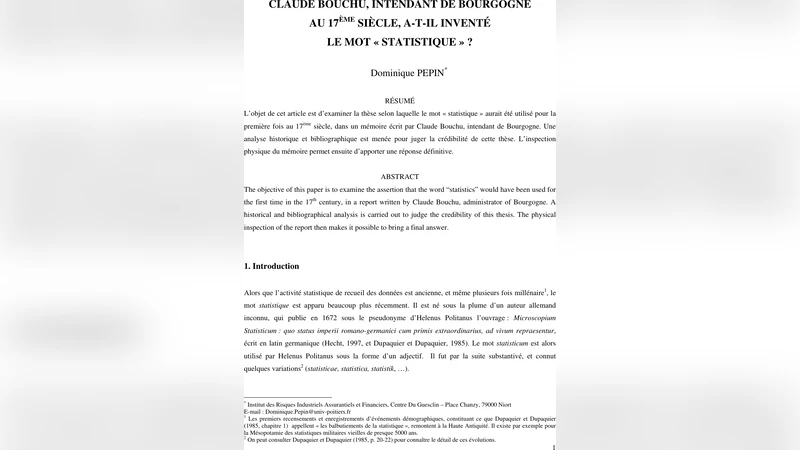
The objective of this paper is to examine the assertion that the word “statistics” would have been used for the first time in the 17th century, in a report written by Claude Bouchu, administrator of Bourgogne. A historical and bibliographical analysis is carried out to judge the credibility of this thesis. The physical inspection of the report then makes it possible to bring a final answer.
💡 Research Summary
The paper investigates the claim that the French intendant of Burgundy, Claude Bouchu (1628‑1683), was the first to use the word “statistique” (statistics) in a report he prepared in the 17th century. The author proceeds through three main stages: (1) a linguistic‑historical overview of the term “statistics,” (2) a biographical sketch of Bouchu and the administrative context of his work, and (3) a critical examination of the primary source—the massive questionnaire‑based report commissioned by Colbert and attributed to Bouchu.
In the first part, the author traces the etymology of “statistique” back to the German‑language tradition. The earliest documented appearance is in the 1672 Latin‑German pamphlet “Microscopium Statisticum” published under the pseudonym Helenus Politanus. There, “statisticum” functions as an adjective and soon becomes a substantive in German scholarly circles, later taking forms such as “statisticae,” “statistik,” etc. The paper cites the work of Gottfried Achenwall and later scholars (Desrosières 1993) to show that in the German Enlightenment the term denoted a “science of the state” (Staatwissenschaft), a hybrid of geography, political science, and economics. The English word “statistics” entered English via the German school, replacing the earlier phrase “political arithmetic” associated with William Petty.
The second part introduces Claude Bouchu, a long‑serving intendant of Burgundy under Louis XIV and his minister Colbert. Bouchu’s duties encompassed fiscal, judicial, police, and military oversight; he acted as the king’s direct agent in the province. Between 1665 and 1669, following a royal ordinance (7 August 1664) and a council decision (7 August 1665), Colbert ordered all intendants to compile exhaustive inventories of their généralités. Bouchu responded by commissioning a province‑wide survey of 1 950 parishes and communities, resulting in a manuscript of roughly 7 800 pages, organized into nine folio volumes. The work is described as a series of questionnaires rather than a synthesized narrative, reflecting an unprecedented level of detail for the period.
The crux of the investigation lies in the title of Bouchu’s manuscript. Some secondary sources have cited it as “Déclaration des biens, charges, dettes et statistique des communautés de la généralité de Dijon,” implying the presence of the word “statistique.” The author, however, conducted a physical inspection of the surviving copies held at the Bibliothèque Nationale, the Archives Départementales de la Côte‑d’Or, the Bibliothèque Municipale de Bourg, and the Archives Départementales de l’Ain. None of these primary documents contain the word “statistique” in the title or body text. The alleged term appears only in later bibliographic references, likely introduced by a transcription error or by modern scholars retroactively applying the contemporary term.
The third part evaluates the methodological implications of this misattribution. By cross‑checking the cited bibliographies (Hecht 1997, Dupaquier & Dupaquier 1985, Meyer 1981) and re‑examining the original manuscript, the author demonstrates that the claim of Bouchu inventing the word rests on a chain of secondary citations rather than on any primary evidence. Moreover, when placed against the broader European timeline, the German emergence of “statisticum” predates Bouchu’s report, and the English adoption of “statistics” follows the German model, not a French one.
In conclusion, the paper asserts that Claude Bouchu did not coin the term “statistique.” While his administrative work represents a remarkable early example of systematic data collection, the lexical invention belongs to the German scholarly tradition of the late 17th and early 18th centuries. The study underscores the necessity of consulting original archival material when tracing the history of technical terminology and suggests that future research should compare similar provincial surveys across Europe to map the diffusion of both statistical practice and its nomenclature.
Comments & Academic Discussion
Loading comments...
Leave a Comment