Physical modeling of shrink-swell cycles and cracking in a clayey vadose zone
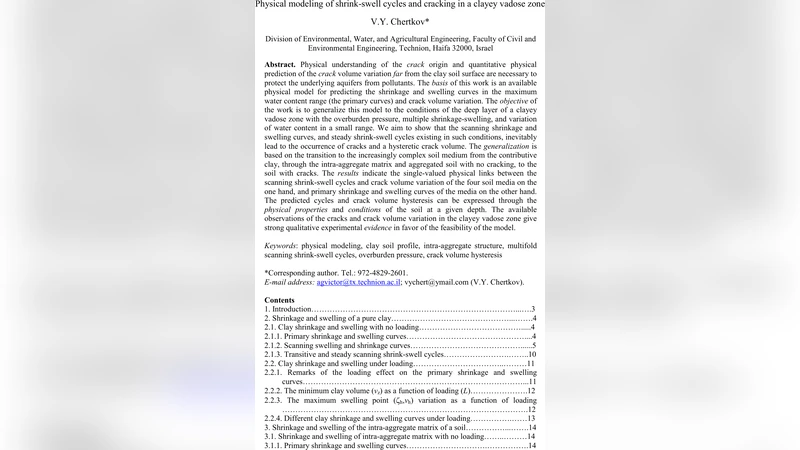
Physical understanding of the crack origin and quantitative physical prediction of the crack volume variation far from the clay soil surface are necessary to protect the underlying aquifers from pollutants. The basis of this work is an available physical model for predicting the shrinkage and swelling curves in the maximum water content range (the primary curves) and crack volume variation. The objective of the work is to generalize this model to the conditions of the deep layer of a clayey vadose zone with the overburden pressure, multiple shrinkage-swelling, and variation of water content in a small range. We aim to show that the scanning shrinkage and swelling curves, and steady shrink-swell cycles existing in such conditions, inevitably lead to the occurrence of cracks and a hysteretic crack volume. The generalization is based on the transition to the increasingly complex soil medium from the contributive clay, through the intra-aggregate matrix and aggregated soil with no cracking, to the soil with cracks. The results indicate the single-valued physical links between the scanning shrink-swell cycles and crack volume variation of the four soil media on the one hand, and primary shrinkage and swelling curves of the media on the other hand. The predicted cycles and crack volume hysteresis can be expressed through the physical properties and conditions of the soil at a given depth. The available observations of the cracks and crack volume variation in the clayey vadose zone give strong qualitative experimental evidence in favor of the feasibility of the model.
💡 Research Summary
The paper presents a physically based, parameter‑free model for predicting shrink‑swell behavior and crack development in deep clayey vadose zones where overburden pressure, limited water‑content fluctuations, and repeated wet‑dry cycles coexist. The authors start from an established “primary” shrinkage and swelling framework for a pure clay paste and systematically extend it to increasingly complex soil media: (1) the intra‑aggregate matrix that includes silt and sand, (2) an aggregated soil without cracks, and (3) an aggregated soil layer that contains cracks.
In the simplest case (no loading), the primary shrinkage curve v(ζ) is piecewise linear‑plus‑curved, while the primary swelling curve v̂(ζ) follows a quadratic form. From these, scanning (or transitive) curves v(ζ,ζ₀) and v̂(ζ,ζ₀) are analytically derived for any initial water content ζ₀. Two families of scanning curves are distinguished: “usual” curves that retain the shape of the primary swelling curve and “special” curves that become linear when the initial state lies above the air‑entry point, reflecting the absence of air entrapment.
When an external load L is applied, the model introduces load‑dependent minimum volume v_z(L), maximum swelling point (ζ_h, v_h), and a lacunar‑pore factor k(L). These quantities shift the primary curves and modify the slopes of the scanning curves. The intra‑aggregate matrix inherits the same functional forms but adds structural pore volume U_s and lacunar pore volume, both of which vary with L. A mass‑ratio parameter K (and its loaded counterpart K̂) links the aggregate mass to the intra‑aggregate mass, decreasing with increasing load and thereby promoting crack initiation.
Crack formation is incorporated through a crack factor q (or q̂) that multiplies a reference crack volume V_crack. The total specific volume becomes V_total = V_matrix + U_i + U_s + q·V_crack, where U_i is the interface‑layer volume. During repeated shrink‑swell cycles, q exhibits hysteresis: it does not return to its original value after a full wet‑dry loop, leading to a permanent increase (or decrease) in crack volume. This hysteresis is directly linked to the load‑dependent changes in k, U_s, and K.
The authors validate the theoretical framework against limited field and laboratory data (Peng et al., 2009; Talsma, 1977). By fitting only the basic physical parameters (solid fraction v_s, minimum volume v_z, maximum swelling water content ζ_h, lacunar factor k, and aggregate‑matrix mass ratio K), the model reproduces observed trends: higher overburden shifts the onset of cracking to shallower depths, reduces the amplitude of the shrinkage curve, and enlarges the hysteresis loop of crack volume. Quantitative agreement is modest, but the qualitative consistency supports the model’s underlying physics.
Key insights include: (i) knowledge of the primary shrinkage and swelling curves alone suffices to predict scanning curves, steady‑state cycles, and crack‑volume hysteresis under any combination of load and water‑content range; (ii) overburden influences crack evolution primarily through its effect on lacunar and structural pore volumes, which in turn modulate the crack factor q; (iii) the model’s parameters are directly measurable physical properties, enabling predictions for depths and loading conditions without empirical calibration.
The paper concludes that the presented framework offers a unified, physically transparent tool for assessing crack development in deep clayey vadose zones, with potential applications in groundwater protection, contaminant transport modeling, and civil‑engineering design. Future work is suggested to focus on dynamic measurement of the crack factor, integration with three‑dimensional numerical simulations, and extension to heterogeneous field conditions.
Comments & Academic Discussion
Loading comments...
Leave a Comment