Saving Energy in Mobile Devices for On-Demand Multimedia Streaming -- A Cross-Layer Approach
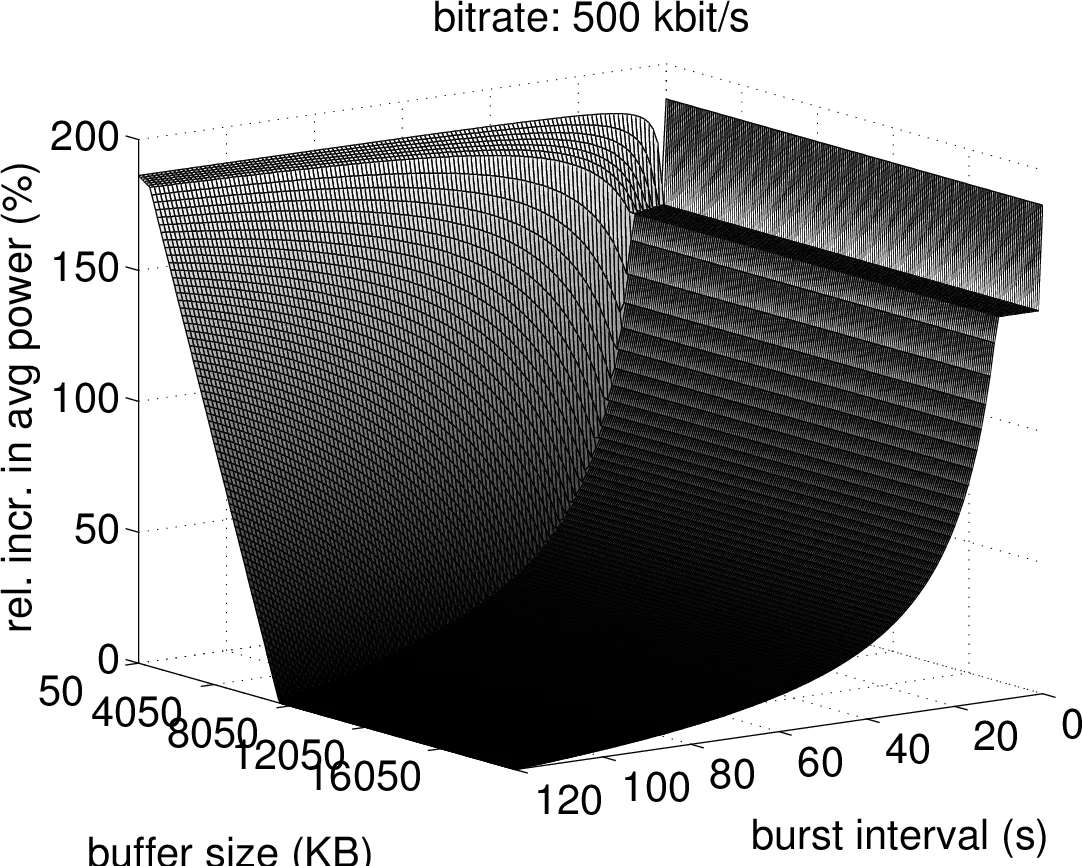
This paper proposes a novel energy-efficient multimedia delivery system called EStreamer. First, we study the relationship between buffer size at the client, burst-shaped TCP-based multimedia traffic, and energy consumption of wireless network interfaces in smartphones. Based on the study, we design and implement EStreamer for constant bit rate and rate-adaptive streaming. EStreamer can improve battery lifetime by 3x, 1.5x and 2x while streaming over Wi-Fi, 3G and 4G respectively.
💡 Research Summary
The paper addresses the growing problem of high power consumption on smartphones when streaming on‑demand multimedia over wireless networks. While Wi‑Fi, 3G (HSPA) and 4G (LTE) interfaces dominate today’s mobile traffic, their radio hardware remains active for most of the streaming session, consuming as much or more energy than the actual media playback. The authors investigate how shaping TCP‑based streaming traffic into periodic bursts interacts with the client’s playback buffer and the TCP receive buffer, and they develop a cross‑layer system, EStreamer, that dynamically selects an energy‑optimal burst size.
First, the authors characterize the power profiles of the three major wireless technologies. Wi‑Fi uses a modified Power‑Saving Mode (PSM‑A) that keeps the radio in an idle state for a fixed interval (≈200 ms) after each transmission, creating a “tail energy” component that dominates overall consumption. HSPA follows an RRC state machine (CELL_DCH → CELL_PCH → IDLE) with timers (T1‑T3) on the order of seconds; long idle periods between bursts cause the radio to stay in high‑power states. LTE has only two RRC states (CONNECTED and IDLE) and a Discontinuous Reception (DRX) mechanism that periodically wakes the radio, dramatically reducing tail energy.
The core analytical contribution is a model linking burst size (B) to the sum of the playback buffer (Bplay) and the TCP receive buffer (Btcp). If B ≤ Bplay + Btcp, the burst can be fully absorbed, after which the radio can transition to a low‑power state, yielding energy savings. If B exceeds this combined buffer space, excess data remains queued, forcing the radio to stay active and causing a sharp rise in power draw. Using this model, the authors derive a heuristic that continuously estimates the optimal B based on real‑time feedback from the client (ACKs and buffer occupancy reports). The server then adapts the burst size on the fly.
EStreamer implements this heuristic for two streaming scenarios. In constant‑bit‑rate (CBR) streaming, the server pre‑computes the appropriate burst interval from the known encoding rate and the client’s buffer capacity. In rate‑adaptive streaming (e.g., DASH, HLS, MSS), the client first estimates the available bandwidth, selects a suitable representation, and the server adjusts the burst size accordingly. Because TCP guarantees delivery, the system can use arbitrarily large bursts without packet loss, unlike earlier UDP‑based burst shaping approaches.
The authors evaluate EStreamer on four commercial smartphones (Android and iOS) using real services such as YouTube, Dailymotion, and Internet radio. Over Wi‑Fi, they achieve up to 65 % power reduction, corresponding to a three‑fold increase in battery life. Over HSPA, with appropriately shortened inactivity timers, they obtain about 38 % savings; over LTE, leveraging DRX, they report 50‑60 % reductions. Importantly, similar gains are observed for adaptive streaming, confirming that the heuristic works across different bit‑rates and content types.
A second line of evaluation focuses on the impact on radio‑access‑network signaling. When the radio transitions to a low‑power state, the device must later re‑establish an RRC connection, generating control messages. In HSPA, shortening the inactivity timers dramatically increases the number of RRC reconnections, potentially leading to signaling storms that have caused network outages in the past. LTE’s DRX mechanism mitigates this problem because the radio can stay in the CONNECTED state while sleeping, reducing the frequency of full reconnections. The paper therefore advises network‑aware tuning of timers and DRX parameters when deploying EStreamer.
In summary, the paper makes three key contributions: (1) a quantitative model of how burst size, client buffer space, and wireless interface power consumption interact for TCP‑based streaming; (2) the design and implementation of EStreamer, a cross‑layer system that uses standard TCP feedback to select energy‑optimal burst sizes, supporting both CBR and adaptive streaming; and (3) a thorough experimental validation showing substantial battery life extensions across Wi‑Fi, 3G, and 4G, together with an analysis of the trade‑off between energy savings and RAN signaling load. The work demonstrates that burst‑shaped TCP streaming, when coupled with dynamic client‑server coordination, can be a practical and standards‑compliant solution for reducing mobile energy consumption without sacrificing user experience.
Comments & Academic Discussion
Loading comments...
Leave a Comment