Duality theorems for etale gerbes on orbifolds
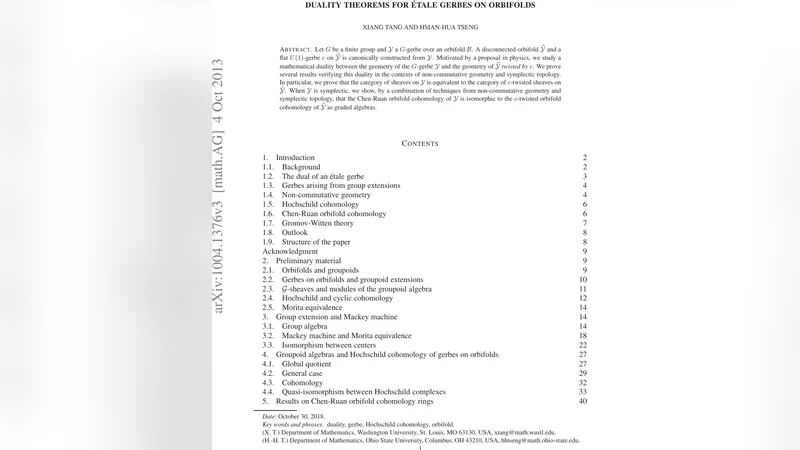
Let $G$ be a finite group and $\Y$ a $G$-gerbe over an orbifold $\B$. A disconnected orbifold $\hat{\Y}$ and a flat U(1)-gerbe $c$ on $\hat{\Y}$ is canonically constructed from $\Y$. Motivated by a proposal in physics, we study a mathematical duality between the geometry of the $G$-gerbe $\Y$ and the geometry of $\hat{\Y}$ {\em twisted by} $c$. We prove several results verifying this duality in the contexts of noncommutative geometry and symplectic topology. In particular, we prove that the category of sheaves on $\Y$ is equivalent to the category of $c$-twisted sheaves on $\hat{\Y}$. When $\Y$ is symplectic, we show, by a combination of techniques from noncommutative geometry and symplectic topology, that the Chen-Ruan orbifold cohomology of $\Y$ is isomorphic to the $c$-twisted orbifold cohomology of $\hat{\Y}$ as graded algebras.
💡 Research Summary
The paper investigates a mathematical incarnation of a duality that originates in physics, relating a finite‑group‑gerbe on an orbifold to a “dual” orbifold equipped with a flat U(1)‑gerbe. Let G be a finite group and let 𝒴 be a G‑gerbe over an orbifold ℬ. From the data of 𝒴 the authors construct a disconnected orbifold Ĥ𝒴 together with a flat U(1)‑gerbe c on Ĥ𝒴. The construction proceeds by decomposing the gerbe’s band G into its irreducible representations; each representation gives rise to a connected component of Ĥ𝒴, while the original gerbe class α∈H²(ℬ,G) is transgressed via Pontryagin duality to a U(1)‑valued 2‑cocycle c∈H²(Ĥ𝒴,U(1)). This mirrors the physical proposal that a B‑field on a space with a G‑bundle should be dual to a twisted sector on the representation‑theoretic “mirror’’ space.
The authors first address the duality at the level of non‑commutative geometry. They model 𝒴 and Ĥ𝒴 by proper étale Lie groupoids 𝔾 and 𝔾̂, respectively, and consider the convolution algebra C_c^∞(𝔾) and the c‑twisted convolution algebra C_c^∞(𝔾̂,c). By constructing an explicit bibundle that simultaneously carries the G‑action on 𝒴 and the representation data on Ĥ𝒴, they prove that these two algebras are Morita equivalent. Consequently, the associated K‑theory, cyclic homology, and other invariants of the non‑commutative spaces coincide.
Next, the paper establishes a categorical equivalence. The abelian category of (quasi‑)coherent sheaves on 𝒴, denoted Coh(𝒴), is shown to be equivalent to the category of c‑twisted sheaves on Ĥ𝒴, Coh_c(Ĥ𝒴). The equivalence is realized by a Fourier–Mukai type transform defined via the same bibundle that yields the Morita equivalence. The authors verify that the transform is fully faithful and essentially surjective, thus giving a concrete bridge between the sheaf theories of the original gerbe and its dual twisted orbifold.
When the gerbe 𝒴 carries a symplectic structure compatible with the G‑action, the authors turn to orbifold cohomology. They compute the Chen–Ruan orbifold cohomology H_CR^(𝒴) and the c‑twisted orbifold cohomology H_CR^(Ĥ𝒴,c). By carefully tracking the age grading on twisted sectors and the contribution of the obstruction bundles, they prove that the two cohomology rings are isomorphic as graded algebras: \
Comments & Academic Discussion
Loading comments...
Leave a Comment