Spherical geometry and integrable systems
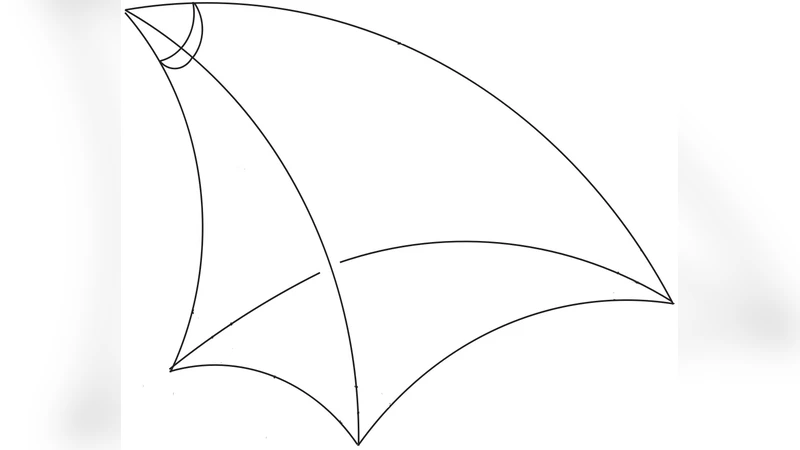
We prove that the cosine law for spherical triangles and spherical tetrahedra defines integrable systems, both in the sense of multidimensional consistency and in the sense of dynamical systems.
💡 Research Summary
The paper establishes that the classical cosine law for spherical triangles and spherical tetrahedra can be interpreted as integrable maps, thereby linking elementary spherical geometry with modern theories of integrable systems. The authors first rewrite the cosine law for a spherical triangle as a nonlinear transformation among the four cosine variables associated with its three angles and the opposite side. This “spherical cosine map” is shown to be three‑dimensionally consistent: when placed on the faces of an elementary cube, applying the map on each face in any order yields the same result on the opposite vertex. This property is the hallmark of multidimensional consistency, a defining feature of discrete integrable equations in the ABS classification, but here it appears with an explicit curvature parameter that distinguishes the spherical case from the flat one.
The analysis is then extended to spherical tetrahedra (4‑simplices). The six cosine variables attached to the faces satisfy a higher‑dimensional analogue of the cosine law, which the authors formulate as a map on the vertices of a 4‑simplex. Remarkably, this tetrahedral map solves the set‑theoretic Yang‑Baxter equation in three dimensions, providing a concrete geometric example of a Yang‑Baxter map. The authors verify directly that the map is 3‑D consistent, confirming that the same global configuration is obtained regardless of the order in which the local tetrahedral relations are imposed.
From a dynamical‑systems viewpoint, the spherical cosine map is interpreted as a time‑step evolution. The authors construct a discrete Lagrangian expressed as a sum of logarithmic‑cosine terms attached to each edge. By applying the discrete variational principle they derive Euler–Lagrange equations that coincide with the map itself, demonstrating that the evolution is variational. Moreover, a Lax pair is exhibited, establishing complete integrability in the sense of the existence of a spectral parameter and an infinite hierarchy of commuting flows. The Poisson structure is identified via a natural Poisson bracket on the cosine variables, leading to Hamiltonian formulations and a set of conserved quantities (e.g., total spherical area, certain combinations of dihedral angles). These invariants confirm that the dynamics is symplectic and preserves geometric measures intrinsic to the sphere.
Finally, the paper discusses the deformation from spherical to planar geometry. By sending the curvature parameter κ → 0, the spherical cosine law reduces to the ordinary planar cosine law, and the associated map collapses to known integrable lattice equations such as the Hirota–Miwa (discrete KP) equation. This limiting process shows that the spherical cosine maps provide a one‑parameter family interpolating between flat and curved integrable systems, thereby furnishing a geometric bridge between classical spherical trigonometry and modern discrete integrable models.
The authors conclude that the cosine laws of spherical triangles and tetrahedra constitute a rare example of a system that simultaneously satisfies multidimensional consistency, the Yang‑Baxter equation, and possesses a full Lagrangian–Hamiltonian structure. This insight opens new avenues for exploring integrable dynamics on curved manifolds, quantization of geometric maps, and potential applications in physics, such as spin‑chain models on curved spaces or discretizations of curved sigma‑models.