Markov properties for mixed graphs
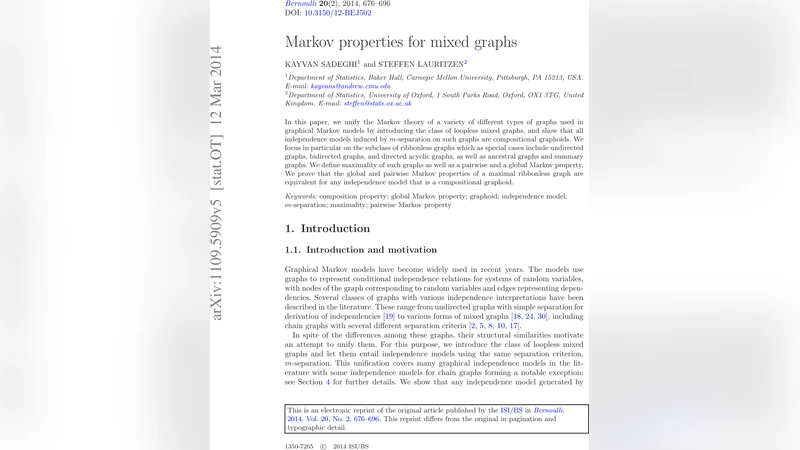
In this paper, we unify the Markov theory of a variety of different types of graphs used in graphical Markov models by introducing the class of loopless mixed graphs, and show that all independence models induced by $m$-separation on such graphs are compositional graphoids. We focus in particular on the subclass of ribbonless graphs which as special cases include undirected graphs, bidirected graphs, and directed acyclic graphs, as well as ancestral graphs and summary graphs. We define maximality of such graphs as well as a pairwise and a global Markov property. We prove that the global and pairwise Markov properties of a maximal ribbonless graph are equivalent for any independence model that is a compositional graphoid.
💡 Research Summary
The paper presents a unifying framework for a wide variety of graphical Markov models by introducing the class of loopless mixed graphs (LMGs) and focusing on a particularly rich subclass called ribbonless graphs. An LMG is a mixed graph that may contain directed edges (arrows), bidirected edges (arcs), and undirected edges (lines) but forbids loops (edges that connect a node to itself). This modest restriction retains the expressive power needed for most statistical dependence structures while simplifying the underlying graph theory.
The authors adopt the m‑separation criterion as a single separation rule applicable to all LMGs. m‑separation generalizes the familiar d‑separation of directed acyclic graphs (DAGs) and the separation rule for undirected graphs by distinguishing colliders from non‑colliders along any path and by specifying how conditioning on a set of nodes blocks or opens paths. They prove that, for any LMG, the independence model induced by m‑separation satisfies all six axioms of a compositional graphoid: symmetry, decomposition, weak union, contraction, intersection, and composition. Consequently, any probabilistic model that is faithful to an LMG (for example, a regular multivariate Gaussian) automatically yields a compositional graphoid, guaranteeing that the usual inference rules of graphical models hold.
Ribbonless graphs are defined as LMGs that contain no “ribbons”—configurations where two undirected edges share a collider without being directly connected. This subclass is broad enough to encompass undirected graphs, bidirected graphs, DAGs, ancestral graphs, and summary graphs. By focusing on ribbonless graphs the authors can exploit additional structural properties while still covering most models used in practice.
A central contribution is the notion of maximality for ribbonless graphs. A ribbonless graph is maximal if adding any missing edge changes the induced independence model (i.e., creates a new conditional independence). The paper shows that not every ribbonless graph is maximal and provides necessary and sufficient conditions for maximality. Maximality is crucial because it ensures that the set of missing edges precisely encodes all conditional independences represented by the graph.
The main theorem (Theorem 6.1) establishes the equivalence of the pairwise Markov property and the global Markov property for any maximal ribbonless graph whose independence model is a compositional graphoid. The pairwise property states that a missing edge between two nodes i and j implies conditional independence of i and j given the set of their common ancestors (or a suitable separating set). The global property asserts that for any disjoint node sets A, B, and C, A is independent of B given C whenever every path from A to B is blocked by C according to m‑separation. The proof proceeds in two directions:
-
Global ⇒ Pairwise: This direction is straightforward because the global property applies to all subsets, including the special case of two singletons.
-
Pairwise ⇒ Global: Here the authors leverage the compositional graphoid axioms, especially composition and intersection, to show that the collection of pairwise independences implied by missing edges generates the full independence model. They also use the concept of anterior paths (paths consisting only of lines and arrows that respect the directionality) and the ribbonless condition to control how colliders can appear, ensuring that any potential unblocked path can be blocked by an appropriate conditioning set derived from the graph’s structure.
The equivalence result has important practical implications. In a maximal ribbonless graph, one can read off all conditional independences directly from the missing edges without having to perform exhaustive m‑separation checks. This greatly simplifies model specification, learning, and interpretation, especially in high‑dimensional settings where the number of possible conditioning sets is combinatorial.
Overall, the paper makes three major contributions:
-
Theoretical Unification – By introducing LMGs and the m‑separation rule, it provides a single, coherent language for a wide spectrum of graphical models that were previously treated separately.
-
Structural Insight – The ribbonless subclass and the maximality concept clarify exactly when the graph’s visual structure faithfully represents the underlying independence model.
-
Markov Property Equivalence – Proving that pairwise and global Markov properties coincide under compositional graphoid assumptions gives a solid foundation for using missing edges as a complete summary of conditional independences.
The work opens several avenues for future research, including extending the framework to non‑compositional independence models, developing efficient algorithms for constructing maximal ribbonless graphs from data, and applying the theory to complex real‑world problems involving latent variables, mixed data types, or causal inference.
Comments & Academic Discussion
Loading comments...
Leave a Comment