Pairwise alignment of the DNA sequence using hypercomplex number representation
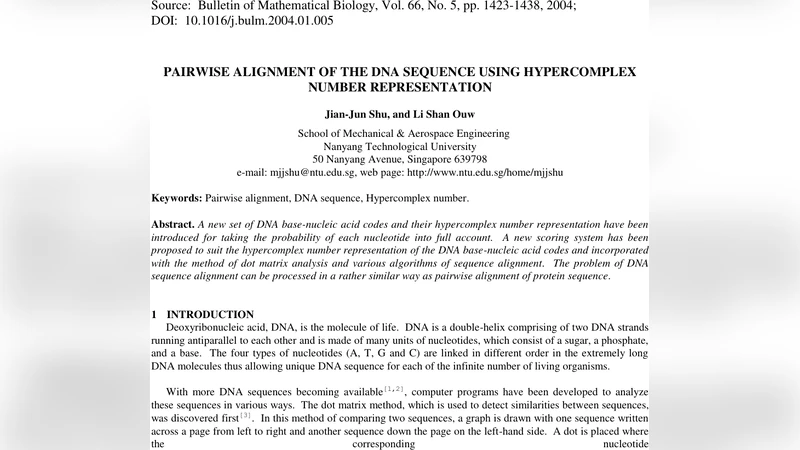
A new set of DNA base-nucleic acid codes and their hypercomplex number representation have been introduced for taking the probability of each nucleotide into full account. A new scoring system has been proposed to suit the hypercomplex number representation of the DNA base-nucleic acid codes and incorporated with the method of dot matrix analysis and various algorithms of sequence alignment. The problem of DNA sequence alignment can be processed in a rather similar way as pairwise alignment of protein sequence.
💡 Research Summary
**
The paper introduces a novel framework for DNA sequence alignment that leverages a four‑dimensional hypercomplex (vector) representation of nucleotides and mixed‑base codes, together with a dot‑product based scoring scheme and a tunable truncation threshold for dot‑matrix construction.
First, the authors map each of the 16 IUPAC symbols (A, T, G, C and the mixed codes W, R, M, K, Y, S, D, H, V, B, N) to a 4‑component real vector (z₁, z₂, z₃, z₄). The components correspond to the probabilities of observing A, T, G, and C respectively, and they sum to one. For example, “W” (A or T) becomes (½,½,0,0) and “N” (any base) becomes (¼,¼,¼,¼). This probabilistic encoding captures the inherent ambiguity of mixed codes, which traditional character‑based alignments cannot handle directly.
In the dot‑matrix stage, the inner product of the two vectors at each pair of positions is computed. The inner product lies between 0 and 1; a user‑defined truncation value (threshold) determines whether a dot is placed. Raising the threshold yields a more stringent matrix that only displays high‑probability matches, while lowering it increases sensitivity at the cost of noise. The authors illustrate this effect with two thresholds (3.0 and 5.0) on a sample pair of sequences, showing how the density of dots changes.
To convert inner products into alignment scores, the authors linearly scale the dot product to an integer range of 5–15 (score = 20·dot – 5, rounded) and adopt a constant gap penalty of 8. The resulting scoring matrix (Figure 3) can be plugged directly into classic dynamic‑programming algorithms such as Needleman‑Wunsch (global) and Smith‑Waterman (local).
Using a single illustrative DNA pair, the paper demonstrates:
- Global alignment yields a total score of 14 and a specific optimal alignment.
- Local alignment finds a highest cell score of 38, producing the subsequence “BYMARHCHMWWAGATAT‑”.
- Repeated‑match (threshold‑based) alignment with T = 20 captures many regions, whereas T = 40 isolates only the most reliable short segment.
- Overlap alignment with a threshold of 20 reproduces the same optimal subsequence as the local case, confirming that the method can detect overlapping regions.
The key insight is that the hypercomplex representation together with a tunable truncation value gives the analyst direct control over the trade‑off between sensitivity (detecting weak, probabilistic matches) and specificity (focusing on strong, high‑confidence matches). Because the representation is numeric, the dot product naturally incorporates the probability of each base, turning the binary “match/no‑match” paradigm into a graded similarity measure.
However, the study has notable limitations. The probability vectors assume equal base frequencies (each component ¼ for a pure base, ½ for a two‑base mix, etc.), which does not reflect organism‑specific nucleotide bias. The linear scaling of inner products to a coarse integer score may discard subtle differences in similarity. Experimental validation is confined to a single short sequence pair; scalability, computational complexity, and performance on large genomic datasets remain untested. Moreover, the choice of truncation threshold is heuristic; the paper does not propose an automated method for optimal threshold selection.
In conclusion, the authors successfully extend traditional dot‑matrix and dynamic‑programming alignment methods by embedding a probabilistic hypercomplex encoding of DNA symbols. This approach offers a flexible, mathematically elegant way to handle ambiguous nucleotides and to adjust alignment stringency. Future work should focus on refining the probability model (e.g., using empirical base frequencies), evaluating the method on large‑scale data, and developing systematic strategies for threshold optimization.
Comments & Academic Discussion
Loading comments...
Leave a Comment