Attainability in Repeated Games with Vector Payoffs
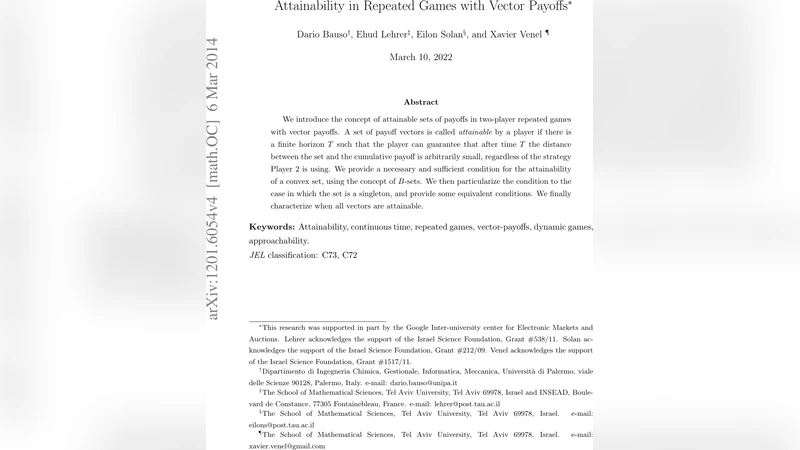
We introduce the concept of attainable sets of payoffs in two-player repeated games with vector payoffs. A set of payoff vectors is called {\em attainable} if player 1 can ensure that there is a finite horizon $T$ such that after time $T$ the distance between the set and the cumulative payoff is arbitrarily small, regardless of what strategy player 2 is using. This paper focuses on the case where the attainable set consists of one payoff vector. In this case the vector is called an attainable vector. We study properties of the set of attainable vectors, and characterize when a specific vector is attainable and when every vector is attainable.
💡 Research Summary
The paper introduces a novel notion of “attainability” for two‑player repeated games with vector‑valued stage payoffs. While Blackwell’s classic approachability theory concerns the convergence of average payoffs to a target set, attainability asks whether player 1 can guarantee that the cumulative payoff vector will, after some finite horizon, lie arbitrarily close to a prescribed set, regardless of player 2’s actions. The authors focus on the simplest non‑trivial case: the target set consists of a single vector (v\in\mathbb{R}^d). Such a vector is called an attainable vector.
The model is standard: each period (t) both players choose actions (a_t^1\in A_1) and (a_t^2\in A_2) (finite sets), generating a bounded payoff vector (g(a_t^1,a_t^2)). Strategies may depend on the entire history. The cumulative payoff up to time (T) is (G_T=\sum_{t=1}^T g(a_t^1,a_t^2)). A set (C) is attainable if for every (\varepsilon>0) there exist a horizon (T) and a strategy for player 1 such that, no matter how player 2 plays, (\text{dist}(G_T, C)\le\varepsilon). When (C={v}) we speak of an attainable vector.
The first main result provides a necessary and sufficient condition for a given vector (v) to be attainable. Define the stage‑payoff cone (\operatorname{cone}(G)={\lambda g : \lambda\ge0,; g\in G}) where (G={g(a^1,a^2): a^1\in A_1, a^2\in A_2}). Theorem 1 states that (v) is attainable iff (v) belongs to (\operatorname{cone}(G)). Intuitively, if (v) lies outside the cone generated by the stage payoffs, player 2 can always push the cumulative payoff away from any scalar multiple of (v). Conversely, if (v) is inside the cone, player 1 can construct a mixed action at each stage that yields an expected payoff pointing in the direction of (v). By solving a linear program (or equivalently a zero‑sum matrix game) that maximizes the projection of the expected payoff onto (v), player 1 obtains a guaranteed positive gain in the (v) direction each period. Repeating this for a sufficiently large number of periods produces a cumulative payoff arbitrarily close to a scalar multiple of (v); scaling the horizon yields closeness to (v) itself.
The second major contribution characterizes games in which every vector in (\mathbb{R}^d) is attainable. Theorem 2 shows that this holds precisely when the stage‑payoff set spans the whole space and, for every unit direction (u\in S^{d-1}), the min‑max value (\max_{a^1}\min_{a^2} u\cdot g(a^1,a^2)) is strictly positive. In other words, in every direction there exists a mixed action for player 1 that guarantees a positive component of the payoff, no matter how player 2 responds. Under this “global positivity” condition, player 1 can, for any target vector (v), first decompose (v) as a positive linear combination of a finite number of stage payoff vectors (possible because the cone is the whole space) and then follow the corresponding mixed actions for a suitably long horizon. The cumulative payoff then tracks the desired vector with arbitrarily small error.
The paper also discusses several illustrative examples. In a two‑dimensional game with payoff vectors forming a convex polygon, the cone condition can be visualized: vectors inside the polygon’s convex hull are attainable, those outside are not. A network routing application is presented where each period’s vector records delay, loss, and bandwidth consumption; attainability guarantees that after a finite number of packets the aggregate performance can be driven arbitrarily close to any feasible QoS vector, provided the underlying routing actions satisfy the global positivity condition.
Methodologically, the authors rely on linear programming duality, the minimax theorem for finite zero‑sum games, and elementary convex geometry. The proofs are constructive: they explicitly describe how to compute the mixed strategies that achieve the required directional gains, which makes the results potentially useful for algorithmic implementation.
The discussion section acknowledges limitations. The analysis assumes undiscounted cumulative payoffs and finite action sets; extending the framework to discounted or stochastic transition structures would require new techniques. Moreover, the paper leaves open the multi‑player case and settings with partial monitoring, where the definition of attainability may need to incorporate information constraints.
In summary, the work enriches the theory of repeated games by shifting focus from average to cumulative outcomes, provides clean geometric characterizations of when a vector can be forced into the cumulative payoff, and identifies a strong condition under which the game is fully controllable in the vector sense. These insights open avenues for applications in multi‑objective control, resource allocation, and any domain where long‑run aggregate performance across several criteria must be guaranteed despite adversarial disturbances.
Comments & Academic Discussion
Loading comments...
Leave a Comment