A further generalization of the colourful Caratheodory theorem
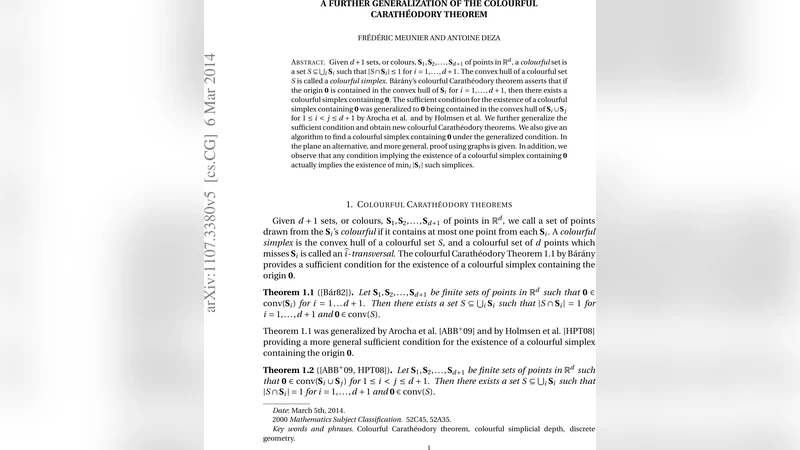
Given $d+1$ sets, or colours, $S_1, S_2,…,S_{d+1}$ of points in $\mathbb{R}^d$, a {\em colourful} set is a set $S\subseteq\bigcup_i S_i$ such that $|S\cap S_i|\leq 1$ for $i=1,…,d+1$. The convex hull of a colourful set $S$ is called a {\em colourful simplex}. B'ar'any’s colourful Carath'eodory theorem asserts that if the origin 0 is contained in the convex hull of $S_i$ for $i=1,…,d+1$, then there exists a colourful simplex containing 0. The sufficient condition for the existence of a colourful simplex containing 0 was generalized to 0 being contained in the convex hull of $S_i\cup S_j$ for $1\leq i< j \leq d+1$ by Arocha et al. and by Holmsen et al. We further generalize the sufficient condition and obtain new colourful Carath'eodory theorems. We also give an algorithm to find a colourful simplex containing 0 under the generalized condition. In the plane an alternative, and more general, proof using graphs is given. In addition, we observe that any condition implying the existence of a colourful simplex containing 0 actually implies the existence of $\min_i|S_i|$ such simplices.
💡 Research Summary
The paper investigates extensions of the colourful Carathéodory theorem, a cornerstone of discrete geometry that guarantees the existence of a colourful simplex (the convex hull of one point from each of d + 1 colour classes) containing the origin whenever the origin lies in the convex hull of each colour class individually. Earlier work by Arocha et al. (2009) and Holmsen et al. (2008) weakened the hypothesis to require the origin to belong to the convex hull of every pairwise union S_i ∪ S_j.
The authors push this line further by introducing a new, strictly weaker sufficient condition. Their main result (Theorem 1.3) states that for every unordered pair of colours (i, j) there must exist a third colour k ≠ i, j such that, for every point x_k in S_k, the convex hull of S_i ∪ S_j meets the ray from x_k towards the origin in a point different from x_k. This “ray‑intersection” condition can be checked by solving a linear‑program feasibility problem, thus it is polynomial‑time verifiable.
Under a general‑position assumption the authors present a stronger formulation (Theorem 1.4). They define a b_i‑transversal as a set of d points each taken from a distinct colour other than i. For any i ≠ j they require that (S_i ∪ S_j) intersect the open half‑space H⁺(T_j) determined by the affine hull of a j‑transversal T_j and containing the origin. This geometric condition translates into a combinatorial structure: an abstract (d‑1)‑pseudomanifold M built from pairs of transversals. By analysing the parity of intersections between a ray emanating from the origin and M, they prove that the ray must intersect M exactly once, which yields a colourful d‑simplex containing the origin.
In the planar case (d = 2) they give an alternative proof (Theorem 1.5) using directed graphs. Vertices are the points of the three colour classes, and an edge is oriented so that the origin lies to the right of its supporting line. Every vertex has both an incoming and an outgoing edge, guaranteeing a directed cycle. The shortest cycle has length three or four; a length‑three cycle directly gives a colourful triangle containing the origin, while a length‑four cycle (necessarily 2‑coloured) together with a vertex of the missing colour also yields such a triangle. This combinatorial argument does not yet extend to higher dimensions.
Algorithmically, the paper shows how to exploit Theorem 1.3: for each pair (i, j) one checks the ray‑intersection condition via linear programming, constructs appropriate transversals, builds the pseudomanifold M, and finally extracts a colourful simplex by following the unique intersection of a generic ray with M. The whole procedure runs in polynomial time.
A further observation (stated after the main theorems) is that any condition sufficient for the existence of a colourful simplex actually guarantees at least min_i|S_i| distinct colourful simplices containing the origin. This links the results to the notion of colourful simplicial depth and suggests that stronger conditions yield a larger family of such simplices.
The authors illustrate the hierarchy of conditions with several examples (e.g., the configuration S⁴_d where each colour is clustered near a vertex of a simplex containing the origin). Some configurations satisfy the new theorems while failing the older ones, demonstrating the genuine strengthening.
Finally, the paper situates its contributions within the broader context of the colourful feasibility problem, a TFNP problem for which the existence of a solution is guaranteed but the computational complexity remains open. The authors note that their algorithm falls into the PPA (Polynomial Parity Argument) subclass, echoing recent complexity‑theoretic work on related geometric fixed‑point problems.
In summary, the work delivers a substantially weaker sufficient condition for colourful Carathéodory, provides both topological and combinatorial proofs, presents a concrete polynomial‑time algorithm, and highlights an intrinsic multiplicity of solutions, thereby advancing both the theory and algorithmic practice of colourful convex geometry.
Comments & Academic Discussion
Loading comments...
Leave a Comment