Leveraging Semantic Web Technologies for Managing Resources in a Multi-Domain Infrastructure-as-a-Service Environment
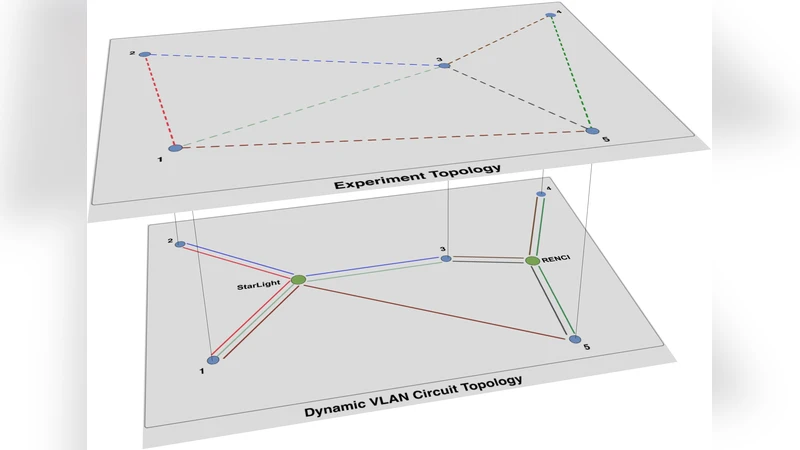
This paper reports on experience with using semantically-enabled network resource models to construct an operational multi-domain networked infrastructure-as-a-service (NIaaS) testbed called ExoGENI, recently funded through NSF’s GENI project. A defining property of NIaaS is the deep integration of network provisioning functions alongside the more common storage and computation provisioning functions. Resource provider topologies and user requests can be described using network resource models with common base classes for fundamental cyber-resources (links, nodes, interfaces) specialized via virtualization and adaptations between networking layers to specific technologies. This problem space gives rise to a number of application areas where semantic web technologies become highly useful - common information models and resource class hierarchies simplify resource descriptions from multiple providers, pathfinding and topology embedding algorithms rely on query abstractions as building blocks. The paper describes how the semantic resource description models enable ExoGENI to autonomously instantiate on-demand virtual topologies of virtual machines provisioned from cloud providers and are linked by on-demand virtual connections acquired from multiple autonomous network providers to serve a variety of applications ranging from distributed system experiments to high-performance computing.
💡 Research Summary
The paper presents the design, implementation, and operational experience of ExoGENI, a multi‑domain Infrastructure‑as‑a‑Service (NIaaS) testbed that tightly integrates network provisioning with compute and storage services. The authors argue that traditional IaaS clouds expose compute and storage via well‑defined APIs, but network resources are usually provisioned implicitly. In contrast, NIaaS requires explicit, on‑demand virtualization of network links with QoS guarantees (bandwidth, latency, jitter), which is essential for many distributed experiments and high‑performance computing workloads.
To manage heterogeneous resources from multiple providers, the authors adopt Semantic Web technologies. They start from the Network Description Language (NDL), an RDFS ontology based on the ITU‑T G.805 model, and re‑define it as an OWL‑DL ontology called NDL‑OWL. OWL‑DL provides richer class hierarchies, property constraints, and reasoning capabilities, allowing each provider to extend the core vocabulary with domain‑specific classes while preserving a common abstract model for links, nodes, interfaces, and virtualization constructs.
ExoGENI’s control plane is built on ORCA (Open Resource Control Architecture), a distributed orchestration framework composed of several actor types: Aggregate Managers (AMs) that represent individual providers, a Broker that coordinates inter‑domain allocations, and Controllers that receive user slice requests. Communication among actors is performed via internal web services that exchange RDF‑XML documents. Four principal data models are defined:
- Substrate Description Model – detailed description of a provider’s physical and virtual resources.
- Substrate Delegation Model – a compressed, privacy‑preserving view of the substrate used for inter‑domain path‑finding.
- Slice Request Model – the user’s desired virtual topology, including compute nodes, storage, virtual links, and QoS attributes.
- Slice Manifest Model – the concrete instantiation of a slice, mapping request elements to specific provider resources.
The orchestration workflow proceeds as follows: providers upload Substrate Descriptions to their AMs; AMs transform them into Substrate Delegations and forward them to the Broker. When a user submits a Slice Request, the Controller queries the Broker for available resources using SPARQL. The queries perform sub‑graph extraction, constraint checking, and topology embedding, often augmented by OWL reasoning (Pellet, Hermit) and Datalog‑like rule inference. Once a feasible mapping is found, the Controller generates a Slice Manifest, which is then used by the AMs to provision virtual machines, storage, and network links in parallel. All actors update their A‑Box assertions to reflect the current state, and the final manifest is returned to the user as RDF‑XML.
Key technical benefits highlighted include:
- Declarative resource description – a shared ontology eliminates the need for provider‑specific parsers and enables portable algorithms.
- Query‑driven algorithms – SPARQL abstracts common operations (path extraction, constraint satisfaction) allowing reuse and automatic optimization similar to database systems.
- Rule‑based reasoning – Datalog‑style rules provide a high‑level, verifiable way to encode policies such as bandwidth guarantees or adaptation constraints.
- Standard toolchain – the use of Jena, Protegé, and mature reasoners leverages existing, well‑tested software for parsing, inference, and validation.
The authors also discuss operational challenges. The static ontology (≈6,500 triples, 1,500 classes) is merged at runtime with dynamic A‑Box assertions whose size grows linearly with the number of hardware elements. To keep performance acceptable, ORCA uses Jena’s in‑memory model with caching and incremental updates. However, providers currently must manually author RDF descriptions using tools like Protegé, indicating a need for automated discovery and translation mechanisms.
During two years of limited operation, ExoGENI has served over 5,000 slices to more than 100 unique users across globally distributed sites, supporting experiments in distributed systems, networking research, and high‑performance computing. The semantic‑driven approach proved effective for multi‑domain path finding, topology embedding, and policy enforcement, while keeping the orchestration logic relatively simple and extensible.
In conclusion, the paper demonstrates that Semantic Web technologies—RDF, OWL‑DL, SPARQL, and rule engines—provide a powerful foundation for modeling, querying, and reasoning about heterogeneous compute, storage, and network resources in a federated NIaaS environment. Future work is suggested in automating ontology generation, scaling reasoning for larger federations, and defining standard interfaces that bridge cloud and network orchestration layers.
Comments & Academic Discussion
Loading comments...
Leave a Comment