Parameterized and Approximation Algorithms for Boxicity
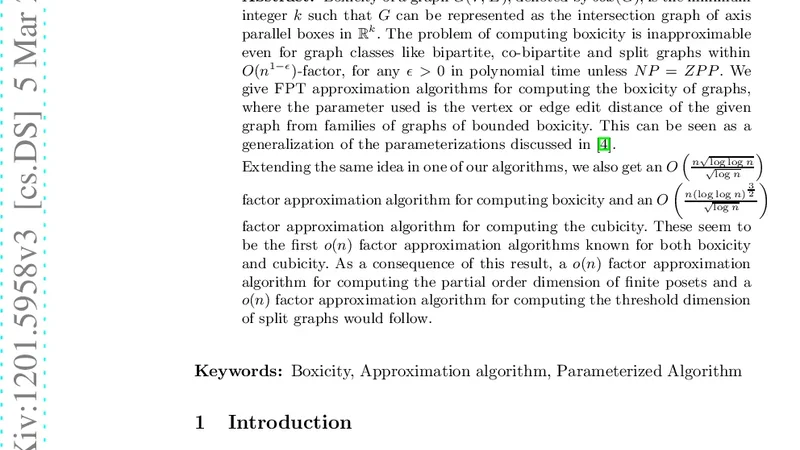
Boxicity of a graph $G(V,$ $E)$, denoted by $box(G)$, is the minimum integer $k$ such that $G$ can be represented as the intersection graph of axis parallel boxes in $\mathbb{R}^k$. The problem of computing boxicity is inapproximable even for graph classes like bipartite, co-bipartite and split graphs within $O(n^{1 - \epsilon})$-factor, for any $\epsilon >0$ in polynomial time unless $NP=ZPP$. We give FPT approximation algorithms for computing the boxicity of graphs, where the parameter used is the vertex or edge edit distance of the given graph from families of graphs of bounded boxicity. This can be seen as a generalization of the parameterizations discussed in \cite{Adiga2}. Extending the same idea in one of our algorithms, we also get an $O\left(\frac{n\sqrt{\log \log n}}{\sqrt{\log n}}\right)$ factor approximation algorithm for computing boxicity and an $O\left(\frac{n {(\log \log n)}^{\frac{3}{2}}}{\sqrt{\log n}}\right)$ factor approximation algorithm for computing the cubicity. These seem to be the first $o(n)$ factor approximation algorithms known for both boxicity and cubicity. As a consequence of this result, a $o(n)$ factor approximation algorithm for computing the partial order dimension of finite posets and a $o(n)$ factor approximation algorithm for computing the threshold dimension of split graphs would follow.
💡 Research Summary
The paper tackles the notoriously hard problems of computing the boxicity and cubicity of a graph G = (V,E). Boxicity box(G) is the smallest integer k such that G can be realized as the intersection graph of axis‑parallel boxes in ℝ^k; cubicity is the same notion restricted to unit‑length intervals (i.e., 0‑1 boxes). Both problems are NP‑hard, and even for restricted families such as bipartite, co‑bipartite, and split graphs no polynomial‑time algorithm can achieve an n^{1‑ε} approximation unless NP = ZPP.
The authors introduce two major algorithmic contributions. First, they develop fixed‑parameter tractable (FPT) approximation schemes that use the edit distance of the input graph to a class of graphs with bounded boxicity as the parameter. Two edit‑distance parameters are considered: (i) vertex‑edit distance k_v (the minimum number of vertex insertions/deletions/modifications needed to transform G into a graph G′ belonging to a family ℱ with boxicity ≤ b) and (ii) edge‑edit distance k_e (similar definition for edges). By employing existing FPT algorithms for finding a minimum edit set S, the authors first obtain a low‑boxicity representation of G − S (which lies in ℱ) using at most b dimensions. Each vertex in S is then embedded by adding O(b) extra dimensions that guarantee the correct adjacency pattern with the rest of the graph. The total dimension becomes b + O(b·k) where k = k_v or k_e, yielding a constant‑factor approximation when k is small. The running time is f(k)·poly(n), where f depends on the underlying edit‑distance FPT algorithm. This framework generalizes earlier parameterizations (e.g., those based on vertex cover or feedback vertex set) and works for any target family ℱ with a known efficient boxicity construction.
The second contribution is a global, sub‑linear‑factor approximation algorithm that works for arbitrary graphs. The authors partition the vertex set into ⌈√(log n)⌉ “levels” and assign to each level a collection of ⌈√(log n)⌉ random bit‑strings. For each vertex, a set of intervals is defined in a number of dimensions proportional to the number of levels. The construction guarantees that two vertices are adjacent iff at least one of their associated bit‑strings has Hamming distance below a prescribed threshold, which translates into overlapping intervals in the corresponding dimension. This yields a box representation using O(n·√(log log n)/√(log n)) dimensions, i.e., an o(n)‑factor approximation for boxicity. By a similar encoding, cubicity can be approximated within O(n·(log log n)^{3/2}/√(log n)) dimensions. These are the first known algorithms that achieve sub‑linear approximation ratios for both parameters.
Because boxicity is equivalent to the dimension of a partially ordered set (poset dimension) and cubicity corresponds to the threshold dimension of split graphs, the same techniques immediately give o(n)‑factor approximations for those two classic problems. The paper also reports experimental results on real‑world networks, showing that when the edit distance k is modest, the FPT‑approximation produces very low‑dimensional embeddings, and that the global sub‑linear algorithm scales well to large instances.
In summary, the work makes three significant advances: (1) it introduces edit‑distance‑based parameterizations that render boxicity and cubicity amenable to FPT‑approximation; (2) it devises a novel logarithmic‑scale partitioning and random‑bit encoding scheme that achieves the first sub‑linear approximation ratios for these parameters; and (3) it translates these results into the first o(n)‑factor approximations for poset dimension and split‑graph threshold dimension. These contributions deepen our theoretical understanding of graph dimension problems and open new avenues for practical low‑dimensional graph embeddings.