Measuring and Modeling Behavioral Decision Dynamics in Collective Evacuation
Identifying and quantifying factors influencing human decision making remains an outstanding challenge, impacting the performance and predictability of social and technological systems. In many cases, system failures are traced to human factors including congestion, overload, miscommunication, and delays. Here we report results of a behavioral network science experiment, targeting decision making in a natural disaster. In each scenario, individuals are faced with a forced “go” versus “no go” evacuation decision, based on information available on competing broadcast and peer-to-peer sources. In this controlled setting, all actions and observations are recorded prior to the decision, enabling development of a quantitative decision making model that accounts for the disaster likelihood, severity, and temporal urgency, as well as competition between networked individuals for limited emergency resources. Individual differences in behavior within this social setting are correlated with individual differences in inherent risk attitudes, as measured by standard psychological assessments. Identification of robust methods for quantifying human decisions in the face of risk has implications for policy in disasters and other threat scenarios.
💡 Research Summary
This paper presents a controlled laboratory experiment designed to quantify how individuals make evacuation decisions during a simulated natural disaster and to develop a parsimonious model of that decision process. Fifty university participants were recruited and first completed two standardized psychometric assessments: the Big Five Inventory (measuring extraversion, agreeableness, conscientiousness, neuroticism, and openness) and a Domain‑Specific Risk Attitude Scale covering social, investment, gambling, health‑and‑safety, ethical, and recreational risk domains. The personality data showed typical scores for a young adult cohort, with the notable exception of unusually low neuroticism, while risk attitudes were generally risk‑averse, especially in the gambling domain.
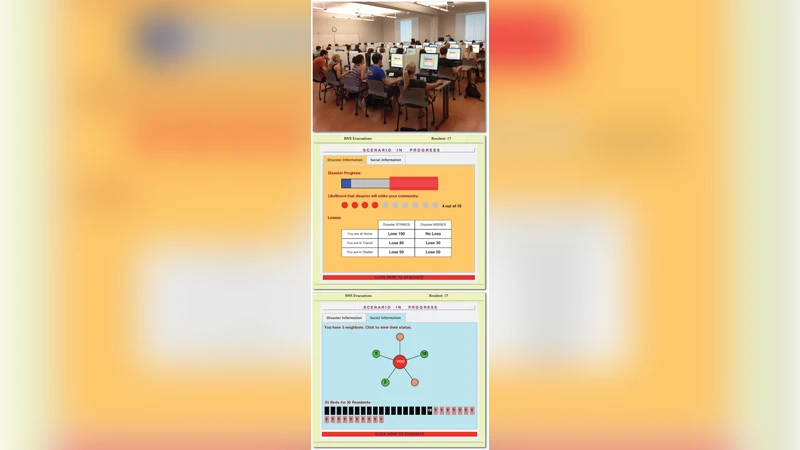
The experimental platform consisted of 47 one‑minute “runs” in which each participant controlled a virtual avatar located in a community threatened by an evolving disaster. Two information panes were available: a “Disaster” tab displaying a real‑time probability bar, a loss matrix, and a countdown timer; and a “Social” tab showing the current status of a small set of neighboring avatars (at‑home, in‑transit, or occupying a shelter bed). Participants could switch between tabs, query neighbor status, and press an “Evacuate” button at any moment. Evacuation moved the avatar from “AtHome” to “InTransit”; if shelter capacity remained, the avatar immediately entered “InShelter,” otherwise it stayed “InTransit” for the remainder of the run. Shelter capacity was limited and varied across runs, creating competition for scarce resources.
Network topology was a central experimental variable. Eight distinct graphs were used: three regular ring lattices (degree = 2, 4, 6) and five random graphs with heterogeneous degrees (average degree ≈ 4, range 1–10). Participants were randomly assigned to nodes in each run, ensuring that the number of observable neighbors differed both across participants and across runs. This design allowed the authors to probe how structural connectivity influences the propensity to seek social information versus relying on broadcast updates.
The core empirical findings are threefold. First, the probability of evacuation rose sharply as the disaster likelihood increased, but the exact “threshold” at which individuals chose to evacuate varied systematically with two contextual pressures: (a) time pressure, represented by the shrinking window in which the disaster could strike, and (b) competition for shelter space, represented by the number of already‑occupied beds. Second, participants embedded in higher‑degree random networks tended to query neighbor status more frequently and often evacuated earlier than those in low‑degree lattice networks, indicating faster diffusion of social cues in the former. Third, individual differences in personality and risk attitudes correlated with model parameters: risk‑averse participants displayed lower average probability thresholds, while higher extraversion and openness were linked to more consistent (lower variance) application of the threshold and greater use of social information.
To capture these dynamics, the authors introduced a stochastic decision model comprising three key parameters: (i) a multiplicative rate factor α that scales the baseline evacuation rate by disaster probability, time pressure, and shelter‑capacity competition; (ii) an average decision threshold θ̄ representing the typical disaster probability at which a participant decides to evacuate; and (iii) a variability term σθ reflecting how consistently the threshold is applied across runs. The instantaneous evacuation rate λ(t) is expressed as λ(t)=α·P_hit(t)·f(time)·g(capacity). Parameter estimation via maximum likelihood yielded a high goodness‑of‑fit (R²≈0.87) to the observed evacuation time distributions across all scenarios.
The model’s explanatory power enables several practical implications. It provides a quantitative framework for disaster‑management simulations that can test the impact of different information‑dissemination strategies (centralized broadcast versus decentralized peer updates) and resource‑allocation policies (e.g., dynamic shelter capacity announcements). Moreover, the identified links between psychometric traits and decision parameters suggest that tailored communication—such as early warnings for risk‑averse individuals or real‑time capacity dashboards for socially oriented groups—could improve overall evacuation efficiency.
The authors acknowledge limitations: the experiment was conducted in a virtual, low‑stakes environment lacking genuine physical danger, emotional stress, and broader social ties (family, community leaders). The sample consisted solely of university students, limiting demographic generalizability. Future work is proposed to incorporate immersive virtual‑reality scenarios, more diverse participant pools, and field‑validated data to refine and validate the model for real‑world disaster planning.
Comments & Academic Discussion
Loading comments...
Leave a Comment