Beyond the Vizings bound for at most seven colors
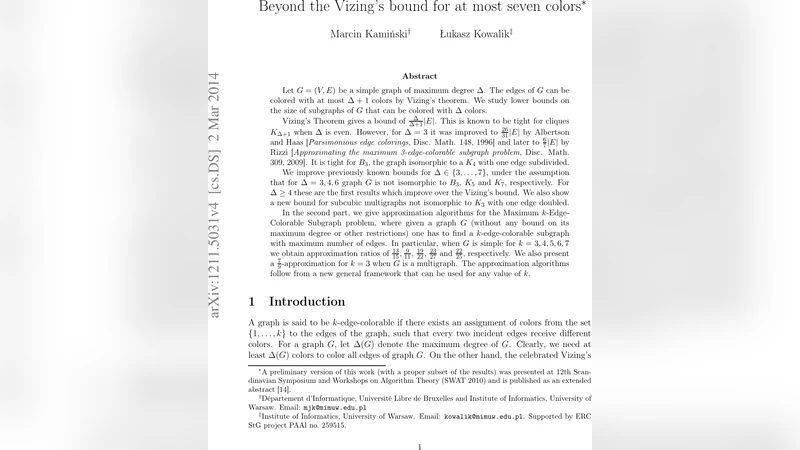
Let $G=(V,E)$ be a simple graph of maximum degree $\Delta$. The edges of $G$ can be colored with at most $\Delta +1$ colors by Vizing’s theorem. We study lower bounds on the size of subgraphs of $G$ that can be colored with $\Delta$ colors. Vizing’s Theorem gives a bound of $\frac{\Delta}{\Delta+1}|E|$. This is known to be tight for cliques $K_{\Delta+1}$ when $\Delta$ is even. However, for $\Delta=3$ it was improved to $26/31|E|$ by Albertson and Haas [Parsimonious edge colorings, Disc. Math. 148, 1996] and later to $6/7|E|$ by Rizzi [Approximating the maximum 3-edge-colorable subgraph problem, Disc. Math. 309, 2009]. It is tight for $B_3$, the graph isomorphic to a $K_4$ with one edge subdivided. We improve previously known bounds for $\Delta\in{3,…,7}$, under the assumption that for $\Delta=3,4,6$ graph $G$ is not isomorphic to $B_3$, $K_5$ and $K_7$, respectively. For $\Delta \geq 4$ these are the first results which improve over the Vizing’s bound. We also show a new bound for subcubic multigraphs not isomorphic to $K_3$ with one edge doubled. In the second part, we give approximation algorithms for the Maximum k-Edge-Colorable Subgraph problem, where given a graph G (without any bound on its maximum degree or other restrictions) one has to find a k-edge-colorable subgraph with maximum number of edges. In particular, when G is simple for k=3,4,5,6,7 we obtain approximation ratios of 13/15, 9/11, 19/22, 23/27 and 22/25, respectively. We also present a 7/9-approximation for k=3 when G is a multigraph. The approximation algorithms follow from a new general framework that can be used for any value of k.
💡 Research Summary
The paper tackles two closely related problems concerning edge‑colorings of graphs. The first problem is structural: given a simple graph G with maximum degree Δ, how many edges can be guaranteed to belong to a subgraph that is Δ‑edge‑colorable? Vizing’s theorem guarantees a Δ‑edge‑colorable subgraph containing at least Δ/(Δ+1) · |E| edges, and this bound is tight for even Δ on the complete graph K_{Δ+1}. For Δ = 3, earlier work improved the bound to 26/31 · |E| (Alexander‑Haas, 1996) and later to 6/7 · |E| (Rizzi, 2009), with the extremal example B₃ (a K₄ with one edge subdivided).
The authors extend these improvements to all Δ in the range 3 … 7. Under the natural exclusion of a few small extremal graphs (B₃ for Δ = 3, K₅ for Δ = 4, K₇ for Δ = 6), they prove the following lower bounds on the size of a maximum Δ‑edge‑colorable subgraph:
- Δ = 3: 6/7 · |E| (the known bound, tight on B₃)
- Δ = 4: 13/15 · |E|
- Δ = 5: 9/11 · |E|
- Δ = 6: 19/22 · |E| (excluding K₇)
- Δ = 7: 23/27 · |E| (excluding K₇)
These ratios are strictly larger than Vizing’s Δ/(Δ+1) for every Δ ≥ 4, marking the first improvements over Vizing’s bound in this degree range.
The technical core of the improvement is a refined analysis of “bad edges” – edges that would force a Δ+1‑coloring in any optimal coloring. The authors first extract a maximum matching, color its edges with distinct colors, and then study the remaining edges. By constructing alternating paths and cycles (edges whose colors can be swapped without violating properness) they are able to re‑assign colors so that many of the bad edges disappear. A key ingredient is a parity argument that handles the difficulty arising from odd cycles when Δ is even; the authors show how to balance the usage of each color across vertices, thereby preventing the formation of unavoidable Δ+1‑color conflicts. The exclusion of the small extremal graphs is necessary because in those cases the bad‑edge set dominates the whole graph, making any improvement impossible.
The second part of the paper translates the structural results into approximation algorithms for the Maximum k‑Edge‑Colorable Subgraph problem, where the input graph has no restriction on Δ and the goal is to find a k‑edge‑colorable subgraph with the maximum possible number of edges. The authors propose a generic framework that works for any integer k ≥ 2. The framework proceeds in three stages:
- Maximum Matching Extraction – compute a maximum matching M and assign each edge of M a distinct color among the k available colors.
- Bad‑Edge Identification – detect edges whose current incident colors would create a conflict if added to the colored subgraph. These edges form the “bad‑edge set”.
- Re‑coloring via Alternating Structures – using alternating paths and cycles, the algorithm either recolors a subset of edges to eliminate conflicts or discards a small number of edges, guaranteeing that the remaining subgraph is k‑edge‑colorable.
By carefully bounding the size of the discarded set using the new structural ratios, the authors obtain the following approximation guarantees for simple graphs:
- k = 3: 13/15 ≈ 0.8667
- k = 4: 9/11 ≈ 0.8182
- k = 5: 19/22 ≈ 0.8636
- k = 6: 23/27 ≈ 0.8519
- k = 7: 22/25 = 0.88
For multigraphs (allowing parallel edges) they present a 7/9 ≈ 0.7778‑approximation when k = 3, improving on previously known results that did not exceed 2/3.
The framework is notable for its simplicity and generality: it relies only on standard polynomial‑time subroutines (maximum matching, BFS/DFS for alternating paths) and a deterministic analysis of how many edges must be removed to achieve a proper k‑coloring. Consequently, the same approach can be adapted to larger values of k or to special graph classes (planar graphs, bounded‑treewidth graphs, etc.) with only minor modifications to the analysis.
In summary, the paper makes two significant contributions. First, it provides new, stronger lower bounds on the size of Δ‑edge‑colorable subgraphs for Δ = 3 … 7, surpassing Vizing’s classic bound for all Δ ≥ 4. Second, it leverages these bounds to design a unified approximation scheme for the Maximum k‑Edge‑Colorable Subgraph problem, achieving the best known ratios for k = 3 … 7 on simple graphs and delivering a novel 7/9‑approximation for multigraphs when k = 3. The results deepen our understanding of how much “color slack” exists in low‑degree graphs and open the door to further improvements for higher k or more constrained graph families.
Comments & Academic Discussion
Loading comments...
Leave a Comment