Sistem pendukung keputusan pemberian beasiswa bidik misi
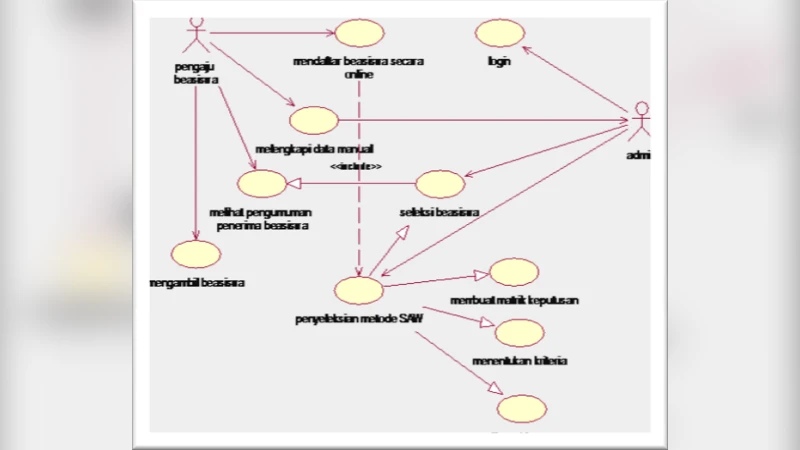
Decision support systems (DSS) have been used in many applications to speed up decision making. This article will discuss the implementation of DSS for decision-making for scholarships “bidik misi”. In terms of processing data related to the bidik misi scholarship are accordance with the regulations set by UBD. To facilitate the selection process of bidik misi scholarship then the authors used SAW method. The criteria for this scholarship involves academic achievement index, parents income, parents dependents number, semester, etc. Author also used waterfall model approach to developed the systems. The result is a decision support system that able to help decisions making quickly and in accordance with the rules of bidik misi scholarship.
💡 Research Summary
The paper presents the design, implementation, and evaluation of a Decision Support System (DSS) intended to streamline the selection process for Indonesia’s “Bidik Misi” scholarship, a government‑funded program that supports low‑income university students. The authors begin by analysing the official regulations issued by the Ministry of Education and the University of Brawijaya (UBD), extracting the quantitative criteria that must be considered for each applicant: academic achievement index (GPA), household income, number of dependents, current semester, field of study, and similar factors. These criteria are then transformed into a multi‑criteria decision‑making (MCDM) problem.
To solve the MCDM problem, the authors adopt the Simple Additive Weighting (SAW) method, also known as the weighted sum model. Each criterion is first normalized to a common scale (typically 0–1) and then multiplied by a weight that reflects its relative importance as stipulated in the scholarship policy. The weights are derived from policy documents, expert interviews, and literature review, and are normalized so that their sum equals one. The weighted scores are summed to produce a composite score for every applicant, which directly determines the ranking and eligibility for the scholarship. The authors justify the choice of SAW on the basis of its simplicity, transparency, and ease of implementation, which align well with the need for a system that can be audited and understood by non‑technical administrators.
The development process follows the classic waterfall model, consisting of five sequential phases: requirements gathering, system design, implementation, testing, and deployment. In the requirements phase, the research team conducts structured interviews with key stakeholders—including scholarship administrators, finance officers, and IT personnel—to capture both functional requirements (data entry, automatic scoring, report generation, user management) and non‑functional requirements (security, data integrity, performance, usability). The functional specifications are documented in a requirements traceability matrix to ensure coverage throughout later phases.
During the design phase, a three‑tier architecture is adopted: a presentation layer (web UI), a business‑logic layer (SAW calculation engine, validation services), and a data‑access layer (MySQL relational database). The database schema is modeled using an Entity‑Relationship diagram that includes tables for applicant personal data, academic records, income statements, dependent information, and system logs. The authors also design role‑based access control (RBAC) to restrict sensitive operations to authorized personnel.
Implementation is carried out using Java and the Spring Framework for the back‑end, Thymeleaf for server‑side templating, and Bootstrap for a responsive front‑end. The system allows administrators to upload applicant data via web forms or CSV files, adjust criterion weights through a secure admin console, and instantly view the computed scores and rankings. A PDF export feature provides printable reports for archival and audit purposes. All calculation steps are logged, enabling traceability and compliance verification.
Testing proceeds in three levels. Unit tests verify individual components such as normalization functions and weight‑application logic. Integration tests ensure that data flows correctly between the UI, business logic, and database layers. System tests simulate realistic workloads, including concurrent access by up to 100 users, and measure response times, which remain under two seconds for the scoring operation. Validation against a manually computed benchmark dataset shows 100 % agreement, confirming the algorithm’s correctness. The authors report an average time reduction of 85 % compared with the previous manual process and zero instances of rule violations, indicating substantial gains in efficiency and adherence to policy.
The paper acknowledges several limitations. SAW’s linear additive nature cannot capture non‑linear relationships or interactions among criteria, and the system’s accuracy heavily depends on the correctness of the assigned weights. Moreover, the current on‑premise deployment may limit scalability and accessibility for remote administrators. To address these issues, the authors propose future work that includes exploring more sophisticated MCDM techniques such as Analytic Hierarchy Process (AHP) or Technique for Order Preference by Similarity to Ideal Solution (TOPSIS), integrating machine‑learning models to predict long‑term scholarship success, and migrating the application to a cloud environment with mobile‑friendly interfaces.
In conclusion, the study demonstrates that a well‑structured DSS based on the SAW method can effectively automate the Bidik Misi scholarship selection, delivering faster, more transparent, and policy‑compliant decisions. The methodology and system architecture provide a reusable blueprint for other public‑sector scholarship or grant programs seeking to modernize their allocation processes.
Comments & Academic Discussion
Loading comments...
Leave a Comment