Government and Social Media: A Case Study of 31 Informational World Cities
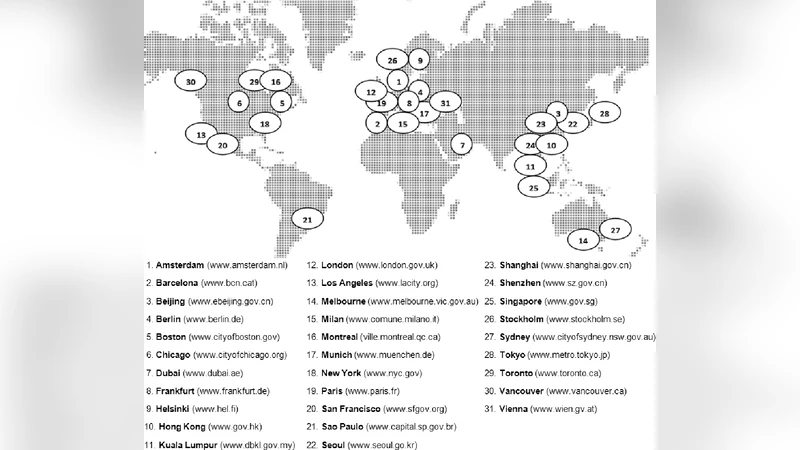
Social media platforms are increasingly being used by governments to foster user interaction. Particularly in cities with enhanced ICT infrastructures (i.e., Informational World Cities) and high internet penetration rates, social media platforms are valuable tools for reaching high numbers of citizens. This empirical investigation of 31 Informational World Cities will provide an overview of social media services used for governmental purposes, of their popularity among governments, and of their usage intensity in broadcasting information online.
💡 Research Summary
This study investigates how municipal governments in highly digitalized “Informational World Cities” employ social‑media platforms to communicate with citizens. Thirty‑one cities worldwide were selected on the basis of advanced ICT infrastructure, broadband penetration above 95 %, and high rankings in international ICT competitiveness indices. The authors compiled a comprehensive dataset covering official government accounts on Facebook, Twitter, Instagram, YouTube, and, where relevant, Chinese platforms such as WeChat and Weibo. Data were collected via public APIs and web‑crawling from January 2018 through December 2020, capturing for each account the number of followers/subscribers, monthly posting frequency, and interaction metrics (likes, comments, shares, retweets, video views). Only accounts explicitly identified as official (e.g., “City Hall”, “Mayor’s Office”, “City Council”) were retained; unofficial or citizen‑run pages were excluded to focus on government‑initiated communication.
Descriptive statistics reveal that Facebook is the dominant channel, used by 28 of the 31 cities (90 %) with an average follower base of roughly 150 000 and a median of 45 posts per month. Twitter follows, present in 20 cities (65 %), and is primarily leveraged for real‑time alerts and crisis communication; its average engagement rate (likes + retweets + replies per tweet) stands at 3.2 %. Instagram appears in 18 cities (58 %) and excels in visual promotion of cultural and tourism initiatives, while YouTube channels exist in 22 cities (71 %) but exhibit comparatively modest subscriber counts (≈30 000) and lower per‑video interaction, suggesting a higher production cost relative to reach. Chinese platforms are only adopted in cities with sizable Chinese‑origin populations (e.g., San Francisco, Sydney), accounting for less than 10 % of the total sample.
Correlation analysis shows a moderate positive relationship (r = 0.42, p < 0.05) between city size (population, GDP, ICT investment) and the breadth of platform adoption, indicating that larger municipalities tend to maintain a multi‑platform presence. Regression models further demonstrate that posting frequency and content type (textual updates versus visual media) are significant predictors of citizen interaction, with image‑rich posts on Instagram and video clips on YouTube generating higher average reactions per post (28–45 interactions) than plain text updates. Nonetheless, the overall posting cadence across all platforms remains low—approximately two to three posts per week—raising concerns about the adequacy of governmental outreach in an environment where citizens expect near‑instantaneous information.
The authors also performed a thematic text‑mining exercise on the corpus of posts, identifying four dominant content categories: (1) public safety and emergency alerts, (2) transportation and infrastructure updates, (3) cultural‑tourism promotion, and (4) social‑welfare announcements. Engagement varies markedly across these themes; emergency alerts on Twitter achieve the highest retweet rates, whereas cultural content on Instagram garners the most likes and comments, underscoring the importance of aligning message format with platform affordances.
Limitations of the study include the relatively short observation window (two years), the exclusion of non‑official accounts that may play a complementary role in civic dialogue, and the reliance on quantitative interaction metrics without direct measures of citizen satisfaction or trust. The authors recommend future mixed‑methods research incorporating surveys and focus groups to capture qualitative dimensions of e‑government effectiveness.
In conclusion, the paper confirms that governments in information‑rich cities are actively experimenting with social media, yet their strategies often lack coherence and fail to fully exploit platform‑specific strengths. To enhance digital governance, municipalities should adopt a differentiated content strategy (e.g., using Twitter for rapid alerts, Instagram for visual storytelling, YouTube for longer‑form informational videos), increase posting frequency, and institutionalize real‑time feedback loops that integrate citizen comments into policy‑making processes. Building robust analytics capabilities to monitor engagement, sentiment, and reach will enable data‑driven adjustments to communication tactics. Moreover, addressing digital inclusion—by providing multilingual accounts and bridging online‑offline outreach—will ensure that the benefits of social‑media communication are equitably distributed across all demographic groups. The study thus offers a roadmap for cities seeking to transform social media from a peripheral broadcasting tool into a central pillar of participatory, transparent, and responsive urban governance.