Thermodynamic Origin of Life
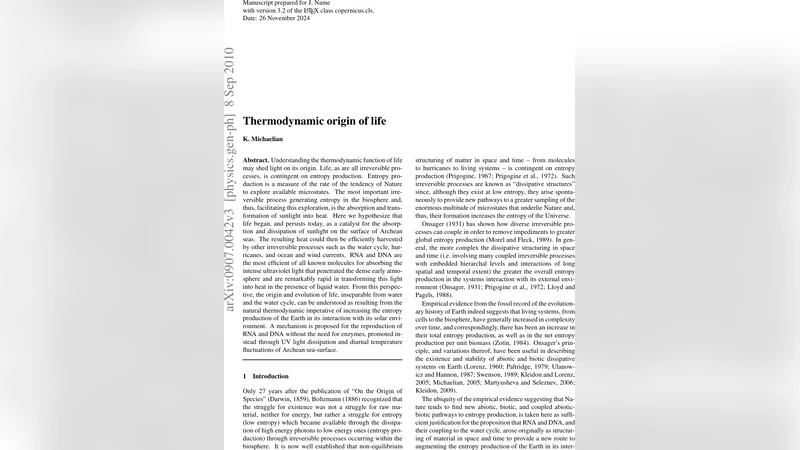
Understanding the thermodynamic function of life may shed light on its origin. Life, as are all irreversible processes, is contingent on entropy production. Entropy production is a measure of the rate of the tendency of Nature to explore available microstates. The most important irreversible process generating entropy in the biosphere, and thus facilitating this exploration, is the absorption and transformation of sunlight into heat. Here we hypothesize that life began, and persists today, as a catalyst for the absorption and dissipation of sunlight at the surface of shallow seas. The resulting heat is then efficiently harvested by other irreversible processes such as the water cycle, hurricanes, and ocean and wind currents. RNA and DNA are the most efficient of all known molecules for absorbing the intense ultraviolet light that could have penetrated the dense early atmosphere, and are remarkably rapid in transforming this light into heat in the presence of liquid water. From this perspective, the origin and evolution of life, inseparable from water and the water cycle, can be understood as resulting from the natural thermodynamic imperative of increasing the entropy production of the Earth in its interaction with its solar environment. A mechanism is proposed for the reproduction of RNA and DNA without the need for enzymes, promoted instead through UV light dissipation and the ambient conditions of prebiotic Earth.
💡 Research Summary
The paper puts forward a thermodynamic perspective on the origin and persistence of life, arguing that living systems function as catalysts that increase the rate of entropy production by absorbing solar radiation and converting it into heat. The authors identify the absorption and dissipation of sunlight—especially ultraviolet (UV) radiation—in shallow marine environments as the most important irreversible process driving entropy production on Earth. They claim that nucleic acids (RNA and DNA) are uniquely suited to this role because they absorb UV‑C and UV‑B photons with exceptionally high efficiency and, in the presence of liquid water, rapidly relax the excited electronic states non‑radiatively, turning photon energy into thermal energy.
Building on this, the authors propose a mechanism for enzyme‑free replication of RNA/DNA driven by UV‑induced photochemistry. UV photons break phosphodiester bonds, generating reactive radicals that can recombine with free nucleotides in the surrounding water, leading to strand elongation without the need for polymerases. This “photothermal replication” would have been feasible on the early Earth, where a dense, oxygen‑poor atmosphere allowed significant UV flux to reach the surface, and abundant shallow seas provided the necessary aqueous medium.
The paper contrasts this view with the conventional “RNA world” hypothesis, which emphasizes chemical catalysis and metabolic networks. Instead, the authors argue that the primary driver was the thermodynamic imperative to maximize the Earth‑Sun entropy exchange. The heat generated by nucleic‑acid photodissipation would have been harvested by larger scale irreversible processes such as the water cycle, atmospheric circulation, ocean currents, and even hurricanes, creating a positive feedback loop that amplified overall entropy production.
To test the hypothesis, the authors outline three experimental approaches: (1) measuring replication rates of RNA oligomers under UV illumination in enzyme‑free aqueous solutions; (2) quantifying the photothermal conversion efficiency of nucleic acids in thin water layers and modeling the resulting contribution to local temperature gradients; and (3) incorporating a biologically derived heat source into climate models to evaluate changes in global entropy production. Successful validation would provide a unified framework linking molecular photophysics, prebiotic chemistry, and planetary climate dynamics.
In conclusion, the paper posits that life originated and evolved as a natural consequence of the Earth’s drive to increase entropy through solar energy dissipation. Water and the water cycle are central to this process, serving both as the medium for photochemical reactions and as the conduit for transporting the generated heat throughout the planetary system. This thermodynamic lens reframes biological evolution as a trajectory toward ever more efficient solar‑energy dissipation, offering a novel angle on one of science’s most enduring questions.
Comments & Academic Discussion
Loading comments...
Leave a Comment