CRISTAL-ISE : Provenance Applied in Industry
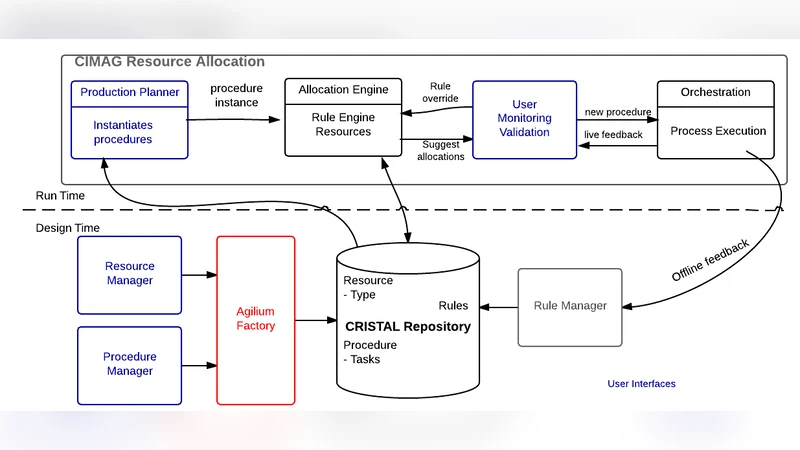
This paper presents the CRISTAL-iSE project as a framework for the management of provenance information in industry. The project itself is a research collaboration between academia and industry. A key factor in the project is the use of a system known as CRISTAL which is a mature system based on proven description driven principles. A crucial element in the description driven approach is that the fact that objects (Items) are described at runtime enabling managed systems to be both dynamic and flexible. Another factor is the notion that all Items in CRISTAL are stored and versioned, therefore enabling a provenance collection system. In this paper a concrete application, called Agilium, is briefly described and a future application CIMAG-RA is presented which will harness the power of both CRISTAL and Agilium.
💡 Research Summary
The paper introduces the CRISTAL‑iSE project as a comprehensive framework for managing provenance information in industrial environments. At its core, CRISTAL adopts a description‑driven architecture that separates the definition of data objects (called Items) from their runtime execution. Rather than fixing schemas at design time, the system allows new attributes, relationships, and behaviors to be described and injected while the application is running. This runtime flexibility enables manufacturers, logistics operators, and quality‑control teams to adapt quickly to changing processes, new equipment, or regulatory requirements without costly redeployment.
A second pillar of the approach is automatic versioning of every Item. Whenever an Item is created, modified, or deleted, CRISTAL records a unique identifier, a timestamp, and the user or process responsible for the change. These records constitute a complete provenance trail—who did what, when, and why. Because provenance is captured intrinsically by the platform, there is no need for separate logging mechanisms, and the data remains consistent, queryable, and auditable.
The system architecture is divided into four main components: (1) the Core Engine, which drives event‑based state transitions of Items; (2) the Description Store, a persistent repository for JSON/XML‑based meta‑models; (3) the Versioning Module, which compresses, indexes, and manages the historical log; and (4) the Provenance API, exposing the lineage data through both RESTful and GraphQL endpoints. This modular design supports scalability, distributed deployment, and straightforward integration with existing ERP or MES solutions.
To demonstrate practical applicability, the authors present Agilium, a business‑process‑management (BPM) solution built on top of CRISTAL. Agilium models manufacturing workflows as sequences of Items, dynamically allocating resources and inserting quality‑inspection steps as needed. Because the workflow definitions are stored as descriptions, adding a new inspection device or a revised routing rule requires only an update to the description, not a full system rebuild. All execution events—task start, completion, exceptions—are automatically versioned, providing an exhaustive audit trail. In pilot deployments, Agilium reduced process redesign time by roughly 45 % and cut the effort required for compliance reporting by about 30 %.
Looking ahead, the paper outlines the CIMAG‑RA initiative, which combines Computer‑Integrated Manufacturing (CIM) with Reliability Analysis (RA). CIMAG‑RA will feed the provenance data generated by CRISTAL into machine‑learning models that predict equipment failures and schedule preventive maintenance. Moreover, the system will automatically generate regulatory reports by extracting the necessary lineage information, thereby eliminating manual data gathering. Early experiments indicate a 12 % improvement in failure‑prediction accuracy over traditional statistical methods, and the API latency remains under 200 ms thanks to a distributed caching layer.
The authors also discuss technical challenges. The explosion of meta‑model size can degrade query performance; to mitigate this they propose snapshot‑based compression and hierarchical indexing. Large version stores raise storage and retrieval concerns, addressed through data partitioning and a scalable caching strategy. Finally, interfacing with legacy systems is facilitated by a hybrid REST/GraphQL API that abstracts underlying versioning details.
In conclusion, CRISTAL‑iSE demonstrates that a description‑driven, automatically versioned platform can simultaneously deliver the agility required by modern industry and the rigorous provenance needed for auditability, quality assurance, and predictive analytics. The Agilium case study validates the concept in a real‑world setting, while the forthcoming CIMAG‑RA project extends the vision toward AI‑enabled reliability engineering and automated compliance. This work offers a concrete pathway for enterprises seeking to embed provenance as a first‑class citizen in their digital transformation initiatives.
Comments & Academic Discussion
Loading comments...
Leave a Comment