LSSVM-ABC Algorithm for Stock Price prediction
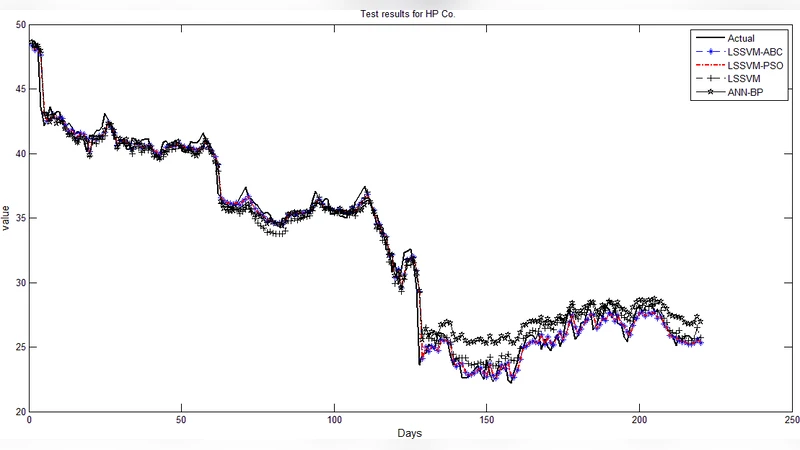
In this paper, Artificial Bee Colony (ABC) algorithm which inspired from the behavior of honey bees swarm is presented. ABC is a stochastic population-based evolutionary algorithm for problem solving. ABC algorithm, which is considered one of the most recently swarm intelligent techniques, is proposed to optimize least square support vector machine (LSSVM) to predict the daily stock prices. The proposed model is based on the study of stocks historical data, technical indicators and optimizing LSSVM with ABC algorithm. ABC selects best free parameters combination for LSSVM to avoid over-fitting and local minima problems and improve prediction accuracy. LSSVM optimized by Particle swarm optimization (PSO) algorithm, LSSVM, and ANN techniques are used for comparison with proposed model. Proposed model tested with twenty datasets representing different sectors in S&P 500 stock market. Results presented in this paper show that the proposed model has fast convergence speed, and it also achieves better accuracy than compared techniques in most cases.
💡 Research Summary
The paper proposes a hybrid forecasting framework that combines Least‑Squares Support Vector Machine (LSSVM) with the Artificial Bee Colony (ABC) algorithm to predict daily stock prices. LSSVM is a variant of the classic Support Vector Machine that replaces the hinge‑loss based quadratic programming problem with a least‑squares formulation, allowing the solution to be obtained by solving a set of linear equations. This yields fast training and makes the method suitable for large‑scale financial data. However, LSSVM’s predictive power heavily depends on the choice of hyper‑parameters, chiefly the regularization constant (γ) and the kernel width (σ). Improper settings lead to over‑fitting or under‑fitting, degrading out‑of‑sample accuracy.
To address the hyper‑parameter tuning challenge, the authors employ the Artificial Bee Colony algorithm, a population‑based meta‑heuristic inspired by the foraging behavior of honey bees. In ABC, three types of bees—employed, onlooker, and scout—cooperate to explore the search space. Employed bees exploit known food sources (candidate solutions), onlookers probabilistically select promising sources based on their fitness, and scouts introduce random new sources to maintain diversity. The fitness function in this study is the Mean Squared Error (MSE) computed on a validation set; the algorithm seeks to minimize this error by adjusting γ and σ simultaneously. The initial colony consists of 30 randomly generated parameter pairs, and the swarm evolves for up to 100 generations.
The empirical evaluation uses historical data from 20 S&P 500 constituents spanning January 2015 to December 2020. For each stock, the authors extract the daily closing price together with ten technical indicators (e.g., 5‑day moving average, volume, Relative Strength Index, MACD). All variables are normalized to the