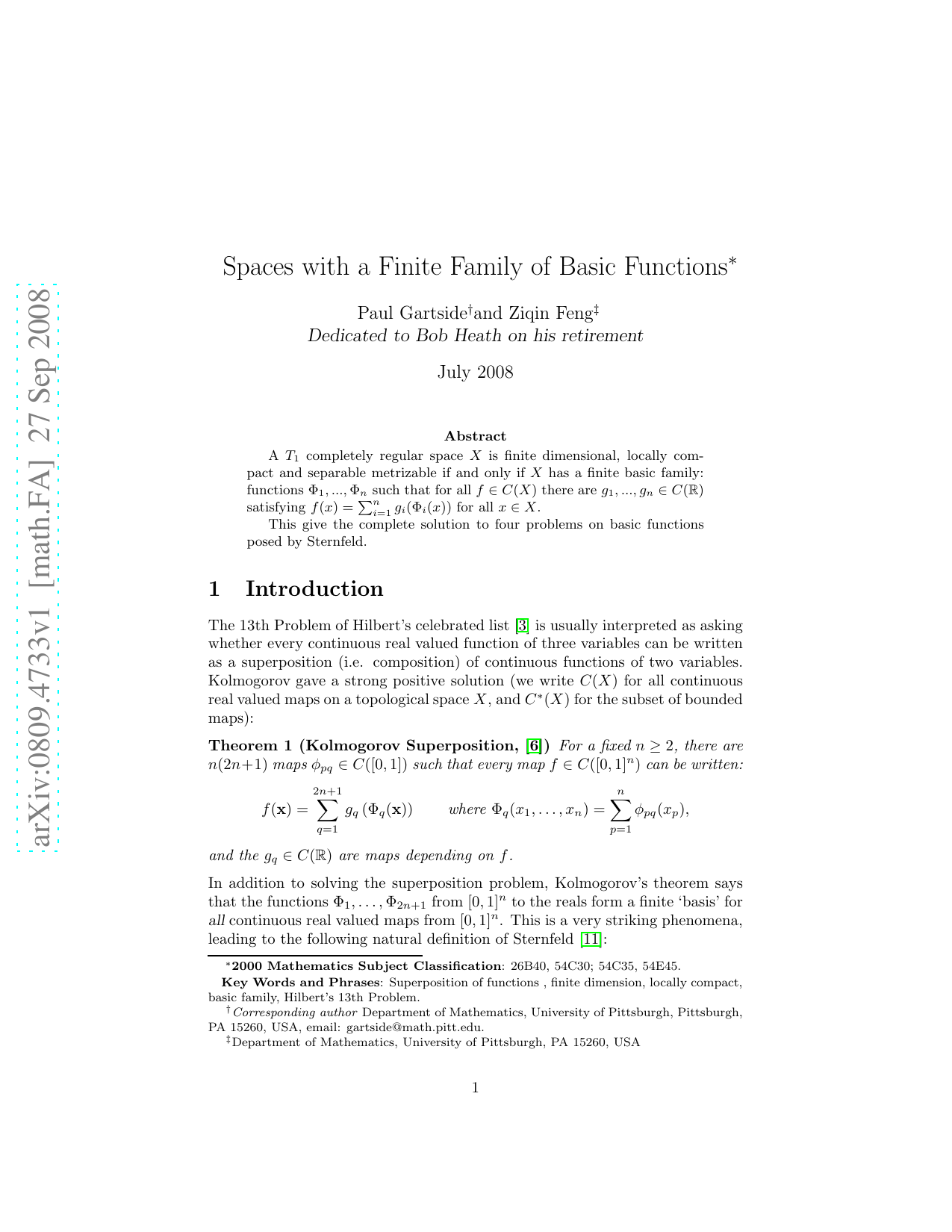
A space X is finite dimensional, locally compact and separable metrizable if and only if X has a finite basic family: continuous functions Phi_1,...,Phi_n of X to the reals, R, such that for all continuous f from X to R there are g_1,..., g_n in C(R) satisfying f(x)=g_1(Phi_1(x))+g_2(Phi_2(x))+...+g_n(Phi_n(x)) for all x in X. This give the complete solution to four problems on basic functions posed by Sternfeld, as well as questions posed by Hattori and others.
Deep Dive into Spaces with a Finite Family of Basic Functions.
A space X is finite dimensional, locally compact and separable metrizable if and only if X has a finite basic family: continuous functions Phi_1,…,Phi_n of X to the reals, R, such that for all continuous f from X to R there are g_1,…, g_n in C(R) satisfying f(x)=g_1(Phi_1(x))+g_2(Phi_2(x))+…+g_n(Phi_n(x)) for all x in X. This give the complete solution to four problems on basic functions posed by Sternfeld, as well as questions posed by Hattori and others.
The 13th Problem of Hilbert's celebrated list [3] is usually interpreted as asking whether every continuous real valued function of three variables can be written as a superposition (i.e. composition) of continuous functions of two variables. Kolmogorov gave a strong positive solution (we write C(X) for all continuous real valued maps on a topological space X, and C * (X) for the subset of bounded maps):
Theorem 1 (Kolmogorov Superposition, [6]) For a fixed n ≥ 2, there are n(2n+1) maps φ pq ∈ C([0, 1]) such that every map f ∈ C([0, 1] n ) can be written:
where Φ q (x 1 , . . . , x n ) = n p=1 φ pq (x p ), and the g q ∈ C(R) are maps depending on f .
In addition to solving the superposition problem, Kolmogorov’s theorem says that the functions Φ 1 , . . . , Φ 2n+1 from [0, 1] n to the reals form a finite ‘basis’ for all continuous real valued maps from [0, 1] n . This is a very striking phenomena, leading to the following natural definition of Sternfeld [11]:
Definition 2 Let X be a topological space. A family Φ ⊆ C(X) is said to be basic (respectively, basic * ) for X if each f ∈ C(X) (respectively, C * (X)) can be written: f = n q=1 (g q • Φ q ), for some Φ 1 , . . . , Φ n in Φ and ‘co-ordinate functions’ g 1 , . . . , g n ∈ C(R).
Beyond their intrinsic interest, basic functions have proved to be widely useful. Since the use of basic functions reduces calculations of functions simply to addition and evaluation of a fixed finite family of functions, applications to numerical analysis, approximation and function reconstruction are immediately apparent. But other applications have emerged including to neural networks [4,5,7].
Extending the Kolmogorov Superposition Theorem, Ostrand [9] showed that every compact metric space of dimension n has a basic family of size 2n + 1. Subsequently Sternfeld [11] showed that this basic family is minimal in the sense that a compact metric space with a basic family of size no more than 2n+1 must have dimension ≤ n. Noting that Doss [1] had shown that Euclidean n-space, R n , has a basic family of size 4n for n ≥ 2, Sternfeld asked (in Problems 9-13 of [11]) exactly which spaces have a finite basic family, and whether the minimal size of a basic family on a space X was 2n + 1 where n = dim(X). Hattori [2] showed that every locally compact, separable metrizable space X of dimension n has a finite basic * family of size 2n + 1. He asked whether the restriction to locally compact spaces was necessary. Our Main Theorem below gives a strong and complete solution to all these problems.
Since spaces with a finite basic family are finite dimensional, it seems plausible that spaces with a countable basic family would be countable dimensional. But we prove that if a space has a countable basic family, then some finite subcollection is also basic, and so the space is finite dimensional (and locally compact, separable metrizable). To facilitate the proof, and provide full generality we make the following definition allowing more general superposition representations than a ‘basic’ representation.
Definition 3 Let X be a topological space. A family Φ ⊆ C(X) is said to be generating (respectively, generating * ) for X with respect to a ‘set of operations’ M of continuous functions mapping from subsets of Euclidean space into subsets of Euclidean space, if each f ∈ C(X) (respectively, C * (X)) can be written as a composition of functions from Φ, M and C(R).
Note that a basic (respectively, basic * ) family is generating (respectively, generating * ) with respect to M = {+}, and clearly ‘generating’ implies ‘generating * ‘.
Theorem 4 (Main Theorem) Let X be T 1 and completely regular. Then the following are equivalent:
X has a countable generating * family with respect to a countable set of operations,
X has a finite basic family, and 3) X is a finite dimensional, locally compact and separable metrizable.
Further, a locally compact separable metrizable space X has dimension ≤ n if and only if it has a basic family of size ≤ 2n + 1.
By the preceding note, 2) =⇒ 1) is immediate. In the next section (Section 2) we prove 1) =⇒ 3), in Section 3 we establish 3) =⇒ 2), and we justify the ‘Further’ claim characterizing dimension in Section 4.
In this section, all topological spaces are T 1 and completely regular.
Lemma 5 Let X have a generating * family Φ with respect to M . Then e : X → R Φ defined by e(x) = (Φ(x)) Φ∈Φ is an embedding.
Proof. Clearly e is continuous (each projection is a Φ in Φ which is continuous). It is also easy to see e is injective. Take
for all i, and so f (x) = f (x ′ ), which is a contradiction.
It remains to show that the topology induced on X by e contains the original topology. Since X is completely regular it is sufficient to check that for every
can be written as a composition of some Φ 1 , . . . , Φ n in Φ and members of M and C(R). Note that for each i we have Φ(e -1 (x)) = π Φi (x), where π Φi is the projection map of R Φ onto the Φ i th c
…(Full text truncated)…
This content is AI-processed based on ArXiv data.