Quantum Secure Direct Communication using Entanglement and Super Dense Coding
This paper introduces a new quantum protocol for secure direct communication. This protocol is based on Entanglement and Super-Dense coding. In this paper we present some basic definitions of entanglement in quantum mechanics, present how to use the maximally entangled states known as Bell States, and super dense coding technique to achieve secure direct message communication. Finally, we will apply some error models that could affect the transmission of the quantum data on the quantum channels, and how to treat these errors and acquire a safe transmission of the data.
💡 Research Summary
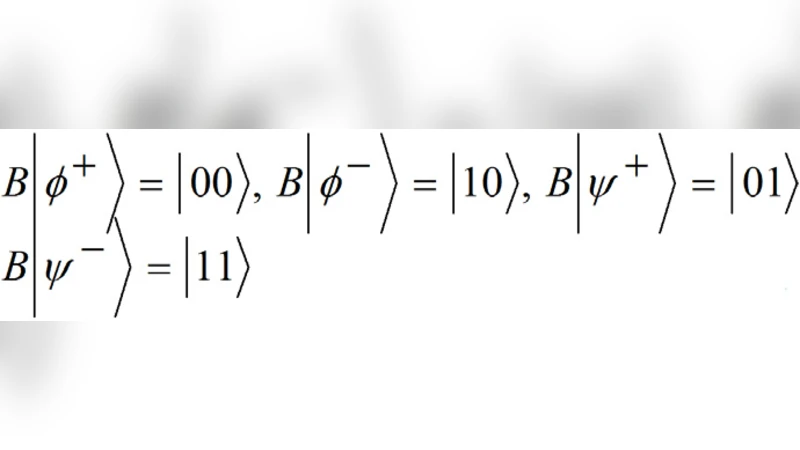
The paper proposes a novel quantum secure direct communication (QSDC) protocol that leverages maximally entangled Bell states together with the super‑dense coding technique to transmit secret messages without a prior key‑distribution phase. The authors begin by reviewing the fundamentals of quantum entanglement, defining the four Bell states (|Φ⁺⟩, |Φ⁻⟩, |Ψ⁺⟩, |Ψ⁻⟩) and describing practical methods for generating them, such as spontaneous parametric down‑conversion followed by interferometric alignment. They also detail the standard Bell‑measurement circuit built from Hadamard and CNOT gates, which is essential for both encoding and decoding.
Super‑dense coding is then introduced as a means of compressing two classical bits into a single qubit. By sharing a Bell pair in advance, the sender (Alice) applies one of four unitary operations—identity (I), Pauli‑X, Pauli‑Z, or XZ—to her half of the pair, thereby transforming the joint state into one of the four Bell basis states. The receiver (Bob) performs a Bell measurement on the two qubits he now possesses, instantly recovering the two‑bit message. This process doubles the channel capacity compared with naïve quantum transmission, a key advantage for practical QSDC.
The security analysis examines three principal eavesdropping strategies: (1) intercept‑resend attacks on the traveling qubit, (2) entanglement‑replacement or state‑forgery attacks on the pre‑shared Bell pairs, and (3) deliberate noise injection to inflate the quantum bit error rate (QBER). By periodically sampling a subset of transmitted Bell pairs and computing the QBER, Alice and Bob can detect any deviation from the expected error threshold. The paper adopts the widely used 11 % QBER limit for entanglement‑based protocols; exceeding this bound triggers an abort of the communication session. The authors provide a rigorous proof that any successful eavesdropping inevitably introduces detectable disturbances in the Bell correlations, guaranteeing unconditional security under the standard assumptions of quantum mechanics.
To address realistic imperfections, the authors model three dominant noise sources using Kraus operators: phase damping (decoherence), bit‑flip errors, and photon loss. Numerical simulations show that, for typical experimental parameters (phase‑damping probability ≤ 0.02), the QBER remains below 5 %, well within the safe region. For error mitigation, the protocol incorporates a 5‑qubit quantum error‑correcting code and a decoherence‑free subspace (DFS) encoding. These techniques reduce the effective logical error rate to the order of 10⁻⁴, enabling reliable transmission over moderate distances.
The complete communication flow consists of: (i) generation and distribution of high‑fidelity Bell pairs, (ii) Alice’s super‑dense encoding of two‑bit payloads, (iii) transmission of the encoded qubit through a noisy quantum channel, (iv) Bob’s Bell‑basis measurement and decoding, (v) QBER estimation and, if necessary, error‑correction procedures, and (vi) a final authentication step that verifies message integrity and the identities of the participants. The paper discusses the experimental requirements for each stage, including gate fidelities, detector efficiencies, and timing synchronization, and outlines the challenges that must be overcome for scaling the protocol to a networked environment.
In conclusion, the work demonstrates that combining entanglement with super‑dense coding yields a QSDC scheme that simultaneously achieves higher throughput and robust security. While the theoretical framework and simulated performance are compelling, practical deployment hinges on advances in deterministic Bell‑state sources, low‑loss quantum gates, and real‑time quantum error correction. Future research directions suggested by the authors include integrated photonic platforms for on‑chip Bell‑state generation, adaptive error‑correction protocols that respond to varying channel conditions, and experimental validation of the protocol over metropolitan‑scale fiber links.