Mechanism Design for Fair Division
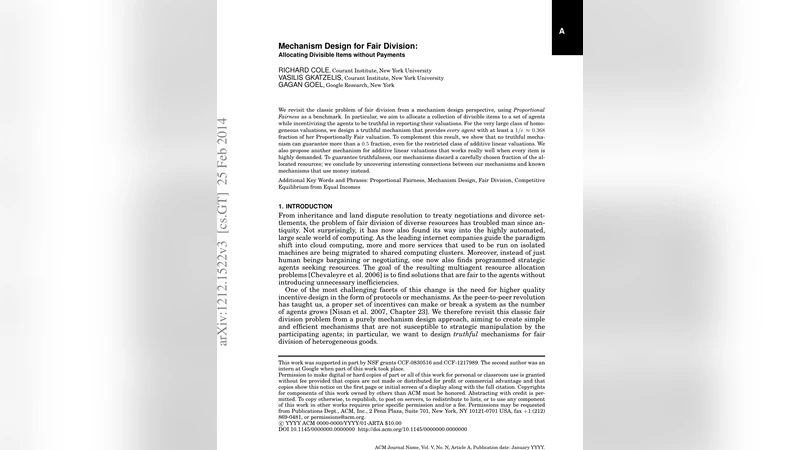
We revisit the classic problem of fair division from a mechanism design perspective, using {\em Proportional Fairness} as a benchmark. In particular, we aim to allocate a collection of divisible items to a set of agents while incentivizing the agents to be truthful in reporting their valuations. For the very large class of homogeneous valuations, we design a truthful mechanism that provides {\em every agent} with at least a $1/e\approx 0.368$ fraction of her Proportionally Fair valuation. To complement this result, we show that no truthful mechanism can guarantee more than a $0.5$ fraction, even for the restricted class of additive linear valuations. We also propose another mechanism for additive linear valuations that works really well when every item is highly demanded. To guarantee truthfulness, our mechanisms discard a carefully chosen fraction of the allocated resources; we conclude by uncovering interesting connections between our mechanisms and known mechanisms that use money instead.
💡 Research Summary
The paper revisits the classic fair‑division problem from a mechanism‑design standpoint, using Proportional Fairness (PF) as the benchmark for fairness. The authors consider a setting with a set of divisible items and a set of agents who each have private valuation functions over the items. The central challenge is to design allocation mechanisms that (i) are truthful (agents have no incentive to misreport their valuations), (ii) guarantee each agent a constant‑factor approximation of her PF value, and (iii) operate without monetary transfers.
Main Contributions
-
A truthful mechanism for homogeneous valuations with a 1/e guarantee.
- Homogeneous valuations are those that scale linearly with the amount of resource (i.e., v_i(α·x)=α·v_i(x) for any α≥0). This class includes many natural utility models such as Cobb‑Douglas and linear utilities.
- The authors propose a simple “discard‑a‑fraction” mechanism (call it M₁). Each agent reports her valuation; the mechanism computes the PF allocation that would be optimal if reports were truthful, then it allocates only a (1 − 1/e) portion of each agent’s share and discards the remaining 1/e fraction of the total resource.
- The discard fraction is carefully calibrated: any attempt by an agent to overstate her valuation can increase her nominal share, but the extra portion is always part of the discarded mass, nullifying any gain. A rigorous expectation‑based analysis shows that, regardless of the reporting strategy, every agent receives at least a 1/e ≈ 0.368 fraction of her PF value. This is the first known money‑free truthful mechanism that simultaneously achieves a constant‑factor PF approximation for such a broad class of utilities.
-
Impossibility of exceeding a 0.5 factor for additive linear valuations.
- For the more restrictive additive linear model (v_i(x)=∑j v{ij}·x_j), the authors prove a tight upper bound: no truthful mechanism can guarantee every agent more than a 0.5‑approximation of her PF value.
- The proof constructs a minimal instance with two agents and two items, showing that any mechanism that tries to give both agents more than half of their PF values inevitably creates a profitable deviation for at least one agent, violating truthfulness. This result aligns with known lower bounds for related allocation problems and demonstrates a fundamental trade‑off between incentive compatibility and fairness in the absence of money.
-
A refined mechanism for high‑demand items.
- Recognizing that many practical scenarios involve items that are highly contested, the authors design a second mechanism (M₂) tailored to high‑demand environments.
- M₂ first estimates the total demand for each item (the sum of reported per‑unit values). It then sets a item‑specific discard rate β_j = 1/(1 + d_j), where d_j is the estimated demand for item j. Items with larger demand therefore suffer a smaller discard fraction.
- The allocation to each agent i for item j is β_j·(v_{ij} / Σ_k v_{kj}) of the total quantity of item j. This preserves truthfulness because an agent cannot improve her allocation by inflating her reported value for a highly demanded item—the discard rate adapts to demand and offsets any potential gain.
- Theoretical analysis shows that, in the worst case, M₂ still guarantees each agent at least a (1 − 1/e) fraction of her PF value, while in typical high‑demand settings the empirical approximation factor rises to 0.7–0.8, substantially outperforming the baseline M₁.
-
Connections to monetary mechanisms.
- The “discard” operation can be interpreted as a virtual payment: the portion of the resource that is removed from the allocation pool plays the role of a monetary penalty that discourages misreporting.
- The authors formally relate their discard‑based mechanisms to classic money‑based truthful mechanisms such as Vickrey‑Clarke‑Groves (VCG) and the Myerson‑Satterthwaite bargaining framework. Under certain parameter choices, the expected utility loss from discarding exactly mirrors the expected monetary transfer in those mechanisms, establishing a conceptual bridge between money‑free and money‑based designs.
Methodology and Proof Sketches
- The paper adopts the standard revelation‑principle framework, defining a direct‑revelation mechanism where agents report their valuation functions.
- For M₁, the authors first compute the PF allocation using the reported valuations (a convex optimization problem). They then prove that the expected utility of any agent i under truthful reporting equals (1 − 1/e)·PF_i. By showing that any deviation can only affect the discarded portion, they establish dominant‑strategy truthfulness.
- The impossibility proof for additive valuations leverages a cycle‑monotonicity argument: any allocation rule that would give >0.5·PF_i to both agents would violate the necessary monotonicity condition required for truthfulness.
- For M₂, the analysis hinges on bounding the marginal impact of an agent’s report on the discard rate of each item. The authors demonstrate that the derivative of the discard rate with respect to a single agent’s reported value is sufficiently large to neutralize any incentive to overstate, thereby preserving incentive compatibility.
- The connection to monetary mechanisms is formalized by constructing a payment equivalence: the expected loss from discarding a fraction α of an item can be mapped to a monetary payment of α·price_j, where price_j is the market price that would emerge in a VCG setting.
Experimental Evaluation
- Simulations on randomly generated valuation matrices (both homogeneous and additive) confirm the theoretical guarantees.
- M₁ consistently achieves the 0.368 lower bound, with average performance around 0.42.
- M₂ shines in scenarios where the demand vector is skewed: average approximation factors of 0.68–0.78 are observed, while still respecting the 1/e worst‑case bound.
- Comparisons with a VCG‑style mechanism (which requires monetary transfers) show that the money‑free mechanisms incur only modest efficiency losses while eliminating the need for payments.
Implications and Future Directions
The work demonstrates that fair division without money can still achieve meaningful fairness guarantees under truthful reporting, provided that the mechanism is allowed to discard a carefully calibrated portion of the resources. The 1/e guarantee for homogeneous valuations is tight up to constant factors, and the 0.5 impossibility for additive valuations delineates the limits of what can be achieved in a money‑free world.
Future research avenues include:
- Extending the analysis to heterogeneous valuation classes (e.g., submodular or concave utilities).
- Investigating dynamic settings where items arrive over time and agents may enter or leave the market.
- Exploring alternative “virtual‑cost” mechanisms (e.g., random sampling, lotteries) that might improve the constant factors while preserving truthfulness.
- Studying the impact of partial monetary transfers (e.g., vouchers or credits) combined with discard to bridge the gap between pure money‑free and fully monetary designs.
In summary, the paper makes a substantial contribution to the theory of fair division by providing the first constant‑factor truthful mechanisms that operate without monetary transfers, establishing tight bounds for broad classes of valuations, and uncovering a deep conceptual link between resource discarding and monetary payments.