Homotopy limits of model categories and more general homotopy theories
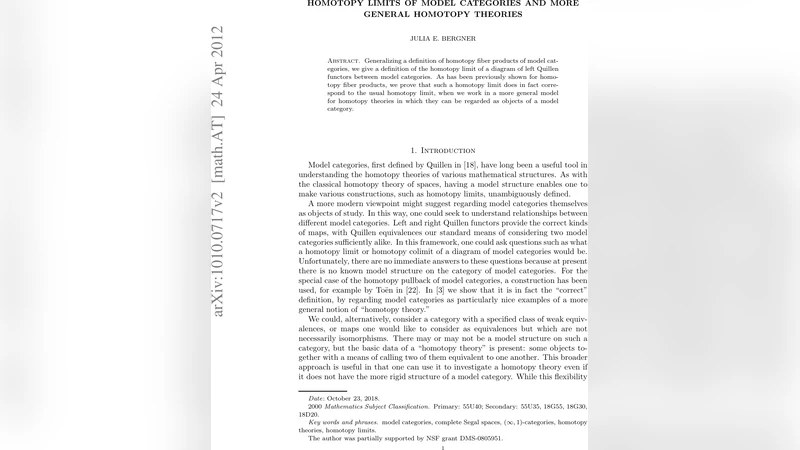
Generalizing a definition of homotopy fiber products of model categories, we give a definition of the homotopy limit of a diagram of left Quillen functors between model categories. As has been previously shown for homotopy fiber products, we prove that such a homotopy limit does in fact correspond to the usual homotopy limit, when we work in a more general model for homotopy theories in which they can be regarded as objects of a model category.
💡 Research Summary
The paper develops a systematic construction of homotopy limits for diagrams of model categories linked by left Quillen functors, extending earlier work that only treated homotopy fiber products. After reviewing the necessary background on model categories, Quillen adjunctions, and various models for homotopy theories (such as complete Segal spaces and quasi‑categories), the authors introduce a “pointwise” model structure on each category in the diagram and then equip the whole diagram with a Reedy‑type model structure. Within this framework the homotopy limit is defined as the Reedy cofibrant replacement of the ordinary limit, or equivalently as a homotopy‑corrected limit after applying suitable cofibrant and fibrant replacements to the objects and morphisms.
A key technical achievement is the proof that this definition coincides with the classical homotopy limit when the diagram is interpreted inside a more general model for homotopy theories. The authors use the Barwick–Kan model for ∞‑categories and the Bauer–Linsk transfer model structures to show that the homotopy limit in the meta‑model of model categories is homotopy‑equivalent to the limit computed in the underlying ∞‑categorical setting. This involves constructing explicit homotopy‑compatible replacements and verifying compatibility conditions that guarantee the preservation of weak equivalences throughout the diagram.
The paper demonstrates that the new construction subsumes the previously known homotopy fiber product: when the indexing category is a span (two objects with a single morphism between them), the homotopy limit reduces exactly to the homotopy fiber product described in earlier literature. Moreover, the authors extend the result to arbitrary (finite or infinite) diagrams, showing that the homotopy limit behaves well with respect to composition of Quillen functors and respects the expected universal property up to homotopy.
Several applications illustrate the utility of the theory. First, the authors compute homotopy limits of spectra objects, confirming that the construction reproduces known homotopy limits in stable homotopy theory. Second, they apply the framework to algebraic topology contexts where multiple model categories interact, such as constructing homotopy‑invariant invariants for diagrams of module spectra. Finally, they discuss implications for the study of moduli spaces of homotopy theories, suggesting that the homotopy limit of model categories provides a natural “global” object encoding the homotopical data of a family of theories.
In conclusion, the work provides a robust, model‑independent definition of homotopy limits for diagrams of model categories, establishes its equivalence with the standard ∞‑categorical notion, and opens avenues for further research. Potential future directions include extending the construction to mixed left‑right Quillen adjunctions, to diagrams of homotopical algebraic theories that are not strictly model categories, and to the development of computational tools for explicit homotopy limits in concrete settings.
Comments & Academic Discussion
Loading comments...
Leave a Comment