Silting mutation in triangulated categories
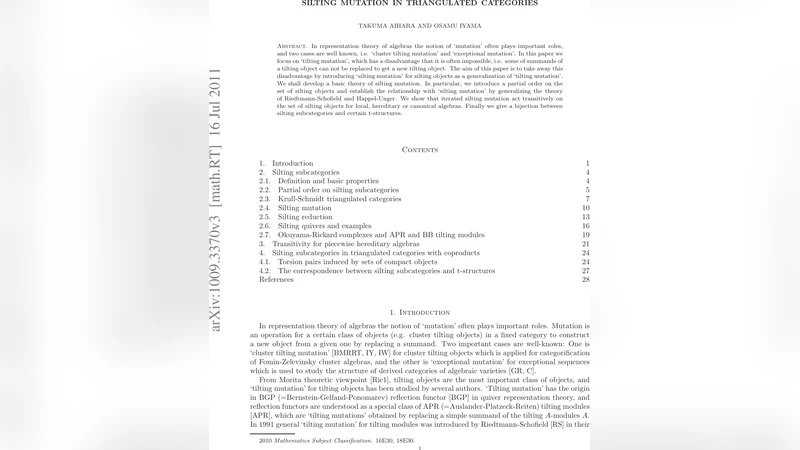
In representation theory of algebras the notion of mutation' often plays important roles, and two cases are well known, i.e. cluster tilting mutation’ and exceptional mutation'. In this paper we focus on tilting mutation’, which has a disadvantage that it is often impossible, i.e. some of summands of a tilting object can not be replaced to get a new tilting object. The aim of this paper is to take away this disadvantage by introducing silting mutation' for silting objects as a generalization of tilting mutation’. We shall develope a basic theory of silting mutation. In particular, we introduce a partial order on the set of silting objects and establish the relationship with `silting mutation’ by generalizing the theory of Riedtmann-Schofield and Happel-Unger. We show that iterated silting mutation act transitively on the set of silting objects for local, hereditary or canonical algebras. Finally we give a bijection between silting subcategories and certain t-structures.
💡 Research Summary
The paper introduces “silting mutation” as a robust generalization of the classical tilting mutation in the setting of triangulated categories. Tilting mutation, while central in representation theory, suffers from a fundamental limitation: for a given tilting object some of its indecomposable summands cannot be replaced so as to obtain another tilting object. The authors overcome this obstacle by moving from tilting objects to silting objects, which relax the rigidity condition yet retain enough structure to generate the whole category.
The first part of the work establishes the basic language of silting objects. An object (T) in a triangulated category (\mathcal{T}) is called silting if (\operatorname{Hom}_{\mathcal{T}}^{i}(T,T)=0) for all (i>0) and the thick subcategory generated by (T) coincides with (\mathcal{T}). This definition mirrors the classical tilting condition but drops the requirement that (\operatorname{Hom}^{i}(T,T)=0) for negative (i). Consequently, silting objects exist in many situations where tilting objects do not, providing a larger universe for mutation.
A central technical contribution is the introduction of a partial order on the set of silting objects. For silting objects (X) and (Y) one writes (X\le Y) if (\operatorname{Hom}{\mathcal{T}}^{i}(X,Y)=0) for all (i>0). This order is a direct analogue of the Riedtmann–Schofield order for tilting modules and serves as the backbone for the mutation theory. The authors prove that the order is compatible with mutation: if a right silting mutation (\mu^{+}{T_i}(T)) is defined, then (T\le \mu^{+}{T_i}(T)); dually, a left mutation satisfies (\mu^{-}{T_i}(T)\le T). These statements generalize the Happel–Unger results on tilting mutation and show that silting mutation always moves “upward” or “downward” in the silting lattice.
Silting mutation itself is defined as follows. Let (T=\bigoplus_{j\in J}T_j) be a basic silting object and fix an indecomposable summand (T_i). Take a minimal right (\operatorname{add}(T/T_i))-approximation (f:T_i\to B) and complete it to a triangle
(T_i \xrightarrow{f} B \to T_i’ \to \Sigma T_i).
If (T_i’) satisfies the silting conditions, the new silting object is (\mu^{+}_{T_i}(T)=(T/T_i)\oplus T_i’). A left mutation is defined dually using a minimal left approximation. Crucially, unlike tilting mutation, this construction is always possible: the approximation always exists, and the resulting object is guaranteed to be silting. Hence the “impossibility” phenomenon disappears.
The paper then investigates the global behaviour of silting mutation. By iterating left and right mutations one obtains a directed graph whose vertices are silting objects and edges are mutations. The authors prove that this graph is connected (i.e., mutation acts transitively) for three important classes of algebras:
- Local algebras – any two silting objects are linked by a finite sequence of mutations.
- Hereditary algebras – here silting coincides with tilting, so the result recovers known transitivity statements for tilting and cluster‑tilting mutations.
- Canonical algebras – using the description of silting objects as canonical pairs, the authors show that mutation again connects the whole silting set.
These transitivity results demonstrate that silting mutation provides a powerful tool for navigating the entire silting landscape in these settings.
Finally, the authors establish a bijection between silting subcategories and certain t‑structures. Given a silting subcategory (\mathcal{S}\subset\mathcal{T}), one defines a t‑structure ((\mathcal{U},\mathcal{V})) by
(\mathcal{U}={X\mid \operatorname{Hom}^{>0}{\mathcal{T}}(S,X)=0\ \forall S\in\mathcal{S}}),
(\mathcal{V}={Y\mid \operatorname{Hom}^{<0}{\mathcal{T}}(Y,S)=0\ \forall S\in\mathcal{S}}).
The heart of this t‑structure is a length abelian category generated by the silting objects, and conversely any t‑structure whose heart is generated by a silting object arises in this way. This bijection links the combinatorial mutation picture with the homological theory of t‑structures, providing a bridge to stability conditions and derived equivalences.
In summary, the paper builds a comprehensive theory of silting mutation: it defines the operation, relates it to a natural partial order, proves transitivity for several important families of algebras, and connects silting subcategories with t‑structures. By removing the obstruction present in tilting mutation, silting mutation opens new avenues for exploring derived categories, cluster theory, and the broader landscape of representation‑theoretic mutations.
Comments & Academic Discussion
Loading comments...
Leave a Comment