Stratifying triangulated categories
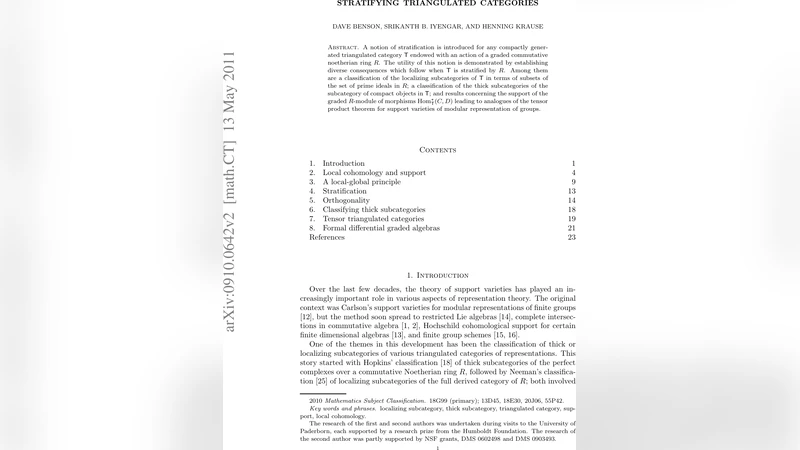
A notion of stratification is introduced for any compactly generated triangulated category T endowed with an action of a graded commutative noetherian ring R. The utility of this notion is demonstrated by establishing diverse consequences which follow when T is stratified by R. Among them are a classification of the localizing subcategories of T in terms of subsets of the set of prime ideals in R; a classification of the thick subcategories of the subcategory of compact objects in T; and results concerning the support of the R-module of homomorphisms Hom_T^*(C,D) leading to an analogue of the tensor product theorem for support varieties of modular representation of groups.
💡 Research Summary
The paper introduces a general notion of stratification for any compactly generated triangulated category (T) equipped with an action of a graded commutative Noetherian ring (R). The authors first recall the standard setup: (R) acts centrally on (T), making each Hom‑group (\operatorname{Hom}T^*(X,Y)) an (R)-module, and they define the support of an object (X) as the set of prime ideals (\mathfrak p\in\operatorname{Spec}R) for which the localized homology (\Gamma{\mathfrak p}X) (or equivalently (\operatorname{Hom}T^*(C,X){\mathfrak p}) for some compact (C)) is non‑zero.
Stratification is then defined by two precise conditions. The minimality condition requires that for each non‑zero prime (\mathfrak p) the localising subcategory (L_{\mathfrak p}T) (the essential image of the localisation functor (L_{\mathfrak p})) contains at least one non‑zero compact object. The decomposition condition asserts that every object (X) admits a canonical decomposition \
Comments & Academic Discussion
Loading comments...
Leave a Comment