Algebraic K-theory, A^1-homotopy and Riemann-Roch theorems
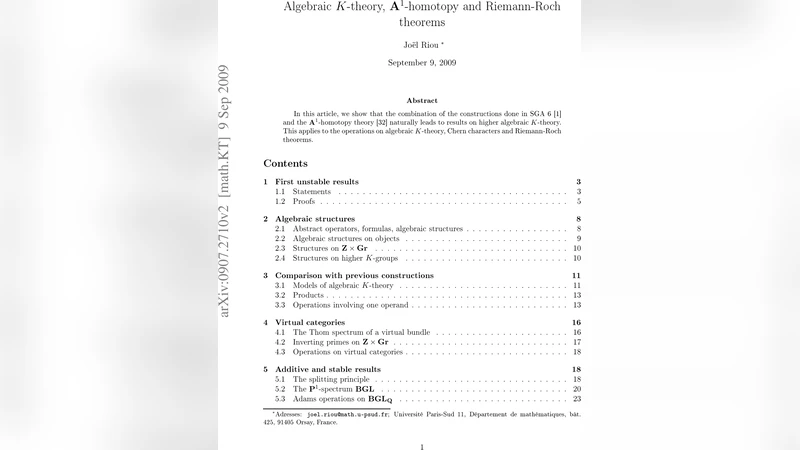
In this article, we show that the combination of the constructions done in SGA 6 and the A^1-homotopy theory naturally leads to results on higher algebraic K-theory. This applies to the operations on algebraic K-theory, Chern characters and Riemann-Roch theorems.
💡 Research Summary
The paper establishes a bridge between classical constructions in SGA 6 and the modern framework of A¹‑homotopy theory, showing that their synthesis yields powerful new results in higher algebraic K‑theory. After a concise review of the foundational material from SGA 6—namely the definition of algebraic K‑theory, the associated λ‑operations, and the classical Grothendieck‑Riemann‑Roch theorem—the author introduces the essential notions of Morel‑Voevodsky’s A¹‑homotopy category: motivic spaces, T‑spectra, and stable A¹‑equivalences. The key technical move is to model the K‑theory spectrum as a T‑spectrum, thereby allowing the full machinery of motivic homotopy to act on K‑theoretic objects. By employing β‑sequences and β‑filtrations, the paper constructs ladder‑type transition maps that resolve the usual homological complications in defining higher operations.
With this motivic model in place, the author re‑examines the algebraic K‑theory operations. The λ‑operations, Adams operations, and other higher operations are shown to be compatible with A¹‑stable equivalences, leading to a streamlined proof of their commutativity and functoriality that bypasses intricate spectral sequence arguments.
The Chern character is then reconstructed as a morphism of motivic spectra. The author proves that the usual Chern character from K‑theory to Chow groups coincides with the β‑transfer induced by the A¹‑stable equivalence, providing a conceptual explanation for its multiplicative and rational isomorphism properties. This perspective also clarifies the behavior of the Chern character under base change and pull‑back, as it becomes a natural transformation in the motivic category.
Building on this, the Grothendieck‑Riemann‑Roch theorem is proved in the motivic setting. The paper shows that for a proper morphism f : X → Y between smooth schemes, the push‑forward on K‑theory and the push‑forward on Chow groups intertwine via the motivic Chern character, provided the morphism satisfies the usual A¹‑compatibility (i.e., it is a smoothable proper map). The proof replaces the classical use of Todd classes with a motivic Todd class defined through the β‑filtration, yielding a more conceptual and flexible formulation that extends to certain singular or non‑flat situations.
The final sections explore applications to higher K‑theory. The author defines higher β‑operations and demonstrates their compatibility with the motivic Chern character, leading to a higher‑dimensional Riemann‑Roch formula that applies to K‑groups beyond K₀. Moreover, the paper discusses how the framework accommodates coefficients in various rings, including rational and ℓ‑adic coefficients, and outlines potential extensions to non‑regular schemes via derived algebraic geometry.
In conclusion, the work not only unifies two major strands of algebraic geometry—classical K‑theory from SGA 6 and modern A¹‑homotopy—but also provides new tools for constructing operations, understanding Chern characters, and proving Riemann‑Roch type theorems in a motivic context. The results open avenues for further research on motivic refinements of classical theorems, interactions with motivic cohomology, and applications to arithmetic geometry.
Comments & Academic Discussion
Loading comments...
Leave a Comment