Clifford theory for tensor categories
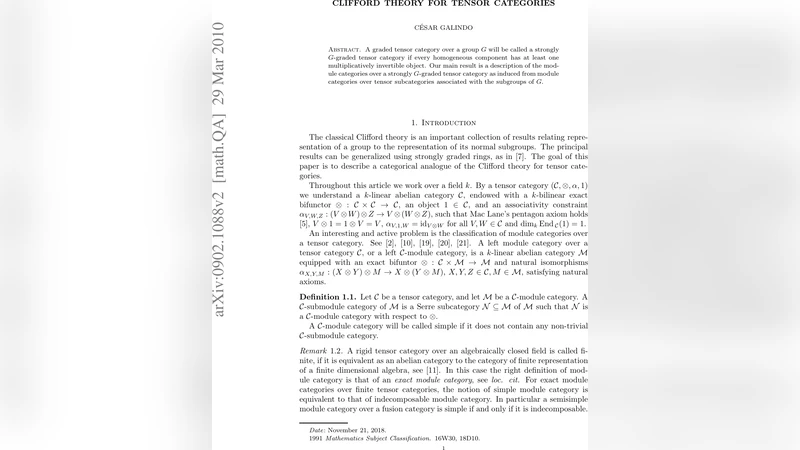
A graded tensor category over a group $G$ will be called a strongly $G$-graded tensor category if every homogeneous component has at least one multiplicativily invertible object. Our main result is a description of the module categories over a strongly $G$-graded tensor category as induced from module categories over tensor subcategories associated with the subgroups of $G$.
💡 Research Summary
The paper develops a categorical analogue of Clifford theory for tensor categories equipped with a group grading. A tensor category 𝒞 is said to be strongly G‑graded if it decomposes as 𝒞 = ⊕{g∈G}𝒞_g, the tensor product respects the grading (𝒞_g ⊗ 𝒞_h ⊂ 𝒞{gh}), and each homogeneous component 𝒞_g contains at least one invertible (multiplicatively invertible) object. This invertibility condition plays the same role as the existence of a one‑dimensional representation in classical group theory and guarantees that each graded piece can be “reversed” by an object in the opposite piece.
The main objective is to describe all module categories over such a strongly G‑graded tensor category. A module category M over 𝒞 is a category equipped with an exact bifunctor ⊗: 𝒞 × M → M satisfying the usual associativity and unit constraints. For a subgroup H ⊂ G the authors consider the tensor subcategory 𝒞_H = ⊕_{h∈H}𝒞_h. Given an 𝒞_H‑module category N, they define the induced 𝒞‑module category \
Comments & Academic Discussion
Loading comments...
Leave a Comment