Large and small group homology
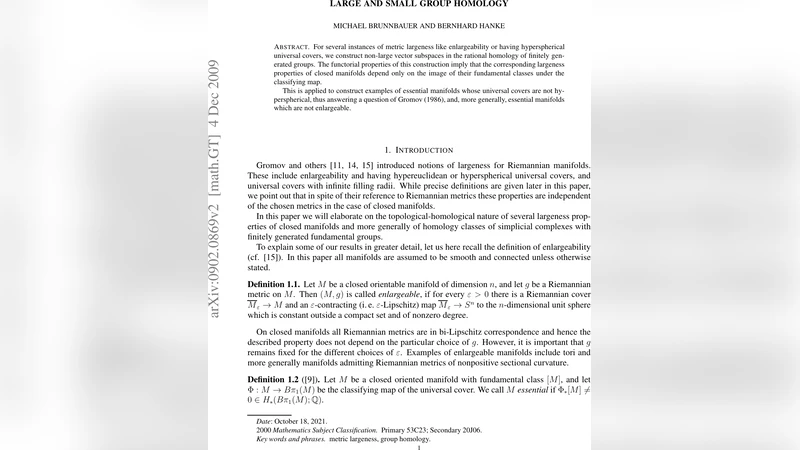
For several instances of metric largeness like enlargeability or having hyperspherical universal covers, we construct non-large vector subspaces in the rational homology of finitely generated groups. The functorial properties of this construction imply that the corresponding largeness properties of closed manifolds depend only on the image of their fundamental classes under the classifying map. This is applied to construct examples of essential manifolds whose universal covers are not hyperspherical, thus answering a question of Gromov (1986), and, more generally, essential manifolds which are not enlargeable.
💡 Research Summary
The paper investigates several notions of “largeness” for manifolds—most notably enlargeability (in the sense of Gromov) and the property that the universal cover is hyperspherical—and shows how these geometric concepts can be detected purely algebraically via the rational homology of the fundamental group. The authors introduce, for any finitely generated group G, a distinguished subspace L_k(G) ⊂ H_k(G;ℚ) called the “small” subspace. An element of H_k(G;ℚ) lies in L_k(G) iff it can be represented by the image of a fundamental class of a finite CW‑complex X under a map X → BG where X itself enjoys one of the largeness properties (e.g. X is enlargeable or has a hyperspherical universal cover). In other words, L_k(G) collects precisely those homology classes that cannot be realized by any large space mapping to BG.
A key technical result is that the construction of L_k(·) is functorial: for any group homomorphism φ : G → H the induced map φ_* on rational homology carries L_k(G) into L_k(H). Consequently, the image of the fundamental class of a closed n‑manifold M under its classifying map c : M → Bπ₁(M) determines whether M can be enlargeable or have a hyperspherical universal cover. If c_*(
Comments & Academic Discussion
Loading comments...
Leave a Comment