Cohomology of finite dimensional pointed Hopf algebras
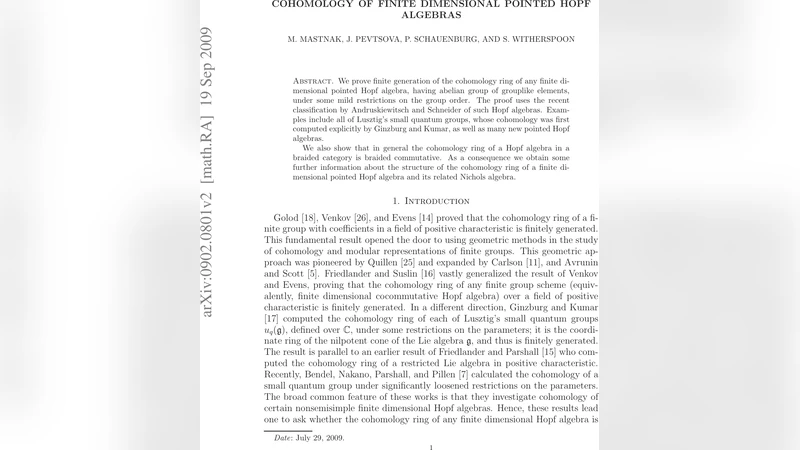
We prove finite generation of the cohomology ring of any finite dimensional pointed Hopf algebra, having abelian group of grouplike elements, under some mild restrictions on the group order. The proof uses the recent classification by Andruskiewitsch and Schneider of such Hopf algebras. Examples include all of Lusztig’s small quantum groups, whose cohomology was first computed explicitly by Ginzburg and Kumar, as well as many new pointed Hopf algebras. We also show that in general the cohomology ring of a Hopf algebra in a braided category is braided commutative. As a consequence we obtain some further information about the structure of the cohomology ring of a finite dimensional pointed Hopf algebra and its related Nichols algebra.
💡 Research Summary
The paper establishes that the cohomology ring of any finite‑dimensional pointed Hopf algebra whose group of grouplike elements is abelian is finitely generated, provided the order of the group satisfies a mild condition (for example, it is coprime to the characteristic of the base field or not a prime power). The argument relies heavily on the Andruskiewitsch–Schneider classification of pointed Hopf algebras via the lifting method. According to this classification, every such Hopf algebra H can be written as a bosonisation H ≅ B(V) ⋊ kG, where G is the abelian group of grouplikes, V is a Yetter‑Drinfeld module over G, and B(V) is the Nichols algebra generated by V.
The authors first analyse the cohomology of the graded Hopf algebra gr H ≅ B(V) ⋊ kG. The Nichols algebra B(V) is shown to have a Koszul‑type resolution; its cohomology is concentrated in finitely many degrees and is generated by classes corresponding to the root vectors of the underlying braided vector space. Because G is abelian, the group cohomology H⁎(G, –) is well understood and remains finite‑dimensional in each degree.
A Lyndon–Hochschild–Serre spectral sequence
E₂^{i,j}=H^{i}(G, H^{j}(B(V),k)) ⇒ H^{i+j}(H,k)
is then constructed. The E₂‑page consists of a tensor product of a finitely generated polynomial algebra (coming from B(V)) with the exterior algebra generated by the group cohomology of G. The mild restriction on |G| guarantees that the differentials in the spectral sequence cannot create infinite families of new generators; they vanish after a bounded degree. Consequently the E∞‑page, and therefore the full cohomology ring H⁎(H,k), is a finitely generated algebra over the base field.
Beyond the finite‑generation result, the paper proves a general structural theorem: for any Hopf algebra living in a braided tensor category, its cohomology ring is braided‑commutative. In concrete terms, the cup product satisfies
a ∪ b = (c_{b,a} ∘ c_{a,b})(b ∪ a)
where c denotes the braiding. This property is weaker than ordinary graded commutativity but is exactly what one expects for cohomology of algebras built from Nichols algebras, whose multiplication is already twisted by the braiding. The theorem provides additional constraints on the possible algebraic relations among cohomology generators.
The authors illustrate the theory with several families of examples. Lusztig’s small quantum groups u_q(𝔤) (with q a root of unity) fall under the framework: their grouplike part is a cyclic group of order coprime to the characteristic, and the associated Nichols algebra is of Cartan type. The known computation of Ginzburg–Kumar, which yields a finitely generated polynomial cohomology ring, is recovered as a special case. Moreover, the paper treats many newly constructed pointed Hopf algebras of rank two and higher, showing that their cohomology rings are also finitely generated and obey the braided‑commutative law. In several rank‑two cases the authors give explicit presentations: the cohomology is a tensor product of a polynomial algebra on a small number of generators with an exterior algebra on degree‑one classes.
In summary, the work extends the finite‑generation theorem from classical small quantum groups to the whole class of finite‑dimensional pointed Hopf algebras with abelian grouplikes, using the AS classification, spectral sequence techniques, and a new braided‑commutativity result. This not only settles a long‑standing conjecture about the cohomology of such algebras but also opens the way for further investigations into the homological properties of Nichols algebras, braided Hopf algebras, and their applications in quantum topology and representation theory.
Comments & Academic Discussion
Loading comments...
Leave a Comment